Cd3e Antibody

Référence OAEE00788
Conditionnement : 100tests(T100)
Marque : Aviva Systems Biology
Contactez votre distributeur local :

Téléphone : +1 850 650 7790
| Datasheets/Manuals | Printable datasheet for Cd3e Antibody |
|---|
| Predicted Species Reactivity | Human|Non-human Primate |
|---|---|
| Product Format | Stabilizing phosphate buffered saline (PBS), pH 7.4, 15 mM sodium azide |
| Clonality | Monoclonal |
| Clone | UCHT1 |
| Isotype | IgG1 |
| Host | Mouse |
| Conjugation | PerCP |
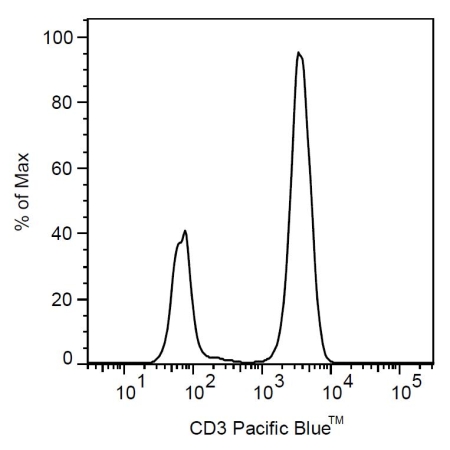
| Application | FC |
| Reconstitution and Storage | 2°C to 8°C |
| Immunogen | human thymocytes followed by Sezary T cells |
| Purification | Purified by size-exclusion chromatography |
| Concentration | 10 ul / test |
| Specificity | The antibody UCHT1 recognizes the CD3 antigen of the TCR/CD3 complex on mature human T cells. The UCHT1 antibody reacts with the epsilon chain of the CD3 complex. HLDA I; WS Code T 3 HLDA III; WS Code T 126 HLDA III; WS Code T 471 HLDA VI; WS Code T 6T-CD3.1 |
| Formulation | PerCP |
| Storage Buffer | The reagent is provided in phosphate buffered saline (PBS) containing 15 mM sodium azide and 0.2% (w/v) high-grade protease free Bovine Serum Albumin (BSA) as a stabilizing agent. |
| Reference | Rieux-Laucat F, Hivroz C, Lim A, Mateo V, Pellier I, Selz F, Fischer A, Le Deist F: Inherited and somatic CD3zeta mutations in a patient with T-cell deficiency. N Engl J Med. 2006 May 4;354(18):1913-21. Arnett KL, Harrison SC, Wiley DC: Crystal structure of a human CD3-epsilon/delta dimer in complex with a UCHT1single-chain antibody fragment. Proc Natl Acad Sci U S A. 2004 Nov 16;101(46):16268-73. Torres PS, Alcover A, Zapata DA, Arnaud J, Pacheco A, Martín-Fernández JM, Villasevil EM, Sanal O, Regueiro JR: TCR dynamics in human mature T lymphocytes lacking CD3 gamma. J Immunol. 2003 Jun 15;170(12):5947-55. le Gouvello S, Manceau V, Sobel A: Serine 16 of stathmin as a cytosolic target for Ca2+/calmodulin-dependent kinase II after CD2 triggering of human T lymphocytes. J Immunol. 1998 Aug 1;161(3):1113-22. Lin CW, Liu TY, Chen SU, Wang KT, Medeiros LJ, Hsu SM: CD94 1A transcripts characterize lymphoblastic lymphoma/leukemia of immaturenatural killer cell origin with distinct clinical features. Blood. 2005 Nov 15;106(10):3567-74. Demedts IK, Brusselle GG, Vermaelen KY, Pauwels RA: Identification and characterization of human pulmonary dendritic cells. Am J Respir Cell Mol Biol. 2005 Mar;32(3):177-84. Fisch P, Malkovsky M, Braakman E, Sturm E, Bolhuis RL, Prieve A, Sosman JA, Lam VA, Sondel PM: Gamma/delta T cell clones and natural killer cell clones mediate distinctpatterns of non-major histocompatibility complex-restricted cytolysis. J Exp Med. 1990 May 1;171(5):1567-79. Siegers GM, Swamy M, Fernández-Malavé E, Minguet S, Rathmann S, Guardo AC, Pérez-Flores V, Regueiro JR, Alarcón B, Fisch P, Schamel WW: Different composition of the human and the mouse gammadelta T cell receptorexplains different phenotypes of CD3gamma and CD3delta immunodeficiencies. J Exp Med. 2007 Oct 29;204(11):2537-44. Garson JA, Beverley PC, Coakham HB, Harper EI: Monoclonal antibodies against human T lymphocytes label Purkinje neurones of many species. Nature. 1982 Jul 22;298(5872):375-7. Barclay, Brown et al.: The Leukocyte Antigen FactsBook, 2nd edition, Harcourt Brace & Company, London, (1997). Leukocyte Typing III., McMichael A. J. et al (Eds.), Oxford University Press (1987). Leukocyte Typing VI., Kishimoto T. et al. (Eds.), Garland Publishing Inc. (1997). Huang Y, Wange RL: T cell receptor signaling: beyond complex complexes. J Biol Chem. 2004 Jul 9;279(28):28827-30. Alarcón B, Swamy M, van Santen HM, Schamel WW: T-cell antigen-receptor stoichiometry: pre-clustering for sensitivity. EMBO Rep. 2006 May;7(5):490-5. Kuhns MS, Davis MM, Garcia KC: Deconstructing the form and function of the TCR/CD3 complex. Immunity. 2006 Feb;24(2):133-9. |
|---|---|
| Gene Symbol | CD3E |
| Gene Full Name | CD3e molecule |
| Alias Symbols | CD3-epsilon, CD3e antigen, epsilon polypeptide (TiT3 complex), CD3e molecule, epsilon (CD3-TCR complex), IMD18, T-cell antigen receptor complex, epsilon subunit of T3, T-cell surface antigen T3/Leu-4 epsilon chain, T-cell surface glycoprotein CD3 epsilon chain, T3E, TCRE. |
| NCBI Gene Id | 916 |
| Protein Name | T-cell surface glycoprotein CD3 epsilon chain |
| Description of Target | Part of the TCR-CD3 complex present on T-lymphocyte cell surface that plays an essential role in adaptive immune response. When antigen presenting cells (APCs) activate T-cell receptor (TCR), TCR-mediated signals are transmitted across the cell membrane by the CD3 chains CD3D, CD3E, CD3G and CD3Z. All CD3 chains contain immunoreceptor tyrosine-based activation motifs (ITAMs) in their cytoplasmic domain. Upon TCR engagement, these motifs become phosphorylated by Src family protein tyrosine kinases LCK and FYN, resulting in the activation of downstream signaling pathways (PubMed:2470098). In addition of this role of signal transduction in T-cell activation, CD3E plays an essential role in correct T-cell developement. Initiates the TCR-CD3 complex assembly by forming the two heterodimers CD3D/CD3E and CD3G/CD3E. Participates also in internalization and cell surface down-regulation of TCR-CD3 complexes via endocytosis sequences present in CD3E cytosolic region (PubMed:10384095, PubMed:26507128). |
| Uniprot ID | P07766 |
| Protein Accession # | NP_031674.1; XP_006510029.1 |
| Nucleotide Accession # | NM_007648.4; XM_006509966.2 |