

Enzalutamide [915087-33-1]

Référence T6002-100mg
Conditionnement : 100mg
Marque : TargetMol
Contactez votre distributeur local :
 Téléphone : +1 850 650 7790
Enzalutamide
(Synonyms: MDV3100) Copy Product Info

Enzalutamide (MDV3100) is an androgen receptor (AR) antagonist (IC50=36 nM in LNCaP) that activates autophagy, exhibits antitumor activity, and is commonly used in treating desmoplasia-resistant prostate cancer.
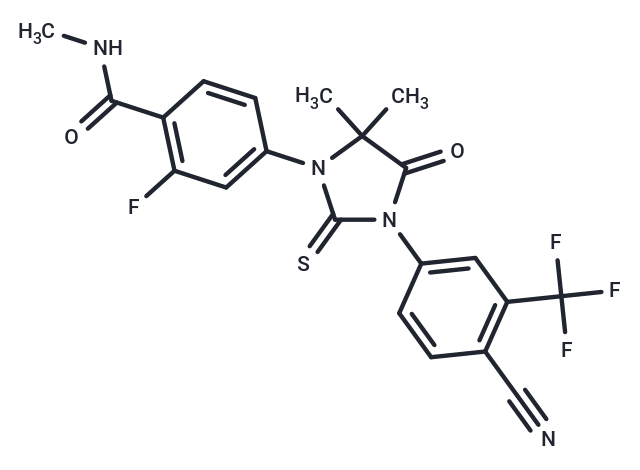
Cas No. 915087-33-1
With extensive experience in compound synthesis, we can provide rapid custom synthesis services for this product according to your research needs.
For research use only—not for human use. No sales to individuals. Use as intended only.
Select Batch
Purity:99.97%
Color:White
COA HNMR LCMS
Product Information
Bioactivity
Chemical Properties
Storage & Solubility Information
| Description | Enzalutamide (MDV3100) is an androgen receptor (AR) antagonist (IC50=36 nM in LNCaP) that activates autophagy, exhibits antitumor activity, and is commonly used in treating desmoplasia-resistant prostate cancer. |
| Targets & IC50 | LNCaP cells:12 μM (LD50), SJSA-1:34.7 μM (LD50), Androgen receptor:36 nM (LNCaP cells), PC3 cells:12 μM (LD50) |
| In vitro | Method: Human prostate cancer cells LNCaP, PC3 and human osteosarcoma cells SJSA-1 were treated with Enzalutamide (0.01-100 μM) for 1 h. Cell viability was measured using MTT. Result: Enzalutamide was shown to decrease the viability of all cell lines, with LD50s of 12 μM, 23.4 μM, and 34.7 μM for LNCaP, PC3, and SJSA-1 cell lines, respectively. [1] Method: Human prostate cancer cells VCaP were treated with Enzalutamide (10 μM) for 1-3 days, and the expression levels of target proteins were detected by Western Blot. Result: Enzalutamide up-regulated cleaved-PARP expression and induced apoptosis in human prostate cancer cells. [2] |
| In vivo | Method: To assay antitumor activity in vivo, Enzalutamide (1-50 mg/kg) was administered by gavage once daily for twenty-eight days to CB17SCID mice bearing human desmoplastic resistance tumor (CRPC) LNCaP-AR-Lux. Result: Enzalutamide induced regression of tumor volume in a CRPC xenograft model and apoptosis in AR overexpanded prostate cancer cells. [3] Method: To assess the role of AR in bone metabolism and bone growth after sexual maturation, Enzalutamide (10-100 mg/kg, 1% carboxymethyl cellulose+0.5% Tween 80+5% dimethylsulfoxide) was administered orally to C57BL/6N mice once daily for twenty-one days. Result: Enzalutamide decreased the amount of bone in the axial skeleton, and Enzalutamide significantly reduced the mechanical strength of the axial skeleton. After sexual maturity, Enzalutamide reduced bone mass in the axial skeleton but not in the appendicular skeleton of male mice. [4] |
| Synonyms | MDV3100 |
| Cell Research | For in vitro experiments, LNCaP or LNCaP/AR cells (10^4 cells/well) were androgen-starved by growth in media containing 5-10% charcoal-stripped serum for 3-5 days. Then the cells were challenged with various concentrations of R1881, bicalutamide, RD162 or MDV3100 in media containing 5-10% charcoal-stripped serum [1]. |
| Animal Research | In vivo tumorigenicity experiments were done by subcutaneous injection of 10^6 cells (100 uL in 50% Matrigel and 50% growth media) into the flanks of castrated male SCID mice. Daily gavage treatment (using a formulation of 1% carboxymethyl cellulose, 0.1% Tween-80, 5% DMSO) was initiated when tumor size reached ~100 mm3. Tumor size was measured weekly in three dimensions (l x w x d) with calipers. For in vivo luciferase imaging, d-luciferin substrate (100 μL, 15 mg/mL) was injected intraperitoneally. After 5 minutes, mice were anesthetized using isofluorane and imaged using a cooled charged-coupled device IVIS camera. Data were analyzed using Living Image 2.30 software [1]. |
| Molecular Weight | 464.44 |
| Formula | C21H16F4N4O2S |
| Cas No. | 915087-33-1 |
| Smiles | S=C1N(C(C)(C)C(=O)N1C2=CC(C(F)(F)F)=C(C#N)C=C2)C3=CC(F)=C(C(NC)=O)C=C3 |
| Relative Density. | 1.49 g/cm3 |
| Storage | Store at low temperature Pure form: -20°C for 3 years | In solvent: -80°C for 1 year Shipping with blue ice/Shipping at ambient temperature. | |||||||||||||||||||||||||||||||||||
| Solubility Information | Ethanol: < 1 mg/mL (insoluble or slightly soluble) DMSO: 257 mg/mL (553.35 mM), Sonication is recommended.  | |||||||||||||||||||||||||||||||||||
| In Vivo Formulation | 10% DMSO+90% Saline: < 10 mg/mL (21.53 mM), Lower concentrations may be soluble, but exact solubility limit is unknown. 10% DMSO+40% PEG300+5% Tween 80+45% Saline: 8.5 mg/mL (18.3 mM), Suspension. 10% DMSO+40% PEG300+ 5% Tween 80 + 45% Saline: 10 mg/mL (21.53 mM), Solution. Please add the solvents sequentially, clarifying the solution as much as possible before adding the next one. Dissolve by heating and/or sonication if necessary. Working solution is recommended to be prepared and used immediately. The formulation provided above is for reference purposes only. In vivo formulations may vary and should be modified based on specific experimental conditions. | |||||||||||||||||||||||||||||||||||
Solution Preparation Table | ||||||||||||||||||||||||||||||||||||
DMSO
Note : The dilution table applies only to solid products. For liquid products, please calculate the stock solution based on the stated concentration and/or density. | ||||||||||||||||||||||||||||||||||||