

Equine IL-2 ELISA

Référence DIY0700E-003
Conditionnement : 1Set
Marque : Kingfisher Biotech
Contactez votre distributeur local :

Téléphone : +1 850 650 7790

Components
| Usage | Quantity | Component | Size |
|---|---|---|---|
| Detection Antibody | 50 µg | PBB0051E-050 | |
| Standard | 5 µg | RP0006E-005 | |
| Capture Antibody | 100 µg | PB0050E-100 | 1 Pack (<= 10 Plates) |
| Capture Antibody | 100 µg X 2 | PB0050E-100 | 1 Pack (<= 20 Plates) |
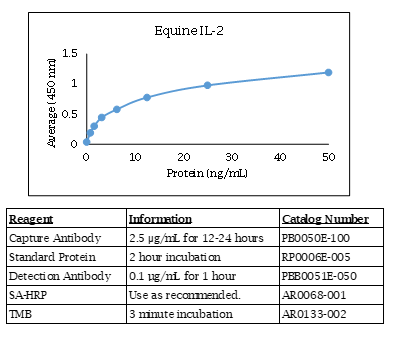
- The Equine IL-2 (Interleukin-2) ELISA is designed for the quantitative measurement of equine IL-2 in cell culture supernatants. With minor modifications to the assay procedure, this ELISA may also be used to measure IL-2 in additional biological sample types reported in the literature, including serum, plasma, peripheral blood mononuclear cell (PBMC) culture supernatants, and tissue homogenates or lysates, depending on the experimental model and physiological context. This flexibility supports a wide range of immunology and translational research applications. Reported measurements: Equine IL-2 has been detected in serum (~20-400 pg/mL), plasma (~15-350 pg/mL), and PBMC culture supernatants (~50-900 pg/mL under stimulation conditions), although levels vary depending on immune activation, infection, or experimental treatment. Interleukin-2 (IL-2) is a cytokine primarily produced by activated CD4⁺ T cells. It plays a central role in T-cell proliferation, differentiation of regulatory T cells, and activation of natural killer (NK) cells, thereby coordinating adaptive immune responses. Measurement of IL-2 is widely used to assess cell-mediated immunity, vaccine response, and immune system activation in horses and related species. IL-2 serves as an important biomarker of T-cell function, immune activation, and adaptive immunity, supporting studies in equine immunology, comparative immunology, and translational research. Why measure Equine IL-2: Measuring IL-2 provides critical insight into T-cell responses, immune activation, and adaptive immunity. Quantifying IL-2 helps evaluate vaccine efficacy, infection-induced immune responses, and immunomodulatory treatments, making it a key tool for both fundamental and applied equine immunology research. IL-2 is a member of the type I cytokine family, which also includes IL-4, IL-7, and IL-15, all contributing to immune regulation, lymphocyte proliferation, and adaptive immune responses. The kit contains a capture antibody, detection antibody, and recombinant protein standard for assay development. These antibodies have been validated to function together in an ELISA format using the provided standard. Optimal buffers, antibody concentrations, incubation times, temperatures, and assay conditions have not been predetermined, allowing researchers to optimize assay sensitivity and dynamic range based on their specific sample type and experimental requirements. The quantities of kit components are not matched, and individual components may be purchased separately. This product is for research use only and is manufactured in the USA.
| Use | For Research Use Only. Not for diagnostic or therapeutic use. |
| Storage Conditions | 2°C to 8°C or -20°C |
| Country Of Origin | USA |
| Use | For Research Use Only. Not for diagnostic or therapeutic use. |
Equine IL-2 (Interleukin-2) is a central T cell–derived cytokine that regulates lymphocyte proliferation, differentiation, and immune homeostasis in horses (Equus caballus). IL-2 is produced primarily by activated CD4⁺ and CD8⁺ T lymphocytes following antigen recognition and costimulatory signaling, and it functions through the IL-2 receptor complex (IL-2Rα/CD25, IL-2Rβ, and the common γ chain) to promote clonal expansion of antigen-specific T cells, enhance cytotoxic T lymphocyte and natural killer (NK) cell activity, and support development and maintenance of regulatory T cells (Tregs). In healthy horses, basal IL-2 expression is generally low but increases during infection, vaccination, and immune stimulation. Altered IL-2 responses have been associated with equine herpesvirus (EHV) infection, equine influenza, strangles (Streptococcus equi), equine infectious anemia virus (EIAV), and immune-mediated inflammatory diseases. Horses serve as important natural models for viral respiratory disease, chronic inflammatory airway disease (equine asthma), and lentiviral infection (EIAV as a model for HIV). In veterinary and comparative medicine research, equine IL-2 is widely used as a biomarker of T cell activation and cell-mediated immunity and is studied to evaluate vaccine efficacy, host–pathogen interactions, and immune regulation in equine health.
Citations
Please to see
