FGG Detection Antibody

Référence OAOA22296
Conditionnement : 50µg
Marque : Aviva Systems Biology
Contactez votre distributeur local :

Téléphone : +1 850 650 7790
FGG Detection Antibody : Biotin (OAOA22296)
| Datasheets/Manuals | Printable datasheet for FGG Detection Antibody : Biotin (OAOA22296) |
|---|
| Predicted Species Reactivity | Human |
|---|---|
| Product Format | Stored in PBS (pH 7.4) with 0.05% sodium azide, 10mg/ml BSA, 50% glycerol |
| Clonality | Monoclonal |
| Clone | OTI2B6 |
| Isotype | IgG1 |
| Host | Mouse |
| Conjugation | Biotin |
| Application | MlpxA |
| Additional Information | Matched ELISA Pair: OAOA21872 |
| Reconstitution and Storage | -20°C |
| Immunogen | Full length human recombinant protein of human FGG (NM_000509) produced in HEK293T cell. |
| Concentration | 0.5 mg/ml |
| Dilution | 1:250 - 1:1000 |
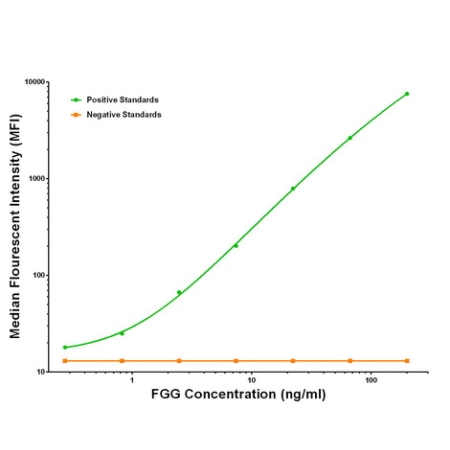
| Description | purified FGG biotinylated mouse monoclonal detection antibody, validated for Luminex assays |
| Gene Symbol | FGG |
|---|---|
| Gene Full Name | fibrinogen gamma chain |
| Alias Symbols | fibrinogen gamma chain, fibrinogen, gamma polypeptide, testicular tissue protein Li 70. |
| NCBI Gene Id | 2266 |
| Protein Name | Fibrinogen gamma chain|Homo sapiens fibrinogen gamma chain (FGG), transcript variant gamma, mRNA |
| Description of Target | Together with fibrinogen alpha (FGA) and fibrinogen beta (FGB), polymerizes to form an insoluble fibrin matrix. Has a major function in hemostasis as one of the primary components of blood clots. In addition, functions during the early stages of wound repair to stabilize the lesion and guide cell migration during re-epithelialization. Was originally thought to be essential for platelet aggregation, based on in vitro studies using anticoagulated blood. However, subsequent studies have shown that it is not absolutely required for thrombus formation in vivo. Enhances expression of SELP in activated platelets via an ITGB3-dependent pathway. Maternal fibrinogen is essential for successful pregnancy. Fibrin deposition is also associated with infection, where it protects against IFNG-mediated hemorrhage. May also facilitate the antibacterial immune response via both innate and T-cell mediated pathways. |
| Uniprot ID | P02679 |
| Protein Accession # | NP_000500 |
| Nucleotide Accession # | https://www.ncbi.nlm.nih.gov/nuccore/NM_000509 |