



Inquiry
Dispatch Time: About 3 working days
- Product Name
- FITC Anti-Human CD156c(ADAM10) Antibody(11G2)
- Catalogue No.
- FITC-30178
- Form
- liquid
- Conjugation
- FITC
- Conjugation Information
- FITC is designed to be excited by the Blue laser (488 nm) and detected using an optical filter centered near 530 nm (e.g., a 525/40 nm bandpass filter).
- Clonality
- Monoclonal
- Isotype
- IgG1, κ
- Clone ID
- 11G2
- Storage
- PBS with 0. 1% sodium azide, 1%BSA, pH 7.3, 2-8℃ for 12 months (Avoid repeated freeze / thaw cycles.)
Immunogen
- Alternative Names
- MADM|KUZ|alpha-secretase antibody
- UniProt ID
- O14672
Application
- Tested Applications
- FC
- Recommended dilution
- Volume per test: 5μL. Each lot of this antibody is quality control tested by flow cytometric analysis. The amount of the reagent is suggested to be used 5 µL of antibody per test (million cells in 100 µL staining volume or per 100 µL of whole blood). Please check your vial before the experiment. Since applications vary, the appropriate dilutions must be determined for individual use.
Validated Images
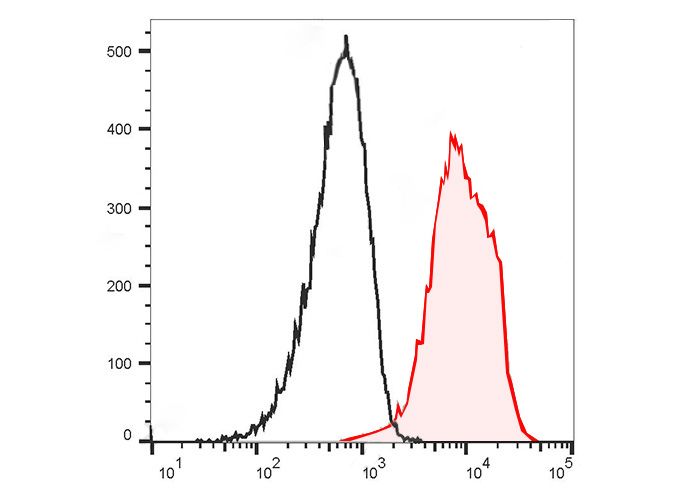 Staining of normal human peripheral blood cells with FITC Anti-Human CD156c (ADAM10) Antibody(11G2) (filled gray histogram) or FITC Mouse IgG1, κ Isotype Control (black histogram). Cells in the lymphocytes gate were used for analysis.
 - Background
- CD156c, also known as a disintegrin and metalloproteinase domain-containing protein 10 (ADAM10), is a 748 amino acid type I membrane glycoprotein ubiquitously expressed on most cell types. It consists of multiple functional domains, including a N-terminal prodomain, catalytic domain, cysteine-rich domain, transmembranous domain, and cytoplasmic domain. It is secreted as a precursor protein and becomes as the activate/mature form through removing the ADAM10 prodomain by proprotein convertase 7 and furin. ADAM10 functions as metalloproteinase to cleave several molecules including Notch, pro-TNF-α, amyloid precursor protein, myelin basic protein, and type IV collagen. It mediates the release of several cell adhesion molecules such as vascular endothelial cadherin or L-selectin to regulate endothelial permeability and leukocyte transmigration. Dysregulation of ADAM activity may contribute to the pathogenesis of vascular diseases.