



RayBio® G-Series Human Apoptosis Antibody Array 1 Kit. Detects 43 Human Apoptotic Factors. Suitable for all liquid sample types but intended for use with cell and tissue lysates.
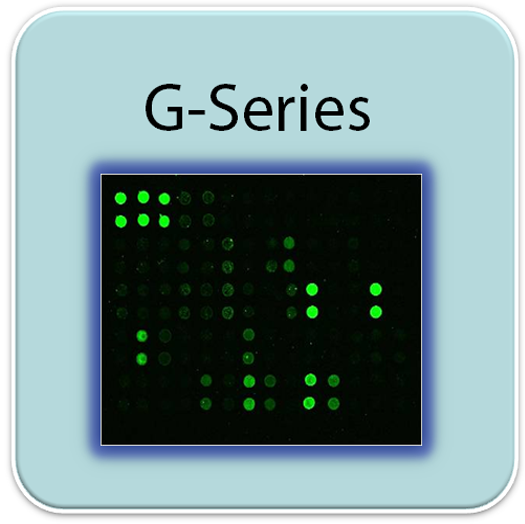
Human Apoptosis Array G1
Human Apoptosis Array G1
Contact Us for Bulk Request
Product Description
Specifications
| Size | 4 Sample Kit, 8 Sample Kit |
| Species | Human |
| Compatible Sample Types | Cell Culture Supernatants, Plasma, Serum, Tissue Lysates, Cell Lysates |
| Quantitative/Semi-Quantitative | Semi-Quantitative |
| Number of Targets Detected | 43 |
| Solid Support | Glass Slide |
| Design Principle | Sandwich-based |
| Method Of Detection | Fluorescence Laser Scanner |
| Research Area | Apoptosis |
| Shipping Type | Blue ice |
| Storage | -20°C |
Product Features
- High sensitivity and specificity
- Low sample volume (10-100 µl per array)
- Large dynamic range of detection
- Compatible with most sample types
- Test 4 or 8 samples on each slide
- Suitable for high-throughput assays
Target Names
| Scroll over each target protein for more information | ||||
|---|---|---|---|---|
bad
| bax
| bcl-2
| bcl-w
| BID
|
BIM
| Caspase-3
| Caspase-8
| CD40 (TNFRSF5)
| CD40 Ligand (TNFSF5)
|
cIAP-2
| Cytochrome C | DR6 (TNFRSF21)
| Fas (TNFRSF6/Apo-1)
| Fas Ligand (TNFSF6)
|
HSP27
| HSP60
| HSP70
| HTRA2
| IGF-1
|
IGF-2
| IGFBP-1
| IGFBP-2
| IGFBP-3
| IGFBP-4
|
IGFBP-5
| IGFBP-6
| IGF-1 R
| livin
| p21
|
p27
| p53
| SMAC
| Survivin (BIRC5)
| TNF RI (TNFRSF1A)
|
TNF RII (TNFRSF1B)
| TNF alpha
| TNF beta (TNFSF1B)
| TRAIL R1 (TNFRSF10A/DR4)
| TRAIL R2 (TNFRSF10B/DR5)
|
TRAIL R3 (TNFRSF10C)
| TRAIL R4 (TNFRSF10D)
| XIAP
| ||
Application Notes
Suggested Application
Multiplexed Protein Detection; Detection of Relative Protein Expression; Detecting Patterns of Cytokine Expression; Biomarker Screening; Identifying Key Factors; Confirming a Biological Process
Kit Components
- Human Apoptosis Antibody Array G1 Slide(s)
- Blocking Buffer
- Wash Buffer 1
- Wash Buffer 2
- Biotinylated Detection Antibody Cocktail
- Streptavidin-Conjugated Fluor
- Lysis Buffer
- Protease Inhibitor Cocktail
- Adhesive Plastic Strips
- 30 ml Centrifuge Tube
- Manual
Other Materials Required
- Small plastic boxes or containers
- Pipettors, pipette tips and other common lab consumables
- Orbital shaker or oscillating rocker
- Aluminum foil
- Gene microarray scanner or similar laser fluorescence scanner
View Compatible Laser Scanners
Don't have a compatible scanner? RayBiotech now offers FREE scanning service for all RayBio glass slide antibody arrays! Learn More
Protocol Outline
- Dry the glass slide
- Block array surface
- Incubate with Sample
- Incubate with Biotinylated Detection Antibody Cocktail
- Incubate with Streptavidin-Conjugated Fluor
- Disassemble the glass slide
- Scan with a gene microarray laser scanner
- Perform densitometry and analysis
Storage/Stability
For best results, store the entire kit frozen at -20°C upon arrival. Stored frozen, the kit will be stable for at least 6 months which is the duration of the product warranty period. Once thawed, store array slide(s) at -20°C and all other reagents undiluted at 4°C for no more than 3 months.
documents
GAL (GAL-AAH-APO-G1-4.gal)
GAL (GAL-AAH-APO-G1-8.gal)
Excel (AAH-APO-G1_Analysis_Tool.xls)
citations
A natural coumarin, benjaminin, suppresses proliferation and migration and induces apoptosis in MCF-7 breast cancer cells
- Year:
- 2026
- Journal Name:
- Scientific Reports
- PubMed ID:
- 42177275
Extracellular vesicles derived from fetal stem cells in early pregnancy modulate glycolysis and lipid metabolism to induce apoptosis in cancer cells
- Species:
- Human
- Sample Type:
- Cell Lysate (HCT116 cells, itAT-FSC-EV treatment); Tissue Lysate / Homogenate
- Year:
- 2026
- Journal Name:
- Translational Oncology
- PubMed ID:
- 42508145
Clofoctol impairs the stemness of gastric cancer and induces TNF-mediated necroptosis by directly binding to RanBP2
- Species:
- Human
- Sample Type:
- Cell Lysate (cell lysates of GCSCs gastric cancer stem cells); Tissue Lysate / Homogenate
- Year:
- 2025
- Journal Name:
- Cellular and Molecular Life Sciences
- PubMed ID:
- 40325218
Berberine hydrochloride inhibits the proliferation and metastasis of p53 mutant gallbladder Cancer cells by regulating the IL6/STAT3 pathway
- Species:
- Human
- Sample Type:
- Other / Unspecified (gallbladder cancer cells)
- Year:
- 2025
- Journal Name:
- Scientific Reports
- PubMed ID:
- 40702096
Inhibition of O-GlcNAcylation protects from Shiga toxin-mediated cell injury and lethality in host
- Species:
- Human
- Sample Type:
- Tissue Lysate / Homogenate (lysates of 3D human mini-kidneys, iPSC-derived human kidney organoids)
- Year:
- 2022
- Journal Name:
- EMBO Molecular Medicine
- PubMed ID:
- 34842355
Combined oncolytic virotherapy gold nanoparticles as synergistic immunotherapy agent in breast cancer control
- Species:
- Human
- Sample Type:
- MCF-7 cell
- Year:
- 2023
- Journal Name:
- Scientific reports
MEIS1-mediated Apoptosis via TNFR1 in Endometriosis
- Species:
- Human
- Sample Type:
- Tissue Lysate / Homogenate (EESC lysates)
- Year:
- 2025
- Journal Name:
- Reproductive Sciences
- PubMed ID:
- 39934615
Epigenetic silencing of miR-137 induces drug resistance and chromosomal instability by targeting AURKA in multiple myeloma
- Species:
- Human
- Sample Type:
- Cell Lysate (H929 and mir-137 overexpressing cells)
- Year:
- 2017
- Journal Name:
- Leukemia
- PubMed ID:
- 27857131
TNF-α-induced p53 activation induces apoptosis in neurological injury
- Species:
- Rat
- Sample Type:
- Other / Unspecified (cortex protein extracts)
- Year:
- 2020
- Journal Name:
- Journal of Cellular and Molecular Medicine
- PubMed ID:
- 32344470
Expression profile of apoptotic and proliferative proteins in hypoxic HUVEC treated with statins
- Species:
- Human
- Sample Type:
- Cell Lysate (HUVEC Cells)
- Year:
- 2014
- Journal Name:
- International Journal of Oncology
- PubMed ID:
- 25434456