
Human ATF2 Antibody : APC (Phospho-Thr71)

Référence OAAQ00059-10tests
Conditionnement : 10Tests
Marque : Aviva Systems Biology
Contactez votre distributeur local :
 Téléphone : +1 850 650 7790
Human ATF2 Antibody : APC (Phospho-Thr71)
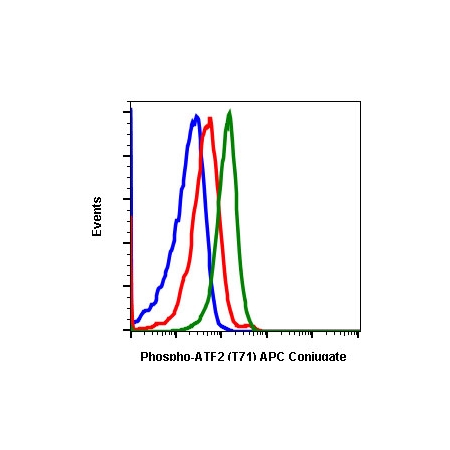
Human ATF2 Antibody : APC (Phospho-Thr71) (OAAQ00059)
| Datasheets/Manuals | Printable datasheet for OAAQ00059 |
|---|
| Tested Species Reactivity | Human, Mouse |
|---|---|
| Predicted Species Reactivity | Mouse, Rat |
| Product Format | Liquid. 1X PBS, 0.09% NaN3, 0.2% BSA. |
| Clonality | Monoclonal |
| Clone | ATF2T71-G3 |
| Isotype | Rabbit IgG1k |
| Host | Rabbit |
| Conjugation | APC: Allophycocyanin |
| Application | FC |
| Reconstitution and Storage | 2-8C |
| Immunogen | A synthetic phospho-peptide corresponding to residues surrounding Thr71 of human phospho ATF2 |
| Purification | Protein A+G |
| Target Post-Translational Modification | Phospho-Thr71 |
| Application Info | For flow cytometric staining, the suggested use of this reagent is 5 uL per million cells or 5 uL per 100 uL of staining volume. It is recommended that the reagent be titrated for optimal performance for each application. |
| Reference | Shaulian E, and Karin M., (2002) Nat Cell Biol. 4:131-136. Shimizu M, et al., (1998) Exp Cell Res. 239:93-103. Lau E, and Ronai ZA. (2012) J Cell Sci. 125:2815-2824. Bailey J, and Europe-Finner GN. (2005), J Mol Endocrinol. 34:19-35. Raingeaud J, et al., (1995) J Biol Chem. 270:7420-7426. Ouwens DM, et al., (2002) EMBO J. 21:3782-3793. Livingstone C, et al., (1995) EMBO J. 1995,14:1785-97. Yamasaki T, et al., (2009). J Biol Chem 284:8567-8581. Lau E, et al., (2012) Cell 48:543-555. Bhoumik A, et al., (2005) Mol Cell 18:577-587. |
|---|---|
| Gene Symbol | ATF2 |
| Gene Full Name | activating transcription factor 2 |
| Alias Symbols | HB16, CREB2, TREB7, CREB-2, CRE-BP1 |
| NCBI Gene Id | 1386 |
| Protein Name | cyclic AMP-dependent transcription factor ATF-2 |
| Description of Target | This gene encodes a transcription factor that is a member of the leucine zipper family of DNA binding proteins. The encoded protein has been identified as a moonlighting protein based on its ability to perform mechanistically distinct functions This protein binds to the cAMP-responsive element (CRE), an octameric palindrome. It forms a homodimer or a heterodimer with c-Jun and stimulates CRE-dependent transcription. This protein is also a histone acetyltransferase (HAT) that specifically acetylates histones H2B and H4 in vitro; thus it may represent a class of sequence-specific factors that activate transcription by direct effects on chromatin components. The encoded protein may also be involved in cell's DNA damage response independent of its role in transcriptional regulation. Several alternatively spliced transcript variants have been found for this gene |
| Uniprot ID | P15336 |
| Protein Accession # | NP_001243019.1 |
| Nucleotide Accession # | NM_001256090.1 |