
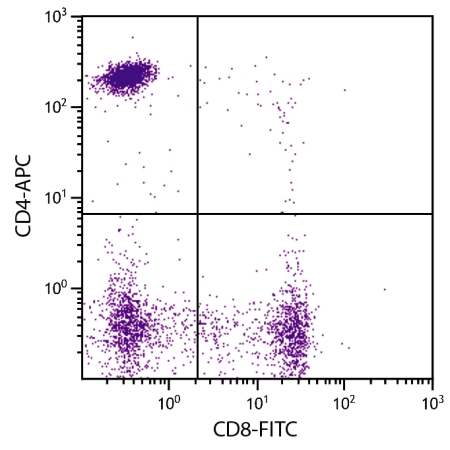
Human CD4C Antibody : APC

Référence OASB02593
Conditionnement : 25tests
Marque : Aviva Systems Biology
Contactez votre distributeur local :
 Téléphone : +1 850 650 7790
Human CD4C Antibody : APC (OASB02593)
| Datasheets/Manuals | Printable datasheet for Human CD4C Antibody : APC (OASB02593) |
|---|
| Tested Species Reactivity | Human |
|---|---|
| Predicted Species Reactivity | Human |
| Product Format | Liquid. Phosphate buffered saline containing 0.1% sodium azide and a stabilizer |
| Clonality | Monoclonal |
| Host | Mouse |
| Conjugation | APC |
| Application | FC |
| Additional Information | Description: CD4 is a 55 kDa type I transmembrane glycoprotein and a member of the Ig-SF of cell surface receptors. It is expressed predominantly on the "helper/inducer" subpopulation of mature T lymphocytes and on monocytes and macrophages. Domains 1 and 2 bind to MHC Class II antigens, while domains 3 and 4 may be involved in cis interactions with the CD3/TCR complex. CD4 functions as an accessory molecule in the recognition of foreign antigens in association with MHC class II antigens by T cells. |
| Reconstitution and Storage | Store at 2-8C |
| Immunogen | Thymocytes and E-rosetted lymphocytes |
| Concentration | Lot specific |
| Specificity | CD4 |
| Gene Symbol | CD4 |
|---|---|
| Gene Full Name | CD4 molecule |
| Alias Symbols | IMD79, OKT4D, CD4mut |
| NCBI Gene Id | 920 |
| Protein Name | T-cell surface glycoprotein CD4 |
| Description of Target | This gene encodes a membrane glycoprotein of T lymphocytes that interacts with major histocompatibility complex class II antigenes and is also a receptor for the human immunodeficiency virus. This gene is expressed not only in T lymphocytes, but also in B cells, macrophages, and granulocytes. It is also expressed in specific regions of the brain. The protein functions to initiate or augment the early phase of T-cell activation, and may function as an important mediator of indirect neuronal damage in infectious and immune-mediated diseases of the central nervous system. Multiple alternatively spliced transcript variants encoding different isoforms have been identified in this gene. |
| Uniprot ID | P01730 |
| Protein Accession # | NP_000607.1 |
| Nucleotide Accession # | NM_000616.4 |