
Human INPPL1 Antibody : APC (Phospho-Tyr1135)

Référence OAAQ00138-10tests
Conditionnement : 10Tests
Marque : Aviva Systems Biology
Contactez votre distributeur local :
 Téléphone : +1 850 650 7790
Human INPPL1 Antibody : APC (Phospho-Tyr1135)
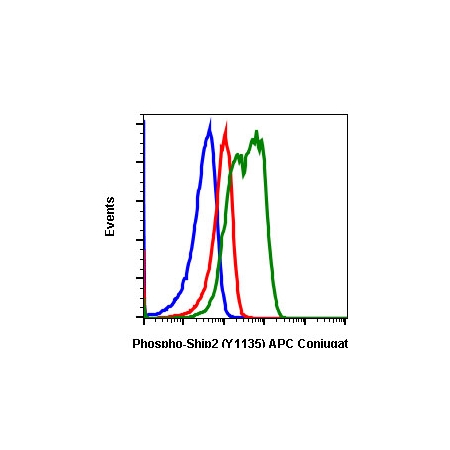
Human INPPL1 Antibody : APC (Phospho-Tyr1135) (OAAQ00138)
| Datasheets/Manuals | Printable datasheet for OAAQ00138 |
|---|
| Tested Species Reactivity | Human, Mouse |
|---|---|
| Predicted Species Reactivity | Mouse, Rat |
| Product Format | Liquid. 1X PBS, 0.09% NaN3, 0.2% BSA. |
| Clonality | Monoclonal |
| Clone | Ship2Y1135-1D2 |
| Isotype | Rabbit IgG1k |
| Host | Rabbit |
| Conjugation | APC: Allophycocyanin |
| Application | FC |
| Reconstitution and Storage | 2-8C |
| Immunogen | A synthetic phospho-peptide corresponding to residues surrounding Tyr1135 of human phospho Ship2 |
| Purification | Protein A+G |
| Target Post-Translational Modification | Phospho-Tyr1135 |
| Application Info | For flow cytometric staining, the suggested use of this reagent is 5 uL per million cells or 5 uL per 100 uL of staining volume. It is recommended that the reagent be titrated for optimal performance for each application. |
| Reference | 1. Goss, V.L. et al. (2006) Blood 107, 4888-97. 2. Rikova, K. et al. (2007) Cell 131, 1190-203. 3. Pesesse, X. et al. (1997) Biochem Biophys Res Commun 239, 697-700. 4. Wada, T. et al. (2001) Mol Cell Biol 21, 1633-46. 5. Ishida, S. et al. (2006) Pancreas 33, 63-7. 6. Dyson, J.M. et al. (2005) Int J Biochem Cell Biol 37, 2260-5. 7. Liang, X. et al. (2006) Proteomics 6, 4554-64. 8. Guo, A. et al. (2008) Proc Natl Acad Sci U S A 105, 692-7. |
|---|---|
| Gene Symbol | INPPL1 |
| Gene Full Name | inositol polyphosphate phosphatase like 1 |
| Alias Symbols | OPSMD, SHIP2 |
| NCBI Gene Id | 3636 |
| Protein Name | phosphatidylinositol 3,4,5-trisphosphate 5-phosphatase 2 |
| Description of Target | The protein encoded by this gene is an SH2-containing 5'-inositol phosphatase that is involved in the regulation of insulin function. The encoded protein also plays a role in the regulation of epidermal growth factor receptor turnover and actin remodelling. Additionally, this gene supports metastatic growth in breast cancer and is a valuable biomarker for breast cancer. |
| Uniprot ID | O15357 |
| Protein Accession # | NP_001558.3 |
| Nucleotide Accession # | NM_001567.3 |