

M-MLV Reverse Transcriptase

Référence P0073
Conditionnement : 10000U(200U/µL)
Marque : Canvax Biotech
Contactez votre distributeur local :
 Téléphone : +1 850 650 7790
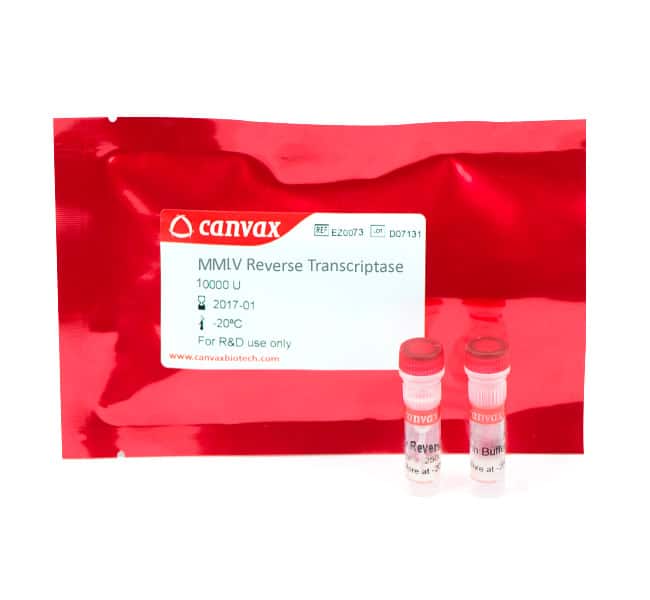
M-MLV Reverse Transcriptase
High-efficiency M-MLV Reverse Transcriptase for reliable and sensitive cDNA synthesis.
M-MLV Reverse Transcriptase from Canvax™ is a recombinant Moloney Murine Leukemia Virus enzyme designed for first-strand cDNA synthesis from RNA templates. It provides high yields, superior sensitivity, and full-length cDNA generation, even from low-copy or partially degraded RNA.
Its exceptional stability and purity ensure consistent, reproducible reverse transcription, making it ideal for RT-PCR, qRT-PCR, and gene expression studies. The enzyme performs efficiently across a broad temperature range, reducing RNA secondary structures and improving accuracy in transcript detection.
Have questions? Contact us
Detailed information:
Advantages & Features
-
High efficiency: Produces full-length cDNA with excellent yield.
-
Sensitive detection: Works with low-abundance RNA templates.
-
Thermostable performance: Efficient up to 50 °C for difficult RNA structures.
-
Excellent purity: Free from RNase and endonuclease contamination.
-
Versatile use: Compatible with oligo(dT), random, or gene-specific primers.
Specifications
Unit definition:
One unit of the enzyme incorporates 1 nmol dTTP into acid-precipitable material in 10 minutes at 37 ° C, using poly(A) oligo dT as a template primer.
Includes
Includes:
– M-MLV Reverse Transcriptase (200 U/μL)
– Reaction Buffer (10x)
Download documentation
 Datasheet MSDS
Applications
-
First-strand cDNA synthesis.
-
RT-PCR and qRT-PCR.
-
Gene expression profiling.
-
cDNA library preparation.
-
RNA quantification workflows.
Tables & Figures
Quality Control
-
Each batch is tested for specific activity, purity, and absence of RNase contamination to ensure reliable and reproducible performance.
Advice
-
Use high-quality RNA templates free from inhibitors.
-
For complex RNA, increase reaction temperature to 50 °C.
-
Include a no-RT control to confirm absence of genomic DNA contamination.
Storage, Shipping & Guarantee
- Shipped in: Gel pack.
- Storage: -20 ºC (NON Frost-Free Freezer).
Citations
- Wu, Y., Rashidpour, A., Duan, W., Fàbregas, A., Almajano, M. P., & Metón, I. (2025). Chitosan-Mediated Expression of Caenorhabditis elegans fat-1 and fat-2 in Sparus aurata: Short-Term Effects on the Hepatic Fatty Acid Profile, Intermediary Metabolism, and Proinflammatory Factors. Marine Drugs, 23(11), 434.
- Gómez-Melero, S. (2022). Desarrollo de anticuerpos terapéuticos contra el receptor CCR6 humano.
- Gómez-Melero, S., García-Maceira, F. I., García-Maceira, T., Luna-Guerrero, V., Montero-Peñalvo, G., Túnez-Fiñana, I., & Paz-Rojas, E. (2021). Amino Terminal Recognition by a CCR6 Chemokine Receptor Antibody Blocks CCL20 Signaling and IL-17 Expression via β-arrestin.
Safety Statements
This product is developed, designed and sold exclusively for Research purposes and in vitro use only (RUO). The product was not tested for use in diagnostics or for drug development, nor is it suitable for administration to humans or animals. For more info, please check its Material Safety Data Sheet available in this website.
Customers Review
Synonym(s)
M-MLV reverse transcriptase enzyme, Moloney murine leukemia virus reverse transcriptase, RT enzyme MMLV, RNA-dependent DNA polymerase M-MLV, cDNA synthesis enzyme
Also known as:
- Spanish: Transcriptasa inversa M-MLV, Enzima RT MMLV, Polimerasa dependiente de ARN M-MLV
- French: Transcriptase inverse M-MLV, Enzyme RT MMLV, Polymérase dépendante de l’ARN M-MLV
- German: M-MLV Reverse Transkriptase, RT-Enzym MMLV, RNA-abhängige DNA-Polymerase M-MLV
- Italian: Trascrittasi inversa M-MLV, Enzima RT MMLV, Polimerasi RNA-dipendente M-MLV
FAQs
Q1: What types of RNA templates are compatible?
It efficiently transcribes total RNA, mRNA, or viral RNA.
Q2: Which primers can be used?
Oligo(dT), random hexamers, or gene-specific primers.
Q3: What is the optimal temperature for cDNA synthesis?
Typically 37–50 °C depending on the complexity of the RNA secondary structure.