
Mouse CD24/HSA Antibody : LE/AF

Référence OASB00384
Conditionnement : 0.5mg
Marque : Aviva Systems Biology
Contactez votre distributeur local :
 Téléphone : +1 850 650 7790
Mouse CD24/HSA Antibody : LE/AF (OASB00384)
| Datasheets/Manuals | Printable datasheet for Mouse CD24/HSA Antibody : LE/AF (OASB00384) |
|---|
| Tested Species Reactivity | Mouse |
|---|---|
| Predicted Species Reactivity | Mouse |
| Clonality | Monoclonal |
| Clone | 91 |
| Isotype | IgG2a |
| Host | Rat |
| Conjugation | LE: Low Endotoxin, AF: Azide Free |
| Application | FC, IHC-F |
| Additional Information | Description: CD24, also known as heat stable antigen, is a phosphatidylinositol-linked cell surface glycoprotein that is expressed at all stages of B cell development and on most thymocytes. The absence of expression from mature T cells is closely associated with their maturation from CD4+CD8+CD24+ thymocytes to either CD4+CD8-CD24- or CD4-CD8+CD24- T cells. CD24 is also present on mouse granulocytes, monocytes, Langerhans cells and erythrocytes. Its ligand is P-selectin (CD62P). CD24 may play a role in regulation of B cell proliferation and differentiation, and it has been proposed that heat stable antigen promotes homotypic adhesion between B lymphocytes. |
| Reconstitution and Storage | Store at -20C |
| Concentration | 0.5 mg/mL |
| Specificity | CD24 |
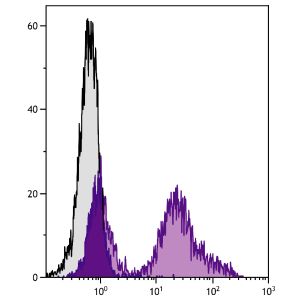
| Characterization | To ensure lot- to- lot consistency, each batch of monoclonal antibody is tested by flow cytometry to conformto characteristics of a standard reference. Representative data are included in this data sheet. |
| Warning | Reagents contain sodium azide. Sodium azide is very toxic if ingested or inhaled. Avoid contact withskin, eyes, or clothing. Wear eye or face protection when handling. If skin or eye contact occurs, washwith copious amounts of water. If ingested or inhaled, contact a physician immediately. Sodium azideyields toxic hydrazoic acid under acidic conditions. Dilute azide- containing compounds in running waterbefore discarding to avoid accumulation of potentially explosive deposits in lead or copper plumbing. |
| Dilution | Flow Cytometry: FITC conjugate <= 4 ug/106 cells Biotin conjugate <= 2 ug/106 cells R-phycoerythrin conjugate <= 0.3 ug/106 cells Allophycocyanin conjugate <= 0.3 ug/106 cells Spectral Red conjugate <= 0.3 ug/106 cells |
| Application Info | Flow cytometry 8, Immunohistochemistry (frozen sections) 8, Immunoprecipitation 8 |
| Other Applications Data | Since applications vary, you should determine the optimum working dilution for the product that is appropriate for yourspecific need. |
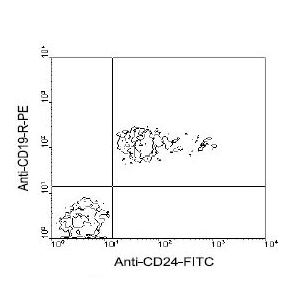
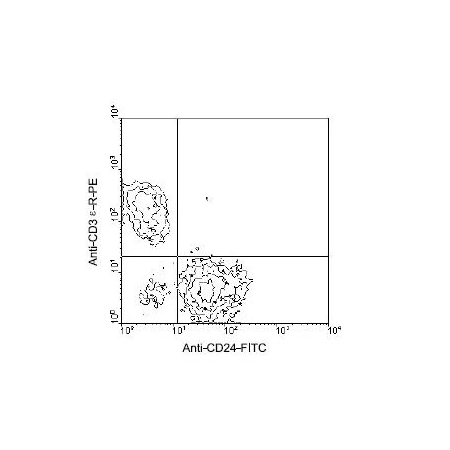
| Other Applications Image 1 Data | Amount Used: 3Ug/106 cells Cells from BALB/c spleen cells were doublestained with rat anti-mouse CD24-FITC and hamster anti-mouse CD3-R-PE , gated on small lymphocytes and analyzed using a FACScan flow cytometer (BDIS, San Jose, CA). |
| Storage | - The purified (UNLB) antibody is supplied as 0.5 mg of purified immunoglobulin in 1.0 mL of 100 mMborate buffered saline, pH 8.2. No preservatives or amine- containing buffer salts added. Store at 2- 8 C - The fluorescein (FITC) conjugate is supplied as 0.5 mg in 1.0 mL of PBS/NaN3. Store at 2- 8 C - The biotin (BIOT) conjugate is supplied as 0.5 mg in 1.0 mL of PBS/NaN3. Store at 2- 8 C - The R- phycoerythrin (R- PE) and allophycocyanin (APC) conjugates are supplied as 0.1 mg in 1.0 mLof PBS/NaN3 and a stabilizing agent. Store at 2- 8 C. Do not freeze! - The Spectral Red (SPRD) conjugate is supplied as 0.1 mg in 1.0 mL of PBS/NaN3 and a stabilizingagent. Store at 2- 8 C. Do not freeze! - The low endotoxin, azide- free (LE/AF) antibody is supplied as 0.5 mg purified immunoglobulin in 1.0 mLof PBS. Aliquot and store at or below - 20 C - Protect conjugated forms from light. Aliquot and freeze the low endotoxin, azide- free product at - 20 Cimmediately upon receipt. Each reagent is stable for the period shown on the bottle label if stored asdirected. |
| Reference | 1. Bruce, J., F.W. Symington, T.J. McKearn, and J. Sprent. 1981. J. Immunol. 127:2496 2. Alterman, L.A., I.N. Crispe, and C. Kinnon. 1990. Eur. J. Immunol. 20:1597 3. Davidson, W.F., T.M. Chused, and H.C. Morse. 1981. Immunogenetics 13:421 4. Rougon, G., L.A. Alterman, K. Dennis, X.J. Guo, and C. Kinnon. 1991. Eur. J. Immunol. 21:1397 5. Wilson, A., L.M. Day, R. Scollay, and K. Shortman. 1984. Immnol. Rev. 82:79 6. Shortman, K., A. Wilson, M. Egerton, M. Pearse, and R. Scollay. 1988. Cell. Immunol. 117:312 7. Aigner, S., M. Ruppert, M. Hubbe, M. Sammar, Z. Sthoeger, E. C. Butcher, D. Vestweber, and P. Altevogt. 1995. International Immunology 7:1557 8. Kearney, J.F. Personal communication. |
|---|---|
| Gene Symbol | CD24A |
| Gene Full Name | Signal transducer CD24 |
| Alias Symbols | H, HSA, Cd24, Ly-5, nect, Ly-52, nectadrin |
| NCBI Gene Id | 12484 |
| Protein Name | signal transducer CD24 |
| Uniprot ID | P24807 |
| Protein Accession # | NP_033976.1 |
| Nucleotide Accession # | NM_009846.2 |