
Mouse CD25/IL-2Ra Antibody : LE/AF

Référence OASB00401
Conditionnement : 0.5mg
Marque : Aviva Systems Biology
Contactez votre distributeur local :
 Téléphone : +1 850 650 7790
Mouse CD25/IL-2Ra Antibody : LE/AF (OASB00401)
| Datasheets/Manuals | Printable datasheet for Mouse CD25/IL-2Ra Antibody : LE/AF (OASB00401) |
|---|
| Tested Species Reactivity | Mouse |
|---|---|
| Predicted Species Reactivity | Mouse |
| Clonality | Monoclonal |
| Clone | 3C7 |
| Isotype | IgG2b |
| Host | Rat |
| Conjugation | LE: Low Endotoxin, AF: Azide Free |
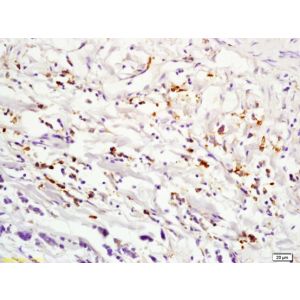
| Application | FC, IHC-F, IP, BL |
| Additional Information | Description: The IL-2 receptor (IL-2R) exists in three alternative forms made up from the individual components of CD25, CD122, and CD132. CD25 represents the low affinity alpha chain of the IL-2R, a type I transmembrane glycoprotein containing two CCP domains. It is rich in O-linked carbohydrates and has a short cytoplasmic tail. CD25 is expressed on activated T cells, B cells, NK cells, and monocytes of all mouse strains tested. Expression of CD25 on activated T lymphocytes is transitory and endogenously regulated. CD25 is expressed on precursor B cells in bone marrow. Its expression is initiated by functional rearrangement and expression of IgM heavy chain genes and is down-regulated when immature B cells mature and express IgD. It is expressed at a higher level on CD4+CD8+ thymocytes. It is also expressed on cultured epidermal Langerhans cells. The biochemical features of murine CD25 have been characterized in detail. The 3C7 monoclonal antibody reacts with an epitope of CD25 which is distinct from that recognized by clone 7D4. 3C7, used in combination with 7D4 in culture, results in higher levels of inhibition of proliferation driven by IL-2 and generation of alloreactive CTL than either of these monoclonal antibodies alone. |
| Reconstitution and Storage | Store at -20C |
| Immunogen | IL-2 dependent BALB/c helper T cell clone HT2 |
| Concentration | 0.5 mg/mL |
| Specificity | CD25 |
| Characterization | To ensure lot- to- lot consistency, each batch of monoclonal antibody is tested by flow cytometry to conformto characteristics of a standard reference reagent. |
| Warning | Reagents contain sodium azide. Sodium azide is very toxic if ingested or inhaled. Avoid contact withskin, eyes, or clothing. Wear eye or face protection when handling. If skin or eye contact occurs, washwith copious amounts of water. If ingested or inhaled, contact a physician immediately. Sodium azideyields toxic hydrazoic acid under acidic conditions. Dilute azide- containing compounds in running waterbefore discarding to avoid accumulation of potentially explosive deposits in lead or copper plumbing. |
| Dilution | Flow Cytometry: Fluorescein conjugate Biotin conjugate R-phycoerythrin conjugate Allophycocyanin conjugate Spectral Red conjugate R-phycoerythrin-Cyanine 7 conjugate <= 3 ug/106 cells <= 3 ug/106 cells <= 0.3 ug/106 cells <= 0.3 ug/106 cells <= 0.3 ug/106 cells <= 0.3 ug/106 cells |
| Application Info | Identification and enumeration of CD25+ cells by flow cytometry 2,4, Immunoprecipitation 2, Inhibition of IL-2 or mitogen-induced T cell proliferation 13, In vitro blocking of IL-2 binding 2 |
| Other Applications Data | Since applications vary, you should determine the optimum workingdilution of the product that is appropriate for your specific need. |
| Storage | - The purified (UNLB) antibody is supplied as 0.5 mg of purified immunoglobulin in 1.0 mL of 100 mMborate buffered saline, pH 8.2. No preservatives or amine- containing buffer salts added. Store at 2- 8 C - The fluorescein (FITC) conjugate is supplied as 0.5 mg in 1.0 mL of PBS/NaN3. Store at 2- 8 C - The biotin (BIOT) conjugate is supplied as 0.5 mg in 1.0 mL of PBS/NaN3. Store at 2- 8 C - The R- phycoerythrin (R- PE) conjugate is supplied as 0.1 mg in 1.0 mL or 0.2 mg in 2.0 mL ofPBS/NaN3 and a stabilizing agent. Store at 2- 8 C. Do not freeze! - The allophycocyanin (APC) conjugate is supplied as 0.1 mg in 1.0 mL of PBS/NaN3 and a stabilizingagent. Store at 2- 8 C. Do not freeze! - The Spectral Red (SPRD) and R- phycoerythrin- Cyanine 7 (R- PE- CY 7) conjugates are supplied as0.1 mg in 1.0 mL of PBS/NaN3 and a stabilizing agent. Store at 2- 8 C. Do not freeze! - The low endotoxin, azide- free (LE/AF) antibody is supplied as 0.5 mg purified immunoglobulin in 1.0 mLof PBS. Aliquot and store at or below - 20 C - Protect conjugated forms from light. Aliquot and freeze the low endotoxin, azide- free product at - 20 Cimmediately upon receipt. Each reagent is stable for the period shown on the bottle label if stored asdirected. |
| Reference | 1. Malek, T. R., R. J. Robb, and E. M. Shevach. 1983. Proc. Natl. Acad. Sci. U. S. A. 80:5694 2. Ortega, G., R. J. Robb, E. M. Shevach, and T. R. Malek. 1984. J. Immunol. 133:1970 3. Malek, T. R., J. A. Schmidt, and E. M. Shevach. 1985. J. Immunol. 134:2405 4. Andrew, M. E., A. M. Churilla, T. R. Malek, V. L. Braciale, and T. J. Braciale. 1985. J. Immunol. 134:920 5. Chen, J., A. Ma, F. Young, and F. W. Alt. 1994. International. Immunology 6:1265 6. Habu, S., K. Okumura, T. Diamantstein, and E. M. Shevach. 1985. Eur. J. Immunol. 15:456 7. Steiner, G., E. Tschachler, M. Tani, T. R. Malek, E. M. Shevach, W. Holter, W. Knapp, K. Wolff, and G. Stingl. 1986. J. Immunol. 137:155 8. Malek, T. R. and P. E. Korty. 1986. J. Immunol. 136:4092 9. Malek, T. R., J. D. Ashwell, R. N. Germain, E. M. Shevach, and J. Miller. 1986. Immunol. Rev. 92:81 10. Saragovi, H. and T. R. Malek. 1988. J. Immunol. 141:476 11. Lorenzo, F., C. Jaulin, N. Vita, P. Froussard, P. Ferrara, D. L. Jankovic, and J. Theze. 1991. J. Immunol. 147:2970 12. Moreau, J. L., M. Nabholz, T. Diamantstein, T. R. Malek, E. Shevach, and J. Theze. 1987. Eur. J. Immunol. 17:929 13. Malek, T. R., G. Ortega, J. P. Jakway, C. Chan, and E. M. Shevach. 1984. J. Immunol. 133:1976 14. Leonard, W.J., et. al. 1984. Nature 311:62615. Rolink, A., U. Grawunder, T.H. Winkler, H. Karasuyama, and F. Melchers. 1994. Int. Immunol. 6:1257 |
|---|---|
| Gene Symbol | IL2RA |
| Gene Full Name | Interleukin-2 receptor subunit alpha |
| Alias Symbols | I, CD25, Il2r, Ly-4, Ly-43 |
| NCBI Gene Id | 16184 |
| Protein Name | interleukin-2 receptor subunit alpha |
| Uniprot ID | P01590 |
| Protein Accession # | NP_032393.3 |
| Nucleotide Accession # | NM_008367.3 |