
Mouse CD3e Antibody : LE/AF

Référence OASB01653
Conditionnement : 0.5mg
Marque : Aviva Systems Biology
Contactez votre distributeur local :
 Téléphone : +1 850 650 7790
Mouse CD3e Antibody : LE/AF (OASB01653)
| Datasheets/Manuals | Printable datasheet for Mouse CD3e Antibody : LE/AF (OASB01653) |
|---|
| Tested Species Reactivity | Mouse |
|---|---|
| Predicted Species Reactivity | Mouse |
| Clonality | Monoclonal |
| Clone | 145-2C11 |
| Isotype | IgG |
| Host | Hamster |
| Conjugation | LE: Low Endotoxin, AF: Azide Free |
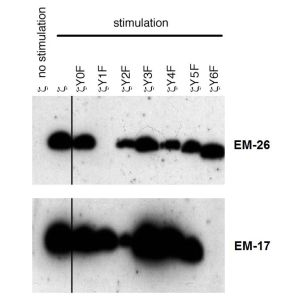
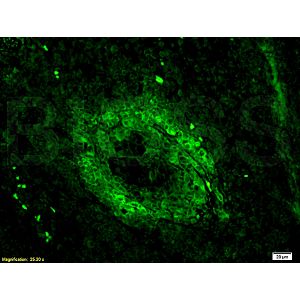
| Application | FC, IHC, IP, WB, BL, CMCD |
| Additional Information | Description: CD3 epsilon, a member of the immunoglobulin superfamily of cell surface receptors, is comprised of five invariable chains ranging in size from 16-28 kDa and is closely associated with the T cell antigen receptor (TCR). It is expressed on all T cells of all mouse strains. CD3 plays a major role in signaling during antigen recognition, leading to T-cell activation. The 145-2C11 monoclonal antibody recognizes an epitope on the 25 kDa epsilon chain of the CD3/TCR complex. In the presence of Fc receptor-bearing accessory cells, soluble 145-2C11 can activate primed and naive T cell in vitro. 145-2C11 can also induce redirected lysis of specific target cells by CTL clones and it can block lysis of specific target cells by antigen-specific CTL's. Immobilized 145-2C11 can activate both normal T lymphocytes and cloned T cell lines. Under certain conditions, T cell activation by 145-2C11 may result in apoptotic cell death. |
| Reconstitution and Storage | Store at -20C |
| Immunogen | H-2Kb-specific murine cytotoxic T-lymphocyte (CTL) clone BM10-37 |
| Concentration | 0.5 mg/mL |
| Specificity | CD3e |
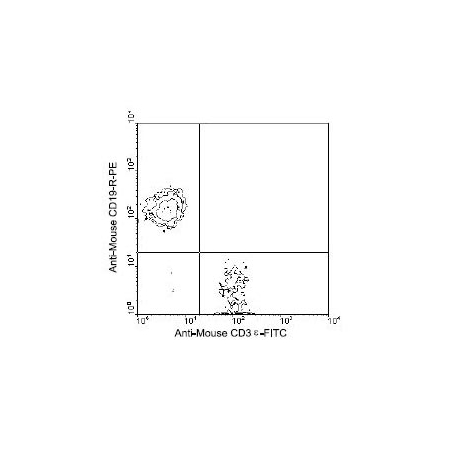
| Characterization | To insure acceptable performance, each batch of product is tested by flow cytometry to conform to thecharacteristics of a standard reference. Representative data are included in this product insert. |
| Warning | Reagents contain sodium azide. Sodium azide is very toxic if ingested or inhaled. Avoid contact with skin,eyes, or clothing. Wear eye or face protection when handling. If skin or eye contact occurs, wash withcopious amounts of water. If ingested or inhaled, contact a physician immediately. Sodium azide yieldstoxic hydrazoic acid under acidic conditions. Dilute azide- containing compounds in running water beforediscarding to avoid accumulation of potentially explosive deposits in lead or copper plumbing. |
| Dilution | Flow Cytometry: Fluorescein conjugate Biotin conjugate PE, APC, SPRD, CY5, and AF647 conjugates <= 3 ug/106 cells <= 1 ug/106 cells <= 0.1 ug/106 cells |
| Application Info | Identification and enumeration of CD3+ cells by flow cytometry 1, 2, Immunoprecipitation 1, Western blotting 7, In vitro depletion of CD3+ cells 2, In vitro activation of T cells 2-4, Immunohistochemistry 8 |
| Other Applications Data | Since applications vary, you should determine the optimum workingdilution of the product that is appropriate for your specific need. |
| Other Applications Image 1 Data | Amount Used: 1 Ug/106 cells BALB/c spleen cells were double-stained with hamster anti-mouse CD3epsilon-FITC and rat anti-mouse CD19-R-PE. Lymphocytes were gated and analyzed on a FACScan flow cytometer (BDIS, San Jose, CA). |
| Storage | - The purified (UNLB) antibody is supplied as 0.5 mg of purified immunoglobulin in 1.0 mL of 100 mMborate buffered saline, pH 8.2. No preservatives or amine- containing buffer salts added. Store at 2- 8 C - The fluorescein (FITC) and Cyanine 5 (CY 5) conjugates are supplied as 0.5 mg or 0.1 mg in 1.0 mLof PBS/NaN3. Store at 2- 8 C - The biotin (BIMA) conjugate is supplied as 0.5 mg in 1.0 mL of PBS/NaN3. Store at 2- 8 C - The R- phycoerythrin (R- PE), allophycocyanin (APC), and Spectral Red (SPRD) conjugates aresupplied as 0.1 mg in 1.0 mL or 0.2 mg in 2.0 mL of PBS/NaN3 and a stabilizing agent. Store at 2- 8 C Do not freeze! - The low endotoxin, azide- free (LE/AF) antibody is supplied as 0.5 mg purified immunoglobulin in 1.0 mLof PBS. Aliquot and store at or below - 20 C - The Alexa Fluor 647 (AF647) conjugate is supplies as 0.1 mg in 0.2mL of PBS/NaN3. Store at 2- 8 C - Protect conjugated forms from light. Aliquot and freeze the low endotoxin, azide- free product at - 20 Cimmediately upon receipt. Each reagent is stable for the period shown on the bottle label if stored asdirected. |
| Reference | 1. Leo, O., M. Foo, D. Sachs, L. Samuelson, and J. Bluestone. 1987. Proc. Natl. Acad. Sci. USA 84:1374 2. Portoles, P., J. Rojo, A. Golby, M. Bonneville, S. Gromkowski, L. Greenbaum, C. A. Janeway, Jr., D. B. Murphy, and K. Bottomly. 1989. J. Immunol 142:4169 3. Kruisbeek, A.M., and E. Shevach. 1991. In: Currents Protocols in Immunology. J. Coligan, A. Kruisbeek, D. Margulies, E.M. Shevach, and W Strober, eds. John Wiley & Sons, New York, pp. 3.12.1- 3.12.14 4. Duke, R.C., J.J. Cohen, S.A. Boehme, M.J. Lenardo, C.D. Surh, H. Kishimoto, and J. Sprent. 1995. In: Currents Protocols in Immunology. J Coligan, A. Kruisbeek, D. Margulies, E.M. Shevach, and W. Strober, eds. John Wiley & Sons, New York, pp. 3.17.1- 3.17.33 5. Ucker, D.S., J. Meyers, and P.D. Obermiller. 1992. J. Immunol. 149:1583 6. Wang, R., K.M. Murphy, D.Y. Loh, C. Weaver, and J.H. Russell. 1993. J. Immunol. 150:3832 7. Salvadori, S., B. Gansbacher, A.M. Pizzimenti, and K.S. Zier. 1994. J. Immunol. 153.5176 8. Payer, E., A. Elbe, and G. Stingl., 1991. J. Immunol. 146:2536. |
|---|---|
| Gene Symbol | CD3E |
| Gene Full Name | T-cell surface glycoprotein CD3 epsilon chain |
| Alias Symbols | CD3, T3e, AI504783, CD3epsilon |
| NCBI Gene Id | 12501 |
| Protein Name | T-cell surface glycoprotein CD3 epsilon chain |
| Uniprot ID | P22646 |
| Protein Accession # | NP_031674.1 |
| Nucleotide Accession # | NM_007648.4 |