



RayBio® C-Series Mouse Chemokine Antibody Array 1 Kit. Detects 25 Mouse Chemokines. Suitable for all liquid sample types.
Mouse Chemokine Array C1
Mouse Chemokine Array C1
Contact Us for Bulk Request
Product Description
Specifications
| Size | 2 Sample Kit, 4 Sample Kit, 8 Sample Kit |
| Species | Mouse |
| Compatible Sample Types | Cell Culture Supernatants, Plasma, Serum, Tissue Lysates, Cell Lysates |
| Quantitative/Semi-Quantitative | Semi-Quantitative |
| Number of Targets Detected | 25 |
| Solid Support | Membrane |
| Design Principle | Sandwich-based |
| Method Of Detection | Chemiluminescence |
| Research Area | Inflammation, Chemokine Biology |
| Shipping Type | Blue ice |
| Storage | -20°C |
Product Features
- Easy to use
- No specialized equipment needed
- Compatible with nearly any liquid sample
- Proven technology (many publications)
- Highly sensitive (pg/ml)
- Sandwich ELISA specificity
- Higher density than ELISA, Western blot or bead-based multiplex
Target Names
| Scroll over each target protein for more information | ||||
|---|---|---|---|---|
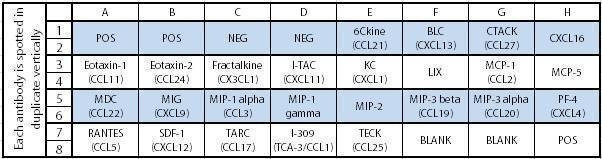
| 6Ckine (CCL21)
| BLC (CXCL13)
| CTACK (CCL27)
| CXCL16
| Eotaxin-1 (CCL11)
|
| Eotaxin-2 (MPIF-2/CCL24)
| Fractalkine (CX3CL1)
| I-TAC (CXCL11)
| KC (CXCL1)
| LIX
|
| MCP-1 (CCL2)
| MCP-5
| MDC (CCL22)
| MIG (CXCL9)
| MIP-1 alpha (CCL3)
|
| MIP-1 gamma
| MIP-2
| MIP-3 beta (CCL19)
| MIP-3 alpha (CCL20)
| Platelet Factor 4 (CXCL4)
|
| RANTES (CCL5)
| SDF-1 (CXCL12)
| TARC (CCL17)
| I-309 (TCA-3/CCL1)
| TECK (CCL25)
|
Application Notes
Suggested Application
Multiplexed Protein Detection; Detection of Relative Protein Expression; Detecting Patterns of Cytokine Expression; Biomarker/ Key Factor Screening; Identifying Key Factors; Confirming a Biological Process
Kit Components
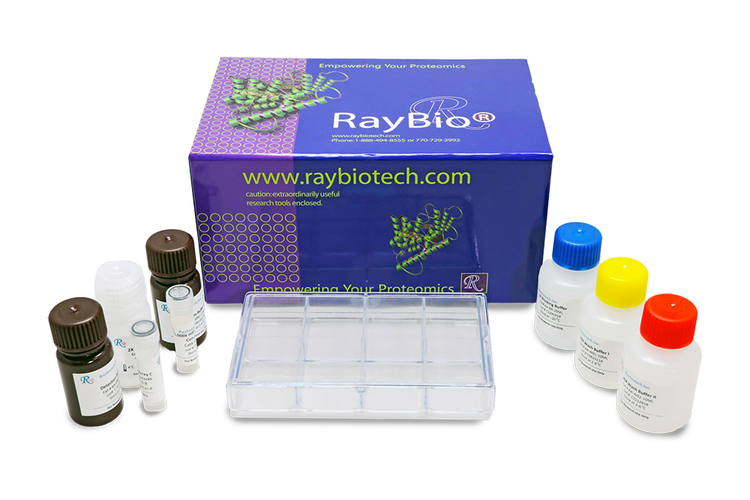
- Mouse Chemokine Antibody Array C1 Membranes
- Blocking Buffer
- Wash Buffer 1
- Wash Buffer 2
- Biotinylated Detection Antibody Cocktail
- Streptavidin-Conjugated HRP
- Detection Buffer C
- Detection Buffer D
- Lysis Buffer
- 8-Well Incubation Tray
- Plastic Sheets
- Array Templates
- Manual
Other Materials Required
- Pipettors, pipet tips and other common lab consumables
- Orbital shaker or oscillating rocker
- Tissue Paper, blotting paper or chromatography paper
- Adhesive tape or Saran Wrap
- Distilled or de-ionized water
- A chemiluminescent blot documentation system (such as UVP's ChemiDoc-It® or EpiChem II Benchtop Darkroom or GE's ImageQuant™ LAS 4000 or Amersham Imagers 600 and 680), X-ray Film and a suitable film processor, or another chemiluminescent detection system.
Protocol Outline
- Block membranes
- Incubate with Sample
- Incubate with Biotinylated Detection Antibody Cocktail
- Incubate with HRP-Conjugated Streptavidin
- Incubate with Detection Buffers
- Image with chemiluminescent imaging system
- Perform densitometry and analysis
Storage/Stability
For best results, store the entire kit frozen at -20°C upon arrival. Stored frozen, the kit will be stable for at least 6 months which is the duration of the product warranty period. Once thawed, store array membranes and 1X Blocking Buffer at -20°C and all other reagents undiluted at 4°C for no more than 3 months.
documents
citations
Chemotherapy-elicited extracellular vesicle CXCL1 from dying cells promotes triple-negative breast cancer metastasis by activating TAM/PD-L1 signaling
- Species:
- Mouse
- Sample Type:
- Extracellular Vesicles (EV-alive, EV-dead solution)
- Year:
- 2024
- Journal Name:
- Journal of Experimental & Clinical Cancer Research
- PubMed ID:
- 38654356
Abstract 586: Development of a novel pan-chemokine receptor inhibitor as therapeutic for breast cancer
- Species:
- Mouse
- Sample Type:
- Serum
- Year:
- 2023
- Journal Name:
- Cancer Research
Programming Cell-Derived Vesicles with Enhanced Immunomodulatory Properties
- Species:
- Mouse
- Sample Type:
- macrophage-engineered vesicles (MEVs)
- Year:
- 2023
- Journal Name:
- Advanced Healthcare Materials
RAI16 maintains intestinal homeostasis and inhibits NLRP3‐dependent IL‐18/CXCL16‐induced colitis and the progression of colitis‐associated colorectal cancer
- Species:
- Mouse
- Sample Type:
- colon
- Year:
- 2022
- Journal Name:
- Clinical and Translational Medicine
Nociception-Dependent CCL21 Induces Dorsal Root Ganglia Axonal Growth via CCR7-ERK Activation
- Species:
- Mouse
- Sample Type:
- neurons
- Year:
- 2022
- Journal Name:
- Frontiers in immunology
Astroglial TLR9 antagonism promotes chemotaxis and alternative activation of macrophages via modulation of astrocyte-derived signals: implications for spinal cord injury
- Species:
- Mouse
- Sample Type:
- Conditioned media (cell culture media)
- Year:
- 2020
- Journal Name:
- Journal of Neuroinflammation
Engineering immunoproteasome-expressing mesenchymal stromal cells: A potent cellular vaccine for lymphoma and melanoma in mice
- Species:
- Mouse
- Sample Type:
- Cell Culture Supernatant (supernatant of DCs, MSCs)
- Year:
- 2021
- Journal Name:
- Cell reports. Medicine
- PubMed ID:
- 35028603
Altered protein prenylation in Sertoli cells is associated with adult infertility resulting from childhood mumps infection.
- Species:
- Mouse
- Sample Type:
- Conditioned Media ( primary Sertoli cells )
- Year:
- 2013
- Journal Name:
- Journal of Experimental Medicine
Mesenchymal stem cell-derived CCL-9 and CCL-5 promote mammary tumor cell invasion and the activation of matrix metalloproteinases.
- Species:
- Mouse
- Sample Type:
- Conditioned Media (Normal mouse mammary gland cells (NMuMG), metastatic mouse mammary cells (4T1), and mesenchymal murine stem (D1) cell)
- Year:
- 2013
- Journal Name:
- Cell adhesion and migration
- PubMed ID:
- 23722213
Influence of the hepatic eukaryotic initiation factor 2 (eIF2) endoplasmic reticulum (ER) stress response pathway on insulin-mediated ER stress and hepatic and peripheral glucose metabolism.
- Species:
- Mouse
- Sample Type:
- Plasma
- Year:
- 2011
- PubMed ID:
- 21832042