

Rat PCNA (Proliferating Cell Nuclear Antigen) ELISA Kit

Référence MBS2515480-96
Conditionnement : 96Tests
Marque : MyBiosource
Contactez votre distributeur local :

Téléphone : +1 850 650 7790
PCNA ELISA Kit for Rat
For Research Use Only. Not for use in diagnostic procedures. Special Promotion Catalog #: MBS2515480SPECIAL PROMOTIONAL PRICING for a limited time
Principle of the Assay: This ELISA kit uses the Sandwich-ELISA principle. The micro ELISA plate provided in this kit has been pre-coated with an antibody specific to Rat PCNA. Standards or samples are added to the micro ELISA plate wells and combined with the… More details
Product Overview
Online Datasheet in PDFProduct Name
PCNA, ELISA Kit
Full Product Name
Rat PCNA (Proliferating Cell Nuclear Antigen) ELISA Kit
Product Gene Name
PCNA elisa kit
Species Reactivity
Rat
Assay Type
Quantitative Sandwich
Samples
Serum, plasma and other biological fluids
Detection Range
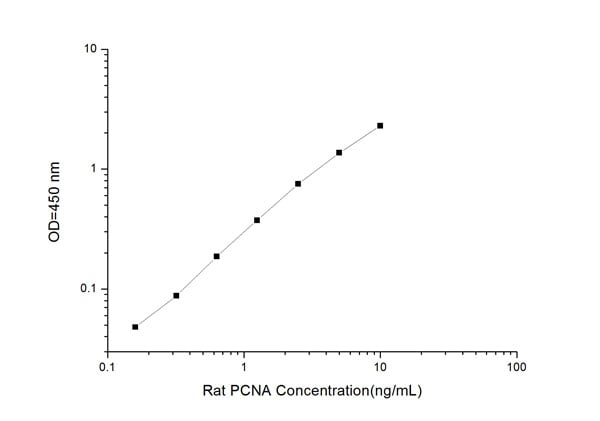
0.16-10ng/mL
Sensitivity
0.1ng/mL
Specificity
This kit recognizes Rat PCNA in samples. No significant cross-reactivity or interference between Rat PCNA and analogues was observed.
Preparation and Storage
Store at 4 degree C.
Inter-assay Precision
Inter-assay Precision (Precision between assays): 3 samples with low, mid range and high level Rat PCNA were tested on 3 different plates, 20 replicates in each plate.
Intra-assay Precision
Intra-assay Precision (Precision within an assay): 3 samples with low, mid range and high level Rat PCNA were tested 20 times on one plate, respectively.
Molecular Weight
28,706 Da
ISO Certification
Manufactured in an ISO 9001:2015 Certified Laboratory.
Other Notes
Small volumes of PCNA elisa kit vial(s) may occasionally become entrapped in the seal of the product vial during shipment and storage. If necessary, briefly centrifuge the vial on a tabletop centrifuge to dislodge any liquid in the container`s cap. Certain products may require to ship with dry ice and additional dry ice fee may apply.
Searchable Terms for PCNA purchase
MBS2515480 is a ready-to-use microwell, strip-or-full plate ELISA (enzyme-linked immunosorbent assay) Kit for analyzing the presence of the PCNA, ELISA Kit target analytes in biological samples. The concentration gradients of the kit standards or positive controls render a theoretical kit detection range in biological research samples containing PCNA. The ELISA analytical biochemical technique of the MBS2515480 kit is based on PCNA antibody-PCNA antigen interactions (immunosorbency) and an HRP colorimetric detection system to detect PCNA antigen targets in samples. The ELISA Kit is designed to detect native, not recombinant, PCNA. Appropriate sample types may include undiluted body fluids and/or tissue homogenates, secretions. Quality control assays assessing reproducibility identified the intra-assay CV (%) and inter-assay CV(%).
Additional Details
NCBI/Uniprot data below describe general gene information for PCNA. It may not necessarily be applicable to this product.
NCBI Official Full Name
PCNA, partial
NCBI Official Synonym Full Names
proliferating cell nuclear antigen
NCBI Official Symbol
PCNA
NCBI Official Synonym Symbols
ATLD2
UniProt Protein Name
Proliferating cell nuclear antigen
Protein Family
Probable DNA polymerase sliding clamp
UniProt Gene Name
PCNA
UniProt Entry Name
Q6FHF5_HUMAN
NCBI Protein Information
proliferating cell nuclear antigen; DNA polymerase delta auxiliary protein; cyclin
NCBI Summary for PCNA
The protein encoded by this gene is found in the nucleus and is a cofactor of DNA polymerase delta. The encoded protein acts as a homotrimer and helps increase the processivity of leading strand synthesis during DNA replication. In response to DNA damage, this protein is ubiquitinated and is involved in the RAD6-dependent DNA repair pathway. Two transcript variants encoding the same protein have been found for this gene. Pseudogenes of this gene have been described on chromosome 4 and on the X chromosome. [provided by RefSeq, Jul 2008]
Show more UniProt Comments for PCNA
PCNA: This protein is an auxiliary protein of DNA polymerase delta and is involved in the control of eukaryotic DNA replication by increasing the polymerase's processibility during elongation of the leading strand. Induces a robust stimulatory effect on the 3'- 5' exonuclease and 3'-phosphodiesterase, but not apurinic- apyrimidinic (AP) endonuclease, APEX2 activities. Has to be loaded onto DNA in order to be able to stimulate APEX2. Homotrimer. Forms a complex with activator 1 heteropentamer in the presence of ATP. Interacts with EXO1, POLH, POLK, DNMT1, ERCC5, FEN1, CDC6 and POLDIP2. Interacts with APEX2; this interaction is triggered by reactive oxygen species and increased by misincorporation of uracil in nuclear DNA. Forms a ternary complex with DNTTIP2 and core histone. Interacts with KCTD10 and PPP1R15A. Interacts with POLD1, POLD3 and POLD4. Interacts with BAZ1B; the interaction is direct. Interacts with HLTF and SHPRH. Interacts with NUDT15. Interaction is disrupted in response to UV irradiation and acetylation. Interacts with p21Cip1/p21(CIP1) and CDT1; interacts via their PIP-box which also recruits the DCX(DTL) complex. Interacts with DDX11. Interacts with EGFR; positively regulates PCNA. Interacts with C12orf48/PARI. Interacts with SMARCAD1. Belongs to the PCNA family.
Protein type: Cell cycle regulation; DNA replication
Chromosomal Location of Human Ortholog: 20pter-p12
Cellular Component: nucleoplasm; centrosome; PCNA complex; cytoplasm; nuclear replication fork; DNA replication factor C complex; nucleus
Molecular Function: identical protein binding; protein binding; DNA polymerase processivity factor activity; purine-specific mismatch base pair DNA N-glycosylase activity; MutLalpha complex binding; receptor tyrosine kinase binding; dinucleotide insertion or deletion binding
Biological Process: mismatch repair; heart development; positive regulation of deoxyribonuclease activity; DNA strand elongation during DNA replication; response to lipid; DNA repair; leading strand elongation; G1/S-specific transcription in mitotic cell cycle; telomere maintenance via semi-conservative replication; cell proliferation; bypass DNA synthesis; response to cadmium ion; epithelial cell differentiation; base-excision repair; nucleotide-excision repair; transcription-coupled nucleotide-excision repair; telomere maintenance via recombination; nucleotide-excision repair, DNA gap filling; mitotic cell cycle; telomere maintenance; regulation of DNA replication; G1/S transition of mitotic cell cycle
Disease: Ataxia-telangiectasia-like Disorder 2
Show more Protein type: Cell cycle regulation; DNA replication
Chromosomal Location of Human Ortholog: 20pter-p12
Cellular Component: nucleoplasm; centrosome; PCNA complex; cytoplasm; nuclear replication fork; DNA replication factor C complex; nucleus
Molecular Function: identical protein binding; protein binding; DNA polymerase processivity factor activity; purine-specific mismatch base pair DNA N-glycosylase activity; MutLalpha complex binding; receptor tyrosine kinase binding; dinucleotide insertion or deletion binding
Biological Process: mismatch repair; heart development; positive regulation of deoxyribonuclease activity; DNA strand elongation during DNA replication; response to lipid; DNA repair; leading strand elongation; G1/S-specific transcription in mitotic cell cycle; telomere maintenance via semi-conservative replication; cell proliferation; bypass DNA synthesis; response to cadmium ion; epithelial cell differentiation; base-excision repair; nucleotide-excision repair; transcription-coupled nucleotide-excision repair; telomere maintenance via recombination; nucleotide-excision repair, DNA gap filling; mitotic cell cycle; telomere maintenance; regulation of DNA replication; G1/S transition of mitotic cell cycle
Disease: Ataxia-telangiectasia-like Disorder 2
Precautions
All of MyBioSource's Products are for scientific laboratory research purposes and are not for diagnostic, therapeutics, prophylactic or in vivo use. Through your purchase, you expressly represent and warrant to MyBioSource that you will properly test and use any Products purchased from MyBioSource in accordance with industry standards. MyBioSource and its authorized distributors reserve the right to refuse to process any order where we reasonably believe that the intended use will fall outside of our acceptable guidelines.
Disclaimer
While every efforts were made to ensure the accuracy of the information provided in this datasheet, MyBioSource will not be liable for any omissions or errors contained herein. MyBioSource reserves the right to make changes to this datasheet at any time without prior notice.
It is the responsibility of the customer to report product performance issues to MyBioSource within 30 days of receipt of the product. Please visit our Terms & Conditions page for more information.
It is the responsibility of the customer to report product performance issues to MyBioSource within 30 days of receipt of the product. Please visit our Terms & Conditions page for more information.
Product Note
Select online data sheet information is drawn from bioinformatics databases, occasionally resulting in ambiguous or non-relevant product information. It is the responsibility of the customer to review, verify, and evaluate the information to make sure it matches their requirements before purchasing the kit. Our ELISA Kit assays are dynamic research tools and sometimes they may be updated and improved. If the format of this assay is important to you then please request the current manual or contact our technical support team with a presales inquiry before placing an order. We will confirm the current details of the assay. We cannot guarantee the sample manual posted online is the most current manual, it is intended to serve as an example only. Please refer to the instructions For Use provided with the assay kit for precise details.
Product PubMed Publications
Pathways associated with PCNA elisa kit
| Products by Pathway | Pathway Diagram |
|---|---|
| BARD1 Signaling Events Pathway antibodies | BARD1 Signaling Events Pathway Diagram |
| BRCA1-associated Genome Surveillance Complex (BASC) Pathway antibodies | BRCA1-associated Genome Surveillance Complex (BASC) Pathway Diagram |
| BRCA1-associated Genome Surveillance Complex (BASC) Pathway antibodies | BRCA1-associated Genome Surveillance Complex (BASC) Pathway Diagram |
| Base Excision Repair Pathway antibodies | Base Excision Repair Pathway Diagram |
| Base Excision Repair Pathway antibodies | Base Excision Repair Pathway Diagram |
| Base Excision Repair Pathway antibodies | Base Excision Repair Pathway Diagram |
| Cell Cycle Pathway antibodies | Cell Cycle Pathway Diagram |
| Cell Cycle, Mitotic Pathway antibodies | Cell Cycle, Mitotic Pathway Diagram |
| Cell Cycle Pathway antibodies | Cell Cycle Pathway Diagram |
| Cell Cycle Pathway antibodies | Cell Cycle Pathway Diagram |
Organs/Tissues associated with PCNA elisa kit
| Organ/Tissue Name | Pubmed Publications |
|---|---|
| Blood Antibodies | >2590 publications with PCNA and Blood |
| Vascular Antibodies | >2024 publications with PCNA and Vascular |
| Liver Antibodies | >2022 publications with PCNA and Liver |
| Muscle Antibodies | >1704 publications with PCNA and Muscle |
| Brain Antibodies | >1114 publications with PCNA and Brain |
| Kidney Antibodies | >1021 publications with PCNA and Kidney |
| Lung Antibodies | >968 publications with PCNA and Lung |
| Skin Antibodies | >872 publications with PCNA and Skin |
| Bone Antibodies | >825 publications with PCNA and Bone |
| Lymph Antibodies | >661 publications with PCNA and Lymph |
Vous serez peut-être également intéressé par les produits suivants :
Référence
Description
Cond.
Prix HT