

Recombinant Histone H4 (H4)

Référence MBS2031469-0,5mg
Conditionnement : 0.5mg
Marque : MyBiosource
Contactez votre distributeur local :

Téléphone : +1 850 650 7790
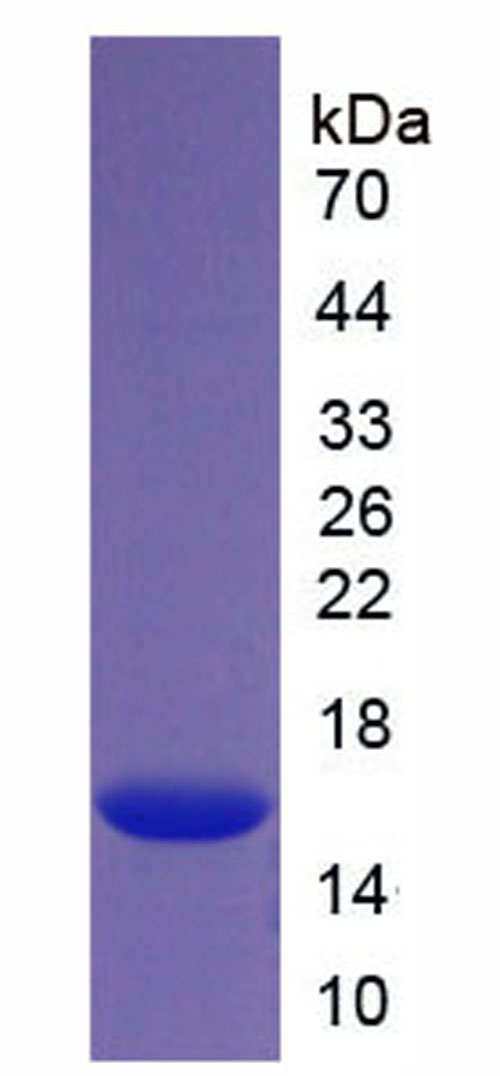
Histone H4 (H4) Recombinant Protein
For Research Use Only. Not for use in diagnostic procedures. Special Promotion Catalog #: MBS2031469SPECIAL PROMOTION: Get FREE Starbucks gift card (Maximum 5 gift cards/product). Gift card(s) will be included with shipment
MBS2031469 is a recombinant protein targeting H4. Also known as Recombinant Histone H4 (H4). Host: E ColiSource: Prokaryotic expression. More details
Product Overview
Online Datasheet in PDFProduct Name
Histone H4, Recombinant Protein
Full Product Name
Recombinant Histone H4 (H4)
Product Gene Name
H4 recombinant protein
Sequence
The target protein is fused with N-terminal His-Tag, its sequence is listed below.
MGHHHHHHS GSEF-SGRGK GGKG LGKGGAKRHR KVLRDNIQGI TKPAIRRLAR RGGVKRISGL IYEETRGVLK VFLENVIRDA VTYTEHAKRK TVTAMDVVYA LKRQGRTLYG FGG
MGHHHHHHS GSEF-SGRGK GGKG LGKGGAKRHR KVLRDNIQGI TKPAIRRLAR RGGVKRISGL IYEETRGVLK VFLENVIRDA VTYTEHAKRK TVTAMDVVYA LKRQGRTLYG FGG
Host
Host: E Coli
Source: Prokaryotic expression
Source: Prokaryotic expression
Form/Format
Supplied as lyophilized form in PBS, pH7.4, containing 5% trehalose, 0.01% sarcosyl.
Purity/Purification
>95%
Concentration
11.2 (lot specific)
Preparation and Storage
Storage: Avoid repeated freeze/thaw cycles. Store at 2-8 degree C for one month. Aliquot and store at -80 degree C for 12 months.
Stability Test: The thermal stability is described by the loss rate of the targetprotein. The loss rate was determined by accelerated thermal degradation test, that is, incubate the protein at 37 degree C for 48h, and no obvious degradation andprecipitation were observed. The loss of this protein is less than 5% within the expiration date under appropriate storage condition.
Stability Test: The thermal stability is described by the loss rate of the targetprotein. The loss rate was determined by accelerated thermal degradation test, that is, incubate the protein at 37 degree C for 48h, and no obvious degradation andprecipitation were observed. The loss of this protein is less than 5% within the expiration date under appropriate storage condition.
Matching Pairs
Unconjugated Antibody: H4 (MBS2027568)
Immunogen: H4 (MBS2031469)
Immunogen: H4 (MBS2031469)
Matching Pairs
APC-CY7 Conjugated Antibody: H4 (MBS2040554)
Immunogen: H4 (MBS2031469)
Immunogen: H4 (MBS2031469)
Molecular Weight
11,367 Da
OMIM
142750
Supply Chain Verification
Manufactured in a lab with traceable raw materials. Bulk orders can typically be prepared to the customer’s specifications, please inquire.
Predicted Molecular Mass
12.8kDa
Accurate Molecular Mass (KD)
16kDa
Endotoxin
<1.0EU per 1ug (determined by the LAL method)
Expression System
Prokaryotic expression
Tag
N-terminal His-Tag
Organism Species
Multi-species
Fragment
Ser2~Gly103
Usage
Reconstitute in sterile PBS, pH7.2-pH7.4.
ISO Certification
Manufactured in an ISO 9001:2015 and ISO 13485:2016 Certified Laboratory.
Applications Tested/Suitable for H4 recombinant protein
SDS-PAGE, Western Blot (WB), ELISA (EIA), Immunoprecipitation (IP)
Other Notes
Small volumes of H4 recombinant protein vial(s) may occasionally become entrapped in the seal of the product vial during shipment and storage. If necessary, briefly centrifuge the vial on a tabletop centrifuge to dislodge any liquid in the container`s cap. Certain products may require to ship with dry ice and additional dry ice fee may apply.
Additional Details
NCBI/Uniprot data below describe general gene information for H4. It may not necessarily be applicable to this product.
NCBI Official Full Name
histone H4
NCBI Official Synonym Full Names
histone cluster 4, H4
NCBI Official Symbol
HIST4H4
NCBI Official Synonym Symbols
H4/p
UniProt Protein Name
Histone H4
Protein Family
Antigen
UniProt Gene Name
HIST1H4A
UniProt Synonym Gene Names
H4/A; H4FA
UniProt Entry Name
H4_HUMAN
NCBI Protein Information
histone H4
NCBI Summary for H4
Histones are basic nuclear proteins that are responsible for the nucleosome structure of the chromosomal fiber in eukaryotes. Nucleosomes consist of approximately 146 bp of DNA wrapped around a histone octamer composed of pairs of each of the four core histones (H2A, H2B, H3, and H4). The chromatin fiber is further compacted through the interaction of a linker histone, H1, with the DNA between the nucleosomes to form higher order chromatin structures. This gene is intronless and encodes a replication-dependent histone that is a member of the histone H4 family. Transcripts from this gene lack polyA tails; instead, they contain a palindromic termination element. [provided by RefSeq, Aug 2015]
Show more UniProt Comments for H4
H4: histones are basic nuclear proteins that are responsible for the nucleosome structure of the chromosomal fiber in eukaryotes. Two molecules of each of the four core histones (H2A, H2B, H3, and H4) form an octamer, around which approximately 146 bp of DNA is wrapped in repeating units, called nucleosomes. The gene encoding H4 is intronless.
Protein type: DNA-binding
Chromosomal Location of Human Ortholog: 6p22.2
Cellular Component: nucleoplasm; nuclear chromosome; protein complex; membrane; extracellular region; nucleosome; nucleus
Molecular Function: protein binding; DNA binding; histone binding; protein heterodimerization activity
Biological Process: chromatin silencing at rDNA; establishment and/or maintenance of chromatin architecture; regulation of gene expression, epigenetic; DNA replication-dependent nucleosome assembly; negative regulation of megakaryocyte differentiation; nucleosome assembly; DNA replication-independent nucleosome assembly at centromere; DNA replication-independent nucleosome assembly; negative regulation of gene expression, epigenetic; protein heterotetramerization; gene expression; mitotic cell cycle; DNA methylation on cytosine; telomere maintenance
Show more Protein type: DNA-binding
Chromosomal Location of Human Ortholog: 6p22.2
Cellular Component: nucleoplasm; nuclear chromosome; protein complex; membrane; extracellular region; nucleosome; nucleus
Molecular Function: protein binding; DNA binding; histone binding; protein heterodimerization activity
Biological Process: chromatin silencing at rDNA; establishment and/or maintenance of chromatin architecture; regulation of gene expression, epigenetic; DNA replication-dependent nucleosome assembly; negative regulation of megakaryocyte differentiation; nucleosome assembly; DNA replication-independent nucleosome assembly at centromere; DNA replication-independent nucleosome assembly; negative regulation of gene expression, epigenetic; protein heterotetramerization; gene expression; mitotic cell cycle; DNA methylation on cytosine; telomere maintenance
Precautions
All of MyBioSource's Products are for scientific laboratory research purposes and are not for diagnostic, therapeutics, prophylactic or in vivo use. Through your purchase, you expressly represent and warrant to MyBioSource that you will properly test and use any Products purchased from MyBioSource in accordance with industry standards. MyBioSource and its authorized distributors reserve the right to refuse to process any order where we reasonably believe that the intended use will fall outside of our acceptable guidelines.
Disclaimer
While every efforts were made to ensure the accuracy of the information provided in this datasheet, MyBioSource will not be liable for any omissions or errors contained herein. MyBioSource reserves the right to make changes to this datasheet at any time without prior notice.
It is the responsibility of the customer to report product performance issues to MyBioSource within 30 days of receipt of the product. Please visit our Terms & Conditions page for more information.
It is the responsibility of the customer to report product performance issues to MyBioSource within 30 days of receipt of the product. Please visit our Terms & Conditions page for more information.
Product Note
Select online data sheet information is drawn from bioinformatics databases, occasionally resulting in ambiguous or non-relevant product information. It is the responsibility of the customer to review, verify, and evaluate the information to make sure it matches their requirements before purchasing the kit. Our ELISA Kit assays are dynamic research tools and sometimes they may be updated and improved. If the format of this assay is important to you then please request the current manual or contact our technical support team with a presales inquiry before placing an order. We will confirm the current details of the assay. We cannot guarantee the sample manual posted online is the most current manual, it is intended to serve as an example only. Please refer to the instructions For Use provided with the assay kit for precise details.
Product PubMed Publications
Pathways associated with H4 recombinant protein
| Products by Pathway | Pathway Diagram |
|---|---|
| Activated PKN1 Stimulates Transcription Of AR (androgen Receptor) Regulated Genes KLK2 And KLK3 Pathway antibodies | Activated PKN1 Stimulates Transcription Of AR (androgen Receptor) Regulated Genes KLK2 And KLK3 Pathway Diagram |
| Alcoholism Pathway antibodies | Alcoholism Pathway Diagram |
| Alcoholism Pathway antibodies | Alcoholism Pathway Diagram |
| Amyloids Pathway antibodies | Amyloids Pathway Diagram |
| Cell Cycle Pathway antibodies | Cell Cycle Pathway Diagram |
| Cell Cycle Checkpoints Pathway antibodies | Cell Cycle Checkpoints Pathway Diagram |
| Cell Cycle, Mitotic Pathway antibodies | Cell Cycle, Mitotic Pathway Diagram |
| Cellular Senescence Pathway antibodies | Cellular Senescence Pathway Diagram |
| Cellular Responses To Stress Pathway antibodies | Cellular Responses To Stress Pathway Diagram |
| Chromatin Modifying Enzymes Pathway antibodies | Chromatin Modifying Enzymes Pathway Diagram |