

STAT1 Leeporter HeLa Cell Line

Référence MBS668877-5x1
Conditionnement : 5x1Vial
Marque : MyBiosource
Contactez votre distributeur local :

Téléphone : +1 850 650 7790
STAT1 Leeporter HeLa Cell Line
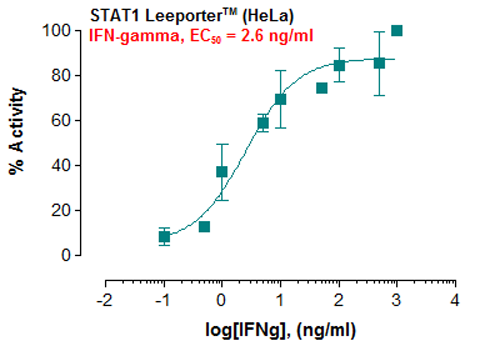
Fig-1: Induction of STAT1 activity by IFN-gamma in STAT1 Leeporter HeLa cells.
STAT1 Cell Line
For Research Use Only. Not for use in diagnostic procedures. Catalog #: MBS668877The STAT1 Leeporter cell line is a stably transfected HeLa cell line which expresses Renilla luciferase reporter gene under the transcriptional control of the interferon (IFN) gamma activation sequence-based STAT1 response element, so that the cell line is… More details
Product Overview
Online Datasheet in PDFProduct Name
STAT1, Cell Line
Full Product Name
STAT1 Leeporter HeLa Cell Line
Product Gene Name
STAT1 cell line
Form/Format
Each vial contains 2 ~ 3 x 10^6 cells in 1 ml of 90% FBS + 10% DMSO.
Preparation and Storage
Immediately upon receipt, store in liquid nitrogen.
Dry Ice Shipment: Extra charge fee may add to your shipping cost as dry ice is required to ship this product.
Shipping Note: Product is available for shipment in the United States, Canada and European countries. Please inquire for shipment to other countries.
Dry Ice Shipment: Extra charge fee may add to your shipping cost as dry ice is required to ship this product.
Shipping Note: Product is available for shipment in the United States, Canada and European countries. Please inquire for shipment to other countries.
Molecular Weight
87,197 Da
Dry Ice Shipment
Extra charge fee may add to your shipping cost as dry ice is required to ship this product.
Product Categories/Family for STAT1 cell line
Cell Lines; Reporter Cell Lines
Applications Tested/Suitable for STAT1 cell line
Functional Assay
Application Notes for STAT1 cell line
Monitor the STAT1 signaling pathway activity. Screen for activators or inhibitors of the STAT1 signaling pathway. Culture conditions: Cells should be grown at 37 degree C with 5% CO2 using DMEM medium supplemented with 10% FBS and 1% Pen/Strep, plus 3 ug/ml of Puromycin. It is recommended to quickly thaw the frozen cells upon receipt or from liquid nitrogen in a 37 degree C water-bath, transfer to a tube containing 10 ml of growth medium without Puromycin, spin down cells, resuspend cells in pre-warmed growth medium without Puromycin, transfer resuspended cells to T25 flask and culture in 37 degree C-CO2 incubator. Leave the T25 flask in the incubator for 2~4 days without disturbing or changing the medium until cells completely recover viability and become adherent. Once cells are over 90% adherent, remove growth medium and passage the cells through trypsinization and centrifugation. At first passage, switch to growth medium containing Puromycin. Cells should be split before they reach complete confluence. To passage the cells, detach cells from culture vessel with Trypsin/EDTA, add complete growth medium and transfer to a tube, spin down cells, resuspend cells and seed appropriate aliquots of cells suspension into new culture vessels. Subcultivation ration = 1: 10 to 1: 20 weekly. Functional validation: A. Response of STAT1 Leeporter- HeLa cells to IFN-gamma. 1. Harvest STAT1 Leeporter- HeLa cells and seed cells into a white solid-bottom 96-well microplate in 100 ul of growth medium at 5 x 10^4 cells/well. 2. Incubate cells at 37 degree C in a CO2 incubator for overnight. 3. The next day, stimulate cells with different concentrations of human IFN-gamma. 4. Incubate at 37 degree C in a CO2 incubator for 6-16 hours. 5. Add 30-50 ul of luciferase assay reagent per well. 6. Incubate at room temperature for 1-5 minutes and measure luminescence using a microplate luminometer.
Other Notes
Small volumes of STAT1 cell line vial(s) may occasionally become entrapped in the seal of the product vial during shipment and storage. If necessary, briefly centrifuge the vial on a tabletop centrifuge to dislodge any liquid in the container`s cap. Certain products may require to ship with dry ice and additional dry ice fee may apply.
Searchable Terms for STAT1 purchase
MBS668877 is a cell line targeting STAT1. Also known as STAT1 Leeporter HeLa Cell Line.
Additional Details
NCBI/Uniprot data below describe general gene information for STAT1. It may not necessarily be applicable to this product.
UniProt Related Accession #
NCBI Official Full Name
Stat1
NCBI Official Synonym Full Names
signal transducer and activator of transcription 1
NCBI Official Symbol
Stat1
NCBI Official Synonym Symbols
AA408197; 2010005J02Rik
UniProt Protein Name
Signal transducer and activator of transcription 1
Protein Family
Signal transducer and activator of transcription
UniProt Gene Name
Stat1
NCBI Protein Information
signal transducer and activator of transcription 1
UniProt Comments for STAT1
STAT1: transcription factor of the STAT family. Phosphorylated and activated by receptor-associated kinases downstream of certain receptor tyrosine kinases, GPCRs, and receptors for various interleukins and interferons. Forms homo- or heterodimers that translocate into the nucleus where they regulate transcription. Two alternatively spliced isoforms have been described.
Protein type: DNA-binding; Transcription factor
Chromosomal Location of Human Ortholog: 1 C1.1|1 26.81 cM
Cellular Component: axon; cell-cell adherens junction; cytoplasm; dendrite; nuclear chromatin; nucleolus; nucleoplasm; nucleus; perinuclear region of cytoplasm
Molecular Function: CCR5 chemokine receptor binding; DNA binding; double-stranded DNA binding; enzyme binding; nuclear hormone receptor binding; protein homodimerization activity; protein phosphatase 2A binding; sequence-specific DNA binding; transcription factor activity; tumor necrosis factor receptor binding
Biological Process: blood circulation; caspase activation; cellular response to insulin stimulus; cytokine and chemokine mediated signaling pathway; JAK-STAT cascade; lipopolysaccharide-mediated signaling pathway; negative regulation of angiogenesis; negative regulation of endothelial cell proliferation; negative regulation of I-kappaB kinase/NF-kappaB cascade; negative regulation of viral protein levels in host cell; positive regulation of cell proliferation; positive regulation of nitric-oxide synthase biosynthetic process; positive regulation of smooth muscle cell proliferation; positive regulation of transcription from RNA polymerase II promoter; positive regulation of transcription, DNA-dependent; response to bacterium; response to cAMP; response to cytokine stimulus; response to drug; response to exogenous dsRNA; response to lipopolysaccharide; response to mechanical stimulus; response to nutrient; response to peptide hormone stimulus; transcription, DNA-dependent; tumor necrosis factor-mediated signaling pathway
Show more Protein type: DNA-binding; Transcription factor
Chromosomal Location of Human Ortholog: 1 C1.1|1 26.81 cM
Cellular Component: axon; cell-cell adherens junction; cytoplasm; dendrite; nuclear chromatin; nucleolus; nucleoplasm; nucleus; perinuclear region of cytoplasm
Molecular Function: CCR5 chemokine receptor binding; DNA binding; double-stranded DNA binding; enzyme binding; nuclear hormone receptor binding; protein homodimerization activity; protein phosphatase 2A binding; sequence-specific DNA binding; transcription factor activity; tumor necrosis factor receptor binding
Biological Process: blood circulation; caspase activation; cellular response to insulin stimulus; cytokine and chemokine mediated signaling pathway; JAK-STAT cascade; lipopolysaccharide-mediated signaling pathway; negative regulation of angiogenesis; negative regulation of endothelial cell proliferation; negative regulation of I-kappaB kinase/NF-kappaB cascade; negative regulation of viral protein levels in host cell; positive regulation of cell proliferation; positive regulation of nitric-oxide synthase biosynthetic process; positive regulation of smooth muscle cell proliferation; positive regulation of transcription from RNA polymerase II promoter; positive regulation of transcription, DNA-dependent; response to bacterium; response to cAMP; response to cytokine stimulus; response to drug; response to exogenous dsRNA; response to lipopolysaccharide; response to mechanical stimulus; response to nutrient; response to peptide hormone stimulus; transcription, DNA-dependent; tumor necrosis factor-mediated signaling pathway
Research Articles on STAT1
Precautions
All of MyBioSource's Products are for scientific laboratory research purposes and are not for diagnostic, therapeutics, prophylactic or in vivo use. Through your purchase, you expressly represent and warrant to MyBioSource that you will properly test and use any Products purchased from MyBioSource in accordance with industry standards. MyBioSource and its authorized distributors reserve the right to refuse to process any order where we reasonably believe that the intended use will fall outside of our acceptable guidelines.
Disclaimer
While every efforts were made to ensure the accuracy of the information provided in this datasheet, MyBioSource will not be liable for any omissions or errors contained herein. MyBioSource reserves the right to make changes to this datasheet at any time without prior notice.
It is the responsibility of the customer to report product performance issues to MyBioSource within 30 days of receipt of the product. Please visit our Terms & Conditions page for more information.
It is the responsibility of the customer to report product performance issues to MyBioSource within 30 days of receipt of the product. Please visit our Terms & Conditions page for more information.
Product Note
Select online data sheet information is drawn from bioinformatics databases, occasionally resulting in ambiguous or non-relevant product information. It is the responsibility of the customer to review, verify, and evaluate the information to make sure it matches their requirements before purchasing the kit. Our ELISA Kit assays are dynamic research tools and sometimes they may be updated and improved. If the format of this assay is important to you then please request the current manual or contact our technical support team with a presales inquiry before placing an order. We will confirm the current details of the assay. We cannot guarantee the sample manual posted online is the most current manual, it is intended to serve as an example only. Please refer to the instructions For Use provided with the assay kit for precise details.
Product PubMed Publications
Pathways associated with STAT1 cell line
| Products by Pathway | Pathway Diagram |
|---|---|
| Adipogenesis Pathway antibodies | Adipogenesis Pathway Diagram |
| Antiviral Mechanism By IFN-stimulated Genes Pathway antibodies | Antiviral Mechanism By IFN-stimulated Genes Pathway Diagram |
| B Cell Receptor Signaling Pathway antibodies | B Cell Receptor Signaling Pathway Diagram |
| Chemokine Signaling Pathway antibodies | Chemokine Signaling Pathway Diagram |
| Chemokine Signaling Pathway antibodies | Chemokine Signaling Pathway Diagram |
| Chemokine Signaling Pathway antibodies | Chemokine Signaling Pathway Diagram |
| Cytokine Signaling In Immune System Pathway antibodies | Cytokine Signaling In Immune System Pathway Diagram |
| Disease Pathway antibodies | Disease Pathway Diagram |
| Downstream Signal Transduction Pathway antibodies | Downstream Signal Transduction Pathway Diagram |
| EGFR1 Signaling Pathway antibodies | EGFR1 Signaling Pathway Diagram |
Organs/Tissues associated with STAT1 cell line
| Organ/Tissue Name | Pubmed Publications |
|---|---|
| Blood Antibodies | >1532 publications with STAT1 and Blood |
| Liver Antibodies | >443 publications with STAT1 and Liver |
| Lung Antibodies | >338 publications with STAT1 and Lung |
| Bone Antibodies | >319 publications with STAT1 and Bone |
| Brain Antibodies | >290 publications with STAT1 and Brain |
| Bone Marrow Antibodies | >221 publications with STAT1 and Bone Marrow |
| Skin Antibodies | >204 publications with STAT1 and Skin |
| Kidney Antibodies | >177 publications with STAT1 and Kidney |
| Spleen Antibodies | >139 publications with STAT1 and Spleen |
| Intestine Antibodies | >112 publications with STAT1 and Intestine |