

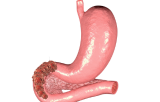
Duodenal cancers
Duodenal cancer is cancer of the early part of the small intestine. It is relatively rare compared with gastric cancer and colorectal cancer. Its histology is generally adenocarcinoma. Familial adenomatous polyposis (FAP), Gardner's syndrome, Lynch syndrome, Muir-Torre syndrome, celiac sprue, Puetz-Jeghers disease, Crohn's disease and juvenile polyposis syndrome are risk factors for developing this cancer. Although duodenal cancer is less common than other types of gastrointestinal cancer, it remains a complex and significant clinical entity. Originating in the duodenum, it is a pathology whose understanding raises a number of medical questions. This form of cancer, although less common than others in the gastrointestinal tract, remains a cause for concern. Originating in the cells of the wall of the duodenum,
The precise mechanisms that trigger its formation are complex, involving both genetic and environmental factors. An in-depth analysis of the molecular biology of this disease is crucial to guide future research.
Select the cells below to find the most commonly used cell lines for each of the specified cell types.