

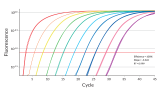
NGS Library quantification products
Accurate quantitation of the number of molecules in a library is the most critical step in the preparation steps for next-generation sequencing (NGS) to obtain high-quality reading data. Indeed, in order to obtain reliable and quality reading data, it is necessary to use a sufficient quantity of DNA, and in particular for Illumina® sequencing. The use of insufficient DNA will result in low sequencing efficiency and DNA overabundance will increase cluster density and result in poor quality data.
Standard methods of quantification of libraries for NGS, such as those based on electrophoresis or spectrophotometry, have low sensitivity, are not specific to the DNA bound to the adapter, and generally require a large amount of library samples for analysis. Quantitative PCR (qPCR) is considered to be the most accurate and efficient method of quantification of the library, providing consistency and reproducibility considerably higher than electrophoresis or spectrophotometry, which measure the total nucleic acid concentration. Amplification-based methods quantify only molecules that contain the two adapter sequences, thus providing a more accurate estimate of the concentration of the library molecules that can be sequenced.


Frequently Asked Questions (FAQ)
Where can I find ngs library quantification products on the Biovalley website?
ngs library quantification products are available in this section and can be sorted by product families or sub-categories, such as Master mix, Kits. You can browse the catalogue tree or use the search bar with a product name, catalogue reference, brand or supplier.
What types of products are available in the ngs library quantification category?
The ngs library quantification category brings together various product references, consumables, reagents, kits, instruments or laboratory solutions, depending on the relevant product family. The Master mix, Kits sub-categories allow you to find the products that meet your needs more quickly.
How can I quickly find a ngs library quantification product?
To find a ngs library quantification product, use the search function by name, product code, supplier, brand or sub-category. You can also browse the product families listed on the page to identify an available product code, an alternative or an equivalent product.
Does Biovalley stock several product codes in the ngs library quantification category?
Yes, Biovalley distributes several product references in the ngs library quantification category, sourced from specialist suppliers. Depending on the product family, references may vary in terms of format, packaging, brand, supplier, technical specifications or availability.
Can I request a quote for ngs library quantification products?
Yes, you can request a quote for ngs library quantification products from the product page or by contacting Biovalley (info@biovalley.fr). To help us process your enquiry, please provide, where possible, the product name, catalogue reference, required quantity, the supplier or brand you are looking for, and the country of delivery.
How can I find out if a ngs library quantification product is available to order?
The availability of a ngs library quantification product depends on the product code, supplier, packaging and country of delivery. For up-to-date information, please check the product details page or contact Biovalley with the product code or name of the product you are looking for.
What should I do if I cannot find the ngs library quantification product I am looking for?
If the ngs library quantification product you are looking for does not appear in the catalogue, please contact Biovalley with the available information: product name, reference number, supplier, brand, format or packaging. The team will be able to search for the reference number within its network of suppliers or suggest an available alternative.
Are all ngs library quantification products available under the same terms and conditions?
No. Ordering, delivery, storage and documentation conditions may vary depending on the product type, the supplier and the applicable regulations. Certain product codes may require specific approval, specialised transport, a safety data sheet or additional information prior to ordering.