

CCCP [555-60-2]

Cat# T7081-100mg
Size : 100mg
Brand : TargetMol
Contact local distributor :
 Phone : +1 850 650 7790
CCCP
(Synonyms: Carbonyl Cyanide m-Chlorophenylhydrazone, Carbonyl cyanide 3-chlorophenylhydrazone) Copy Product Info

CCCP (Carbonyl Cyanide m-Chlorophenylhydrazone) is an oxidative phosphorylation (OXPHOS) inhibitor and mitochondrial proton carrier uncoupler. CCCP inhibits the activation of STING and its downstream signaling molecules TBK1 and IRF3.
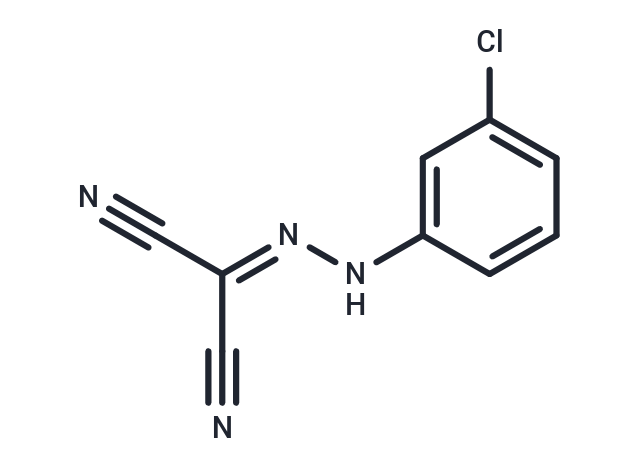
Cas No. 555-60-2
For research use only—not for human use. No sales to individuals. Use as intended only.
Select Batch
Purity:99.64%
Color:White to Yellow
Product Information
Bioactivity
Chemical Properties
Storage & Solubility Information
| Description | CCCP (Carbonyl Cyanide m-Chlorophenylhydrazone) is an oxidative phosphorylation (OXPHOS) inhibitor and mitochondrial proton carrier uncoupler. CCCP inhibits the activation of STING and its downstream signaling molecules TBK1 and IRF3. |
| Targets & IC50 | HepG2 cells:6 μM, HepG2 cells:9.8 μM, HepG2 cells:7.2 μM |
| In vitro | Method: Human cervical cancer cells HeLa were treated with CCCP (20 μM) for 30 min, and the effect on the mitochondria-labeled fluorescent dye DiOC6 was observed using live cell fluorescence microscopy. Result: CCCP-induced loss of mitochondrial membrane potential resulted in efflux of DiOC6 from mitochondria into the cytoplasm and subsequent localization to punctate structures. [1] Method: Mouse alveolar epithelial cells, MLE-12, were treated with CCCP (10-50 μM) for 2-18 h. The expression levels of the target proteins were examined by Western Blot. Result: CCCP caused a dose- and time-dependent conversion of LC3-I to LC3-II. [2] |
| In vivo | Method: To assay in vivo activity, CCCP (5 mg/kg) was administered as a single intraperitoneal injection to adult and aged C57BL/6J mice, and hearts were collected 12 h later. Result: Under CCCP-treated conditions, more mitochondria bound to autophagic vesicles were found in the hearts of adult but not aged mice. [3] Method: To assay in vivo activity, CCCP (1 mg/kg) was administered intraperitoneally to mt-Rosella mice once a day for three days. Result: Mitochondrial fragments were readily visible on the hearts of CCCP-treated mice, and these fragments were trapped in lysosomes for degradation.CCCP induced mitochondrial autophagy. [4] |
| Synonyms | Carbonyl Cyanide m-Chlorophenylhydrazone, Carbonyl cyanide 3-chlorophenylhydrazone |
| Molecular Weight | 204.62 |
| Formula | C9H5ClN4 |
| Cas No. | 555-60-2 |
| Smiles | ClC1=CC=CC(N\N=C(/C#N)C#N)=C1 |
| Relative Density. | 1.3807 g/cm3 (Estimated) |
| Storage | Store at low temperature Pure form: -20°C for 3 years | In solvent: -80°C for 1 year Shipping with blue ice/Shipping at ambient temperature. | ||||||||||||||||||||||||||||||||||||||||
| Solubility Information | DMSO: 252.5 mg/mL (1233.99 mM), Sonication is recommended.  Ethanol: 5 mg/mL (24.44 mM), Sonication is recommended. | ||||||||||||||||||||||||||||||||||||||||
| In Vivo Formulation | 10% DMSO+90% Saline: < 10 mg/mL (48.87 mM), Lower concentrations may be soluble, but exact solubility limit is unknown. 10% DMSO+40% PEG300+5% Tween 80+45% Saline: 6 mg/mL (29.32 mM), Suspension. 10% DMSO+40% PEG300+ 5% Tween 80 + 45% Saline: 10 mg/mL (48.87 mM), Solution. Please add the solvents sequentially, clarifying the solution as much as possible before adding the next one. Dissolve by heating and/or sonication if necessary. Working solution is recommended to be prepared and used immediately. The formulation provided above is for reference purposes only. In vivo formulations may vary and should be modified based on specific experimental conditions. | ||||||||||||||||||||||||||||||||||||||||
Solution Preparation Table | |||||||||||||||||||||||||||||||||||||||||
Ethanol/DMSO
DMSO
Note : The dilution table applies only to solid products. For liquid products, please calculate the stock solution based on the stated concentration and/or density. | |||||||||||||||||||||||||||||||||||||||||