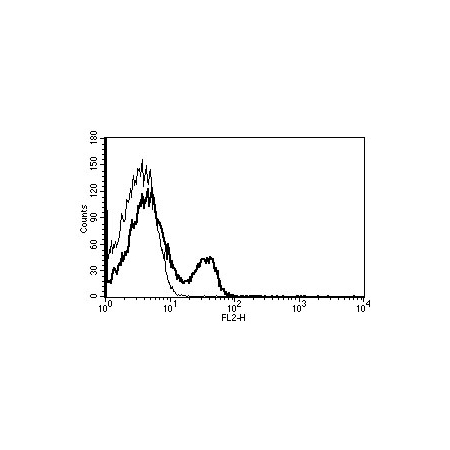
CD40 Antibody - Biotin Conjugated

Cat# OADB00192
Size : 1mL
Brand : Aviva Systems Biology
Contact local distributor :

Phone : +1 850 650 7790
CD40 Antibody - Biotin Conjugated (OADB00192)
| Datasheets/Manuals | Printable datasheet for anti-CD40 (OADB00192) antibody |
|---|
| Predicted Species Reactivity | Human |
|---|---|
| Product Format | Lyophilized |
| Clonality | Monoclonal |
| Clone | B-B20 |
| Isotype | Mouse IgG1 |
| Host | Human |
| Conjugation | Biotin |
| Application | FC |
| Reconstitution and Storage | Reconstitute with 1 mL deionised water Use 10 uL to label 106 cells or 100 uL of whole blood. Stable at +2-8C for six months after reconstitution. For longer storage, freeze aliquots |
| Purification | Ion exchange chromatography |
| Concentration | 100 tests/1mL |
| Preservative | Sodium Azide |
| Specificity | Recognises the Bp50 antigen, a 48 kDa protein |
| Formulation | Lyophilisated in phosphate-buffered saline with 1% BSA and 0.1% sodium azide |
| Storage Buffer | Lyophilisated in phosphate-buffered saline with 1% BSA and 0.1% sodium azide |
| Reference | Challa A. et al, BC12 Leucocyte Typing Workshop VI, Kobe (1996) Kotowvicz K. et al, BC12.1 Leucocyte Typing Workshop VI, Kobe (1996) Naito, A. et al., Proc Natl Acad Sci.,2002; 99(13): 8766-71. Vermot-Desroches C. et al, Immunology Letters 48 : 1-9 (1995) |
|---|---|
| Gene Symbol | CD40 |
| Gene Full Name | CD40 molecule |
| Alias Symbols | p50, Bp50, CDW40, TNFRSF5 |
| NCBI Gene Id | 958 |
| Protein Name | tumor necrosis factor receptor superfamily member 5 |
| Description of Target | This gene is a member of the TNF-receptor superfamily. The encoded protein is a receptor on antigen-presenting cells of the immune system and is essential for mediating a broad variety of immune and inflammatory responses including T cell-dependent immunoglobulin class switching, memory B cell development, and germinal center formation. AT-hook transcription factor AKNA is reported to coordinately regulate the expression of this receptor and its ligand, which may be important for homotypic cell interactions. Adaptor protein TNFR2 interacts with this receptor and serves as a mediator of the signal transduction. The interaction of this receptor and its ligand is found to be necessary for amyloid-beta-induced microglial activation, and thus is thought to be an early event in Alzheimer disease pathogenesis. Mutations affecting this gene are the cause of autosomal recessive hyper-IgM immunodeficiency type 3 (HIGM3). Multiple alternatively spliced transcript variants of this gene encoding distinct isoforms have been reported. |
| Uniprot ID | P25942 |
| Protein Accession # | NP_001241.1 |
| Nucleotide Accession # | NM_001250.5 |
| Molecular Weight | 31 kDa |