

CD68 (Macrophage Marker) Mouse Monoclonal Antibody

Cat# MBS438131-0,1mg-AZ
Size : 0.1mg(WithoutBSA&Azideat1mg/mL)
Brand : MyBiosource
Contact local distributor :
 Phone : +1 850 650 7790
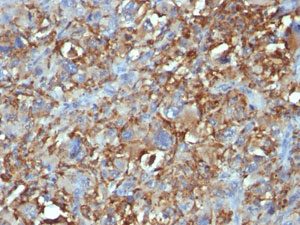
Formalin-fixed, paraffin-embedded human Histiocytoma stained with CD68 Monoclonal Antibody (C68/684).
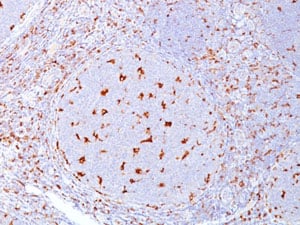
Formalin-fixed, paraffin-embedded human Tonsil stained with CD68 Monoclonal Antibody (C68/684).
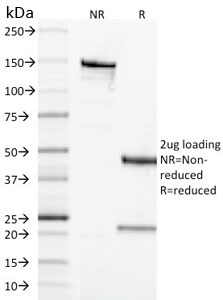
SDS-PAGE Analysis of Purified CD68 Monoclonal Antibody (C68/684).
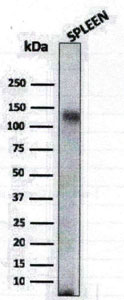
Western Blot Analysis of human Spleen tissue lysate using CD68 Monoclonal Antibody (C68/684).
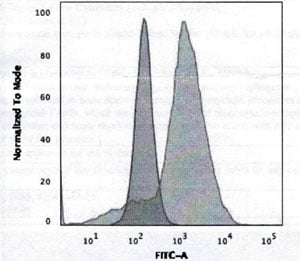
Flow Cytometric Analysis of U87MG cells using CD68 Monoclonal Antibody (C68/684); followed by goat anti-mouse IgG-CF488 (Blue); Isotype Control (Red).
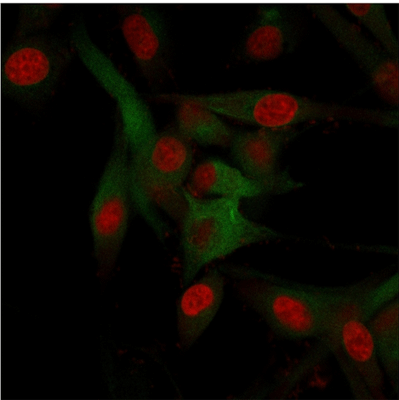
Immunofluorescence staining of U87MG cells using CD68 Mouse Monoclonal Antibody (C68/684) followed by goat anti-Mouse IgG conjugated to MBS4380777 (green). Nuclei are stained with Red dot
CD68 Antibody – Mouse Monoclonal
For Research Use Only. Not for use in diagnostic procedures. Catalog #: MBS438131This antibody recognizes a glycoprotein of 110kDa, which is identified as CD68. It is important for identifying macrophages in tissue sections. It stains macrophages in a wide variety of human tissues, including Kupffer cells and macrophages in the red pulp… More details
Product Overview
Product Name
CD68, Monoclonal Antibody
Full Product Name
CD68 (Macrophage Marker) Mouse Monoclonal Antibody
Product Gene Name
anti-CD68 antibody
Product Synonym Names
GP110, LAMP4, Microsialin, Macrosialin, SCARD1, Scavenger Receptor Class D Member-1
Clonality
Monoclonal
Isotype
IgG1, kappa
Clone Number
C68/684
Host
Mouse
Species Reactivity
Human, Monkey, Mouse, and Rat. Others not known.
Form/Format
200ug/ml of Ab purified from Bioreactor Concentrate by Protein A/G. Prepared in 10mM PBS with 0.05% BSA & 0.05% azide.
Preparation and Storage
Antibody with azide - store at 2 to 8 degree C. Non-hazardous. No MSDS required
Applications Tested/Suitable for anti-CD68 antibody
Western Blot (WB), Immunofluorescence (IF), Flow Cytometry (FC), Immunohistology (Formalin-fixed)
Application Notes for anti-CD68 antibody
Western blotting:
(2-4 ug/ml)
Immunofluorescence:
(1-2 ug/ml)
Flow Cytometry:
(1-2 ug/million cells)
Immunochemistry (Formalin-fixed):
(1-2 ug/ml for 30 minutes at RT)
(Staining of formalin-fixed tissues requires heating tissue sections in 10mM Tris with 1mM EDTA, pH 9.0, for 45 min at 95 degreeC followed by cooling at RT for 20 minutes)
Optimal dilution for a specific application should be determined.
(2-4 ug/ml)
Immunofluorescence:
(1-2 ug/ml)
Flow Cytometry:
(1-2 ug/million cells)
Immunochemistry (Formalin-fixed):
(1-2 ug/ml for 30 minutes at RT)
(Staining of formalin-fixed tissues requires heating tissue sections in 10mM Tris with 1mM EDTA, pH 9.0, for 45 min at 95 degreeC followed by cooling at RT for 20 minutes)
Optimal dilution for a specific application should be determined.
Immunofluorescence of anti-CD68 antibody
Immunofluorescence staining of U87MG cells using CD68 Mouse Monoclonal Antibody (C68/684) followed by goat anti-Mouse IgG conjugated to MBS4380777 (green). Nuclei are stained with Red dot
Product References and Citations for anti-CD68 antibody
Pulford KA et. al. Journal of Clinical Pathology, 1989, 42(4):414-21. Warnke RA et. al. Am J of Pathol, 1989, 135:1089-95.
Other Notes
Small volumes of anti-CD68 antibody vial(s) may occasionally become entrapped in the seal of the product vial during shipment and storage. If necessary, briefly centrifuge the vial on a tabletop centrifuge to dislodge any liquid in the container`s cap. Certain products may require to ship with dry ice and additional dry ice fee may apply.
Searchable Terms for CD68 purchase
MBS438131 is an antibody targeting CD68. Also known as CD68 (Macrophage Marker) Mouse Monoclonal Antibody. Reactive in Human, Monkey, Mouse, and Rat. Others not known.. Host: Mouse.
Additional Details
NCBI/Uniprot data below describe general gene information for CD68. It may not necessarily be applicable to this product.
NCBI Official Full Name
macrosialin isoform B
NCBI Official Synonym Full Names
CD68 molecule
NCBI Official Symbol
CD68
NCBI Official Synonym Symbols
GP110; LAMP4; SCARD1
UniProt Protein Name
Macrosialin
UniProt Synonym Protein Names
Gp110; CD_antigen: CD68
Protein Family
Macrosialin
UniProt Gene Name
CD68
UniProt Entry Name
CD68_HUMAN
NCBI Protein Information
macrosialin
NCBI Summary for CD68
This gene encodes a 110-kD transmembrane glycoprotein that is highly expressed by human monocytes and tissue macrophages. It is a member of the lysosomal/endosomal-associated membrane glycoprotein (LAMP) family. The protein primarily localizes to lysosomes and endosomes with a smaller fraction circulating to the cell surface. It is a type I integral membrane protein with a heavily glycosylated extracellular domain and binds to tissue- and organ-specific lectins or selectins. The protein is also a member of the scavenger receptor family. Scavenger receptors typically function to clear cellular debris, promote phagocytosis, and mediate the recruitment and activation of macrophages. Alternative splicing results in multiple transcripts encoding different isoforms. [provided by RefSeq, Jul 2008]
Show more UniProt Comments for CD68
CD68: Could play a role in phagocytic activities of tissue macrophages, both in intracellular lysosomal metabolism and extracellular cell-cell and cell-pathogen interactions. Binds to tissue- and organ-specific lectins or selectins, allowing homing of macrophage subsets to particular sites. Rapid recirculation of CD68 from endosomes and lysosomes to the plasma membrane may allow macrophages to crawl over selectin-bearing substrates or other cells. Belongs to the LAMP family. 2 isoforms of the human protein are produced by alternative splicing.
Protein type: Membrane protein, integral; Cell surface
Chromosomal Location of Human Ortholog: 17p13
Cellular Component: membrane
Show more Protein type: Membrane protein, integral; Cell surface
Chromosomal Location of Human Ortholog: 17p13
Cellular Component: membrane
Precautions
All of MyBioSource's Products are for scientific laboratory research purposes and are not for diagnostic, therapeutics, prophylactic or in vivo use. Through your purchase, you expressly represent and warrant to MyBioSource that you will properly test and use any Products purchased from MyBioSource in accordance with industry standards. MyBioSource and its authorized distributors reserve the right to refuse to process any order where we reasonably believe that the intended use will fall outside of our acceptable guidelines.
Disclaimer
While every efforts were made to ensure the accuracy of the information provided in this datasheet, MyBioSource will not be liable for any omissions or errors contained herein. MyBioSource reserves the right to make changes to this datasheet at any time without prior notice.
It is the responsibility of the customer to report product performance issues to MyBioSource within 30 days of receipt of the product. Please visit our Terms & Conditions page for more information.
It is the responsibility of the customer to report product performance issues to MyBioSource within 30 days of receipt of the product. Please visit our Terms & Conditions page for more information.
Product Note
Select online data sheet information is drawn from bioinformatics databases, occasionally resulting in ambiguous or non-relevant product information. It is the responsibility of the customer to review, verify, and evaluate the information to make sure it matches their requirements before purchasing the kit. Our ELISA Kit assays are dynamic research tools and sometimes they may be updated and improved. If the format of this assay is important to you then please request the current manual or contact our technical support team with a presales inquiry before placing an order. We will confirm the current details of the assay. We cannot guarantee the sample manual posted online is the most current manual, it is intended to serve as an example only. Please refer to the instructions For Use provided with the assay kit for precise details.
Product PubMed Publications
Products associated with anti-CD68 antibody
| Reference Product | PubMed Publications |
|---|---|
| CD34 antibody | >692 publications with CD68 and CD34 |
| CD163 antibody | >575 publications with CD68 and CD163 |
| CD36 antibody | >103 publications with CD68 and CD36 |
| PTPRC antibody | >31 publications with CD68 and PTPRC |
| ITGAM antibody | >21 publications with CD68 and ITGAM |
| EMR1 antibody | >17 publications with CD68 and EMR1 |
| ITGAX antibody | >4 publications with CD68 and ITGAX |
| EMR2 antibody | >1 publications with CD68 and EMR2 |
| CD8A antibody | >1 publications with CD68 and CD8A |
Pathways associated with anti-CD68 antibody
| Products by Pathway | Pathway Diagram |
|---|---|
| Lysosome Pathway antibodies | Lysosome Pathway Diagram |
| Lysosome Pathway antibodies | Lysosome Pathway Diagram |
Diseases associated with anti-CD68 antibody
| Disease Name | Pubmed Publications |
|---|---|
| Inflammation Antibodies | >2003 publications with CD68 and Inflammation |
| Cardiovascular Diseases Antibodies | >1076 publications with CD68 and Cardiovascular Diseases |
| Necrosis Antibodies | >1020 publications with CD68 and Necrosis |
| Disease Models, Animal Antibodies | >601 publications with CD68 and Disease Models, Animal |
| Fibrosis Antibodies | >567 publications with CD68 and Fibrosis |
| Lung Diseases Antibodies | >498 publications with CD68 and Lung Diseases |
| Kidney Diseases Antibodies | >432 publications with CD68 and Kidney Diseases |
| Atherosclerosis Antibodies | >421 publications with CD68 and Atherosclerosis |
| Liver Diseases Antibodies | >362 publications with CD68 and Liver Diseases |
| Adenocarcinoma Antibodies | >355 publications with CD68 and Adenocarcinoma |
Organs/Tissues associated with anti-CD68 antibody
| Organ/Tissue Name | Pubmed Publications |
|---|---|
| Blood Antibodies | >3184 publications with CD68 and Blood |
| Vascular Antibodies | >1568 publications with CD68 and Vascular |
| Muscle Antibodies | >1202 publications with CD68 and Muscle |
| Skin Antibodies | >1012 publications with CD68 and Skin |
| Bone Antibodies | >971 publications with CD68 and Bone |
| Brain Antibodies | >927 publications with CD68 and Brain |
| Liver Antibodies | >637 publications with CD68 and Liver |
| Lymph Node Antibodies | >598 publications with CD68 and Lymph Node |
| Kidney Antibodies | >570 publications with CD68 and Kidney |
| Lung Antibodies | >567 publications with CD68 and Lung |
You might also be interested by the following products:
Cat#
Description
Cond.
Price Bef. VAT
MBS438131-0,02mg-BSA-AZ
0.02mg(WithBSA&Azideat0.2mg/mL)