

CDK2 (Cyclin-dependent Kinase 2) (PE)

Cat# MBS6244487-0,1mL
Size : 0.1mL
Brand : MyBiosource
Contact local distributor :

Phone : +1 850 650 7790
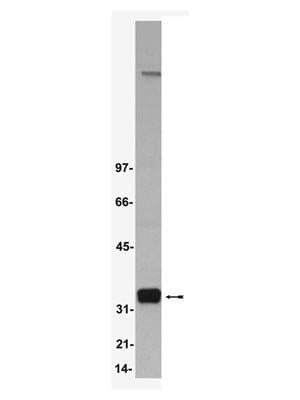
Western Blot: HeLa nuclear extract probed with C2572-07 (1ug/ml).
CDK2 Antibody – Mouse Monoclonal
For Research Use Only. Not for use in diagnostic procedures. Catalog #: MBS6244487MBS6244487 is an antibody targeting CDK2. Also known as CDK2 (Cyclin-dependent Kinase 2) (PE). Reactive in Human, Mouse, Xenopus. Host: Mouse. More details
Product Overview
Online Datasheet in PDFProduct Name
CDK2, Monoclonal Antibody
Full Product Name
CDK2 (Cyclin-dependent Kinase 2) (PE)
Product Gene Name
anti-CDK2 antibody
Clonality
Monoclonal
Isotype
IgG
Clone Number
4i33 (AN4.3)
Host
Mouse
Species Reactivity
Human, Mouse, Xenopus
Form/Format
Supplied as a liquid in PBS, pH 7.2. No preservative added. Labeled with R-Phycoerythrin (PE).
Purity/Purification
Purified by Protein G Affinity Chromatography
Specificity
Recognizes human cdk2, MW 33kD. Does not crossreact with other cdks. Species Crossreactivity: mouse and Xenopus.
Preparation and Storage
Store at 4 degree C. Do Not Freeze.
Applications Tested/Suitable for anti-CDK2 antibody
ELISA (EIA), Immunoprecipitation (IP), Western Blot (WB)
Other Notes
Small volumes of anti-CDK2 antibody vial(s) may occasionally become entrapped in the seal of the product vial during shipment and storage. If necessary, briefly centrifuge the vial on a tabletop centrifuge to dislodge any liquid in the container`s cap. Certain products may require to ship with dry ice and additional dry ice fee may apply.
Additional Details
NCBI/Uniprot data below describe general gene information for CDK2. It may not necessarily be applicable to this product.
NCBI Official Full Name
cyclin-dependent kinase 2 isoform 1
NCBI Official Synonym Full Names
cyclin-dependent kinase 2
NCBI Official Symbol
CDK2
NCBI Official Synonym Symbols
p33(CDK2)
UniProt Protein Name
Cyclin-dependent kinase 2
UniProt Synonym Protein Names
Cell division protein kinase 2; p33 protein kinase
Protein Family
Cyclin-dependent kinase
UniProt Gene Name
CDK2
UniProt Synonym Gene Names
CDKN2
UniProt Entry Name
CDK2_HUMAN
NCBI Protein Information
cyclin-dependent kinase 2; p33 protein kinase; cell devision kinase 2; cdc2-related protein kinase; cell division protein kinase 2
NCBI Summary for CDK2
The protein encoded by this gene is a member of the Ser/Thr protein kinase family. This protein kinase is highly similar to the gene products of S. cerevisiae cdc28, and S. pombe cdc2. It is a catalytic subunit of the cyclin-dependent protein kinase complex, whose activity is restricted to the G1-S phase, and essential for cell cycle G1/S phase transition. This protein associates with and regulated by the regulatory subunits of the complex including cyclin A or E, CDK inhibitor p21Cip1 (CDKN1A) and p27Kip1 (CDKN1B). Its activity is also regulated by its protein phosphorylation. Two alternatively spliced variants and multiple transcription initiation sites of this gene have been reported. [provided by RefSeq, Jul 2008]
Show more UniProt Comments for CDK2
CDK2: a protein kinase of the CDK family. An important component of the cell cycle machinery. Activity of CDK2 is maximal during S phase and G2. Cdk2/cyclin E kinase activity is important for the G1 to S transition and phosphorylates the Rb protein. In S-phase, active cdk2/cyclin A complexes predominate and phosphorylate E2F, and the active cdk2 complex persists in the nucleus through G2. Part of the Rb pathway disregulated in most tumors. Target of several candidate cancer drugs. However, inhibition does not always prevent cancer cell growth, possibly due to CDK redundancy. Inhibitors: BMS-265246, BMS-265246-01, R-roscovitine (CYC200, CYC202), SU9516, R547, L868276
Protein type: Protein kinase, CMGC; EC 2.7.11.22; Protein kinase, Ser/Thr (non-receptor); Cell cycle regulation; Kinase, protein; CMGC group; CDK family; CDK1 subfamily; CDK/CDK1 subfamily
Chromosomal Location of Human Ortholog: 12q13
Cellular Component: nucleoplasm; Y chromosome; Cajal body; centrosome; chromosome, telomeric region; transcription factor complex; X chromosome; cytoplasm; cyclin-dependent protein kinase holoenzyme complex; condensed chromosome; nucleus; cytosol; endosome
Molecular Function: cyclin binding; protein binding; cyclin-dependent protein kinase activity; metal ion binding; histone kinase activity; ATP binding
Biological Process: G1 DNA damage checkpoint; mitosis; meiosis; histone phosphorylation; positive regulation of transcription, DNA-dependent; DNA repair; DNA damage response, signal transduction by p53 class mediator resulting in cell cycle arrest; peptidyl-serine phosphorylation; regulation of ubiquitin-protein ligase activity during mitotic cell cycle; cell division; anaphase-promoting complex-dependent proteasomal ubiquitin-dependent protein catabolic process; Ras protein signal transduction; positive regulation of cell proliferation; mitotic cell cycle; blood coagulation; DNA replication; G2/M transition of mitotic cell cycle; centrosome duplication; potassium ion transport; positive regulation of DNA replication initiation; G1/S transition of mitotic cell cycle
Show more Protein type: Protein kinase, CMGC; EC 2.7.11.22; Protein kinase, Ser/Thr (non-receptor); Cell cycle regulation; Kinase, protein; CMGC group; CDK family; CDK1 subfamily; CDK/CDK1 subfamily
Chromosomal Location of Human Ortholog: 12q13
Cellular Component: nucleoplasm; Y chromosome; Cajal body; centrosome; chromosome, telomeric region; transcription factor complex; X chromosome; cytoplasm; cyclin-dependent protein kinase holoenzyme complex; condensed chromosome; nucleus; cytosol; endosome
Molecular Function: cyclin binding; protein binding; cyclin-dependent protein kinase activity; metal ion binding; histone kinase activity; ATP binding
Biological Process: G1 DNA damage checkpoint; mitosis; meiosis; histone phosphorylation; positive regulation of transcription, DNA-dependent; DNA repair; DNA damage response, signal transduction by p53 class mediator resulting in cell cycle arrest; peptidyl-serine phosphorylation; regulation of ubiquitin-protein ligase activity during mitotic cell cycle; cell division; anaphase-promoting complex-dependent proteasomal ubiquitin-dependent protein catabolic process; Ras protein signal transduction; positive regulation of cell proliferation; mitotic cell cycle; blood coagulation; DNA replication; G2/M transition of mitotic cell cycle; centrosome duplication; potassium ion transport; positive regulation of DNA replication initiation; G1/S transition of mitotic cell cycle
Research Articles on CDK2
Precautions
All of MyBioSource's Products are for scientific laboratory research purposes and are not for diagnostic, therapeutics, prophylactic or in vivo use. Through your purchase, you expressly represent and warrant to MyBioSource that you will properly test and use any Products purchased from MyBioSource in accordance with industry standards. MyBioSource and its authorized distributors reserve the right to refuse to process any order where we reasonably believe that the intended use will fall outside of our acceptable guidelines.
Disclaimer
While every efforts were made to ensure the accuracy of the information provided in this datasheet, MyBioSource will not be liable for any omissions or errors contained herein. MyBioSource reserves the right to make changes to this datasheet at any time without prior notice.
It is the responsibility of the customer to report product performance issues to MyBioSource within 30 days of receipt of the product. Please visit our Terms & Conditions page for more information.
It is the responsibility of the customer to report product performance issues to MyBioSource within 30 days of receipt of the product. Please visit our Terms & Conditions page for more information.
Product Note
Select online data sheet information is drawn from bioinformatics databases, occasionally resulting in ambiguous or non-relevant product information. It is the responsibility of the customer to review, verify, and evaluate the information to make sure it matches their requirements before purchasing the kit. Our ELISA Kit assays are dynamic research tools and sometimes they may be updated and improved. If the format of this assay is important to you then please request the current manual or contact our technical support team with a presales inquiry before placing an order. We will confirm the current details of the assay. We cannot guarantee the sample manual posted online is the most current manual, it is intended to serve as an example only. Please refer to the instructions For Use provided with the assay kit for precise details.
Product PubMed Publications
Products associated with anti-CDK2 antibody
| Reference Product | PubMed Publications |
|---|---|
| CDKN1A antibody | >1165 publications with CDK2 and CDKN1A |
| CDKN1B antibody | >1090 publications with CDK2 and CDKN1B |
| PCNA antibody | >323 publications with CDK2 and PCNA |
| CDC25A antibody | >220 publications with CDK2 and CDC25A |
| CDK7 antibody | >128 publications with CDK2 and CDK7 |
| SKP2 antibody | >118 publications with CDK2 and SKP2 |
| CCNA2 antibody | >72 publications with CDK2 and CCNA2 |
| CDC6 antibody | >70 publications with CDK2 and CDC6 |
| CCNE1 antibody | >56 publications with CDK2 and CCNE1 |
| RBL1 antibody | >53 publications with CDK2 and RBL1 |
Pathways associated with anti-CDK2 antibody
| Products by Pathway | Pathway Diagram |
|---|---|
| APC/C-mediated Degradation Of Cell Cycle Proteins Pathway antibodies | APC/C-mediated Degradation Of Cell Cycle Proteins Pathway Diagram |
| Activation Of ATR In Response To Replication Stress Pathway antibodies | Activation Of ATR In Response To Replication Stress Pathway Diagram |
| Activation Of The Pre-replicative Complex Pathway antibodies | Activation Of The Pre-replicative Complex Pathway Diagram |
| B Cell Receptor Signaling Pathway antibodies | B Cell Receptor Signaling Pathway Diagram |
| BARD1 Signaling Events Pathway antibodies | BARD1 Signaling Events Pathway Diagram |
| CDK-mediated Phosphorylation And Removal Of Cdc6 Pathway antibodies | CDK-mediated Phosphorylation And Removal Of Cdc6 Pathway Diagram |
| Cell Cycle Pathway antibodies | Cell Cycle Pathway Diagram |
| Cell Cycle Checkpoints Pathway antibodies | Cell Cycle Checkpoints Pathway Diagram |
| Cell Cycle, Mitotic Pathway antibodies | Cell Cycle, Mitotic Pathway Diagram |
| Cell Cycle Pathway antibodies | Cell Cycle Pathway Diagram |
Diseases associated with anti-CDK2 antibody
| Disease Name | Pubmed Publications |
|---|---|
| Neoplasms Antibodies | >1783 publications with CDK2 and Neoplasms |
| Breast Neoplasms Antibodies | >342 publications with CDK2 and Breast Neoplasms |
| Adenocarcinoma Antibodies | >253 publications with CDK2 and Adenocarcinoma |
| Neoplasms, Experimental Antibodies | >183 publications with CDK2 and Neoplasms, Experimental |
| Drug Toxicity Antibodies | >156 publications with CDK2 and Drug Toxicity |
| Liver Diseases Antibodies | >145 publications with CDK2 and Liver Diseases |
| Liver Neoplasms Antibodies | >137 publications with CDK2 and Liver Neoplasms |
| Prostatic Neoplasms Antibodies | >136 publications with CDK2 and Prostatic Neoplasms |
| Lung Neoplasms Antibodies | >120 publications with CDK2 and Lung Neoplasms |
| Carcinoma, Hepatocellular Antibodies | >119 publications with CDK2 and Carcinoma, Hepatocellular |
Organs/Tissues associated with anti-CDK2 antibody
| Organ/Tissue Name | Pubmed Publications |
|---|---|
| Lymph Node Antibodies | >31 publications with CDK2 and Lymph Node |
| Uterus Antibodies | >28 publications with CDK2 and Uterus |