

ECL Plus Western Blotting Substrate

Cat# MBS1753888-5x200mL
Size : 5x200mL
Brand : MyBiosource
Contact local distributor :

Phone : +1 850 650 7790
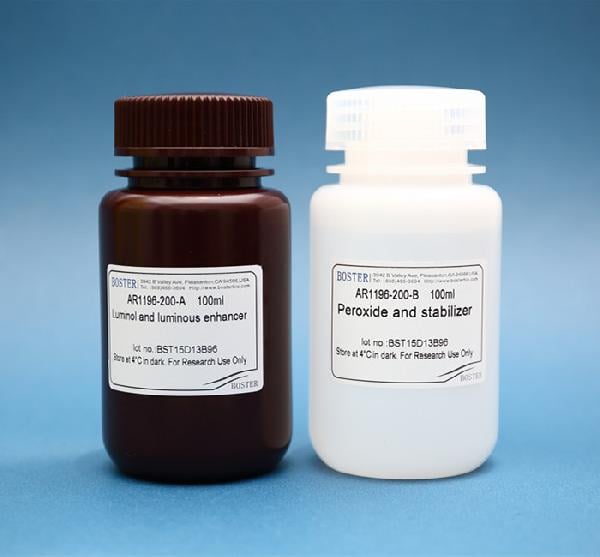
ECL Reagent – Assistive Reagent
For Research Use Only. Not for use in diagnostic procedures. Catalog #: MBS1753888ECL Plus Western Blotting Substrate is an ultra-sensitive, luminol-based chemiluminescent substrate for the detection of horseradish peroxidase (HRP) at high sensitivity levels (low picogram to mid-femtogram). More details
Product Overview
Online Datasheet in PDFProduct Name
ECL, Reagent
Full Product Name
ECL Plus Western Blotting Substrate
Form/Format
Reagent A and B solutions
Preparation and Storage
Upon receipt store ECL Plus Western Blotting Substrate at 4 degree C. Protect from light. It is stable at 4 degree C for one year.
Detection Method
Chemiluminescent
Substrate Type
HRP (Horseradish Peroxidase) Substrate
Assay Principle
ECL Plus Western Blotting Substrate is an ultra-sensitive, luminol-based chemiluminescent substrate for the detection of horseradish peroxidase (HRP) at high sensitivity levels (low picogram to mid-femtogram). Western Blotting Substrate may be used for immunoblots, western blots, dot blots and any blotting application utilizing horseradish peroxidase (HRP)-conjugates. The substrate can be used with various blocking buffers and on nitrocellulose or PVDF membranes. Such blots will exhibit low backgrounds. Produced chemiluminescence can be visualized on CCD imaging systems or x-ray film.
Additional Materials Required
1. Nitrocellulose or PVDF membranes
2. X-ray film or an imaging system
3. Rotary platform shaker for agitation of membrane during incubations
4. Wash Buffer: PBS or TBS containing 0.05-0. 1% Tween-20 (PBS: 10mM Na3PO4, 150mM NaCl, pH7. 2; TBS: 10mM Tris, 150mM NaCl, pH7. 4)
5. Blocking Buffer: Add some blocking medium (e. g. casein, BSA or non-fat milk) into the Wash Buffer for a final blocking medium concentration of 1-5% (w/v)
6. Primary Antibody: Choose an antibody specific to the target proteins. Prepare the antibody stock solution in Wash Buffer or Blocking Buffer
7. HRP-conjugated Secondary Antibody: Choose a HRP-conjugated Secondary Antibody that specifically binds to the primary antibody.
Important Product Information
For optimal results, use a shaking platform during incubation steps.
Do not use sodium azide as a preservative for buffers. Sodium azide is an inhibitor of HRP.
Do not handle the membrane with bare hands. Always wear gloves or use clean forceps.
All equipment must be clean and free of foreign material. Metallic devices must have no visible signs of rust. Rust may cause speckling and high background.
Exposure to the sun or any other intense light can harm the substrate. For best results keep the substrate working solution in an amber bottle and avoid prolonged exposure to any intense light. Short-term exposure to typical laboratory lighting will not harm the working solution.
Empirical testing is essential to determine the appropriate blocking reagent for each Western blot system, as cross reactivity of the blocking reagent with antibodies can cause nonspecific signal and varying system sensitivity.
When using avidin/biotin systems, avoid using milk as a blocking reagent as milk contains variable amounts of endogenous biotin, which causes high background signal.
Use sufficient volumes of wash buffer, blocking buffer, antibody solution and substrate working solution to cover the blot and ensure that it never becomes dry. Using large blocking and wash buffer volumes minimizes nonspecific signal.
Add Tween 20 Detergent (final concentration of 0.05-0.1%) to the blocking buffer and all diluted antibody solutions to minimize nonspecific signal.
Do not use polystyrene vessels to mix and prepare the substrate working solution; this type of plastic causes the solution to become cloudy and produce a precipitate.
Use new pipette tips separately while pipetting reagent A and B to avoid cross contamination.
Assay Protocol
1. Remove blot from the transfer apparatus and wash membrane with Wash Buffer 3 times for 5 minutes each.
2. Block nonspecific sites with Blocking Buffer for 60 minutes at room temperature with shaking.
3. Remove the blocking buffer and add the primary antibody working solution. Incubate blot for 1 hour at room temperature with shaking or overnight at 2-8 degree C with shaking.
4. Suspend membrane in Wash buffer and agitate for more than 5 minutes. Replace Wash Buffer at least 4-6 times. Increasing the volume of Wash Buffer, the numbers of washes and wash duration may help minimize background signal.
5. Incubate blot with the HRP conjugated secondary antibody working solution for 1 hour at room temperature with shaking.
6. Repeat Step 3 to remove nonbound HRP conjugate.
Note: The membrane must be thoroughly washed after incubation with the HRP conjugate.
7. Prepare the substrate working solution by mixing Reagent A and Reagent B at 1:1. Use 0. 1mL working solution per cm 2 of membrane.
8. Incubate blot with working solution for 1-5 minutes at room temperature.
9. Place blot in a clear plastic wrap or transparent plastic sheet protector. Use an absorbent tissue to remove excess liquid and carefully press out any bubbles from between the blot and the membrane protector.
10. Place the protected membrane in a film cassette with the protein side facing up.
11. Place X-ray film on top of the blot membrane. Perform a exposure of 1 minute, Vary the exposure time to achieve optimal results. Light emission is most intense during the first 5-30 minutes after substrate incubation.
Note: CCD detection: Put the blot membrane in the CCD and detect the chemiluminescence image according to the manufacturers' instructions.
12. Develop and fix the film.
Troubleshooting
Problem/ Possible Cause/ Solution:
*Blot glows in the dark room. Membrane has brown or yellow bands. Signal fades quickly
Too much HRP in the system
Dilute HRP conjugate further
*Weak or no signal
Used insufficient quantities of antigen or antibodies. Insufficient protein transfer. Low HRP or substrate activity
Increase the amount of antigen or antibodies. Optimize transfer condition. Replace the secondary antibody or substrate
*High Background
Too much HRP in the system. Inadequate blocking or used inappropriate blocking buffer. Insufficient washing. Use too much antigen or antibodies. Use non-specific primary antibody. Overexposed film
Dilute HRP-conjugate further. Optimize blocking conditions. Increase duration, number and volume of washes. Decrease the amount of antigen or antibodies. Replace the antibody. Decrease exposure time
*Spots within the protein bands
Ineffective protein transfer. Unevenly hydrated membrane. Bubble between X-ray film and membrane
Optimize transfer procedure. Replace the membrane. Remove all bubbles before exposing blot to film
*Speckled background
Inadequate blocking
Optimize blocking conditions
*Nonspecific bands
Too much HRP in the system. SDS caused nonspecific binding to protein. Use non-specific primary antibody. Inadequate blocking
Dilute HRP conjugate further. Do not use SDS. Replace the antibody. Optimize blocking conditions
Notes
Type of ECL Western Blotting Substrate/ Sensitivity Level
Hypersensitive ECL Chemiluminescent Substrate/ low picogram
ECL Plus Western Blotting Substrate/ low-picogram to mid-femtogram level
Hypersensitive ECL Chemiluminescent Substrate/ low picogram
ECL Plus Western Blotting Substrate/ low-picogram to mid-femtogram level
Product Categories/Family for ECL reagent
Assistive Reagent
ISO Certification
Manufactured in an ISO 13485:2003 and EN ISO 13485:2012 Certified Laboratory.
Application Notes for ECL reagent
To detect antigen at low-picogram to mid-femtogram level by reacting with horseradish peroxidase.
Other Notes
Small volumes of ECL reagent vial(s) may occasionally become entrapped in the seal of the product vial during shipment and storage. If necessary, briefly centrifuge the vial on a tabletop centrifuge to dislodge any liquid in the container`s cap. Certain products may require to ship with dry ice and additional dry ice fee may apply.
Searchable Terms for ECL purchase
MBS1753888 is a reagent targeting ECL. Also known as ECL Plus Western Blotting Substrate.
Additional Details
NCBI/Uniprot data below describe general gene information for ECL. It may not necessarily be applicable to this product.
Protein Family
Eclosion hormone
Precautions
All of MyBioSource's Products are for scientific laboratory research purposes and are not for diagnostic, therapeutics, prophylactic or in vivo use. Through your purchase, you expressly represent and warrant to MyBioSource that you will properly test and use any Products purchased from MyBioSource in accordance with industry standards. MyBioSource and its authorized distributors reserve the right to refuse to process any order where we reasonably believe that the intended use will fall outside of our acceptable guidelines.
Disclaimer
While every efforts were made to ensure the accuracy of the information provided in this datasheet, MyBioSource will not be liable for any omissions or errors contained herein. MyBioSource reserves the right to make changes to this datasheet at any time without prior notice.
It is the responsibility of the customer to report product performance issues to MyBioSource within 30 days of receipt of the product. Please visit our Terms & Conditions page for more information.
It is the responsibility of the customer to report product performance issues to MyBioSource within 30 days of receipt of the product. Please visit our Terms & Conditions page for more information.
Product Note
Select online data sheet information is drawn from bioinformatics databases, occasionally resulting in ambiguous or non-relevant product information. It is the responsibility of the customer to review, verify, and evaluate the information to make sure it matches their requirements before purchasing the kit. Our ELISA Kit assays are dynamic research tools and sometimes they may be updated and improved. If the format of this assay is important to you then please request the current manual or contact our technical support team with a presales inquiry before placing an order. We will confirm the current details of the assay. We cannot guarantee the sample manual posted online is the most current manual, it is intended to serve as an example only. Please refer to the instructions For Use provided with the assay kit for precise details.