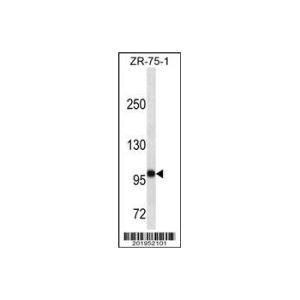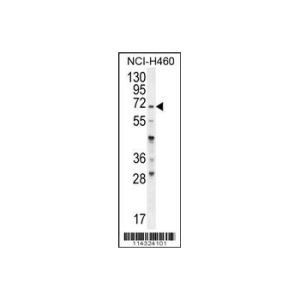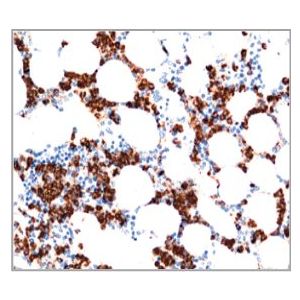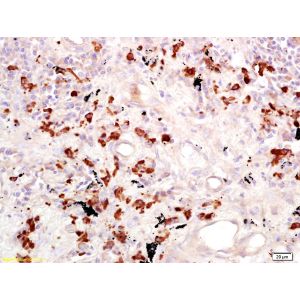

FUT4 Antibody

Cat# OAEE00652
Size : 100tests(T100)
Brand : Aviva Systems Biology
Contact local distributor :
 Phone : +1 850 650 7790

| Datasheets/Manuals | Printable datasheet for FUT4 Antibody |
|---|
| Predicted Species Reactivity | Bovine|Human|Porcine|Sheep |
|---|---|
| Product Format | Stabilizing Tris buffered saline (TBS), pH 8.0, 15 mM sodium azide |
| Clonality | Monoclonal |
| Clone | MEM-158 |
| Isotype | IgM |
| Host | Mouse |
| Conjugation | PerCP |
| Application | FC |
| Reconstitution and Storage | 2°C to 8°C |
| Immunogen | Human granulocytes |
| Purification | Purified by size-exclusion chromatography |
| Concentration | 10 ul / test |
| Specificity | The antibody MEM-158 reacts with CD15, a cell membrane molecule 3-fucosyl-N-acetyllactosamine (3-FAL) strongly expressed on granulocytes, monocytes, macrophages, mast cells; it is also present on Langerhans cells and some myeloid precursors cells. HLDA VI; WS Code AS A053 |
| Formulation | PerCP |
| Storage Buffer | The reagent is provided in phosphate buffered saline (PBS) containing 15 mM sodium azide and 0.2% (w/v) high-grade protease free Bovine Serum Albumin (BSA) as a stabilizing agent. |
| Reference | Leukocyte Typing VI., Kishimoto T. et al. (Eds.), Garland Publishing Inc. (1997). Li C, Wong P, Pan T, Xiao F, Yin S, Chang B, Kang SC, Ironside J, Sy MS: Normal cellular prion protein is a ligand of selectins: binding requires Le(X) but is inhibited by sLe(X). Biochem J. 2007 Sep 1;406(2):333-41. Hakomori S: Le(X) and related structures as adhesion molecules. Histochem J. 1992 Nov;24(11):771-6. Benharroch D, Dima E, Levy A, Ohana-Malka O, Ariad S, Prinsloo I, Mejirovsky E, Sacks M, Gopas J: Differential expression of sialyl and non-sialyl-CD15 antigens onHodgkin-Reed-Sternberg cells: significance in Hodgkin's disease. Leuk Lymphoma. 2000 Sep;39(1-2):185-94. |
|---|---|
| Gene Symbol | FUT4 |
| Gene Full Name | Alpha-(1,3)-fucosyltransferase 4 |
| Alias Symbols | LeX, CD15, ELFT, FCT3A, FUTIV, SSEA-1, FUC-TIV |
| NCBI Gene Id | 2526 |
| Protein Name | Alpha-(1,3)-fucosyltransferase 4 |
| Uniprot ID | P22083 |
| Protein Accession # | NP_002024.1 |
| Nucleotide Accession # | NM_002033.3 |