

Heat Shock Protein 65, Recombinant, Mycobacterium bovis BCG (HSP65)

Cat# H1830-89B-100ug
Size : 100ug
Brand : US Biological
Contact local distributor :
 Phone : +1 850 650 7790
H1830-89B Heat Shock Protein 65, Recombinant, Mycobacterium bovis BCG (HSP65)
Swiss Prot
P0A521Grade
PurifiedApplications
E WBShipping Temp
Blue IceStorage Temp
-20°CHsp65 isolated from Mycobacterium bovis BCG, is a member of the hsp60 family of heat shock proteins (2, 3). Hsp60s are mitochondrial chaperonins that are typically held responsible for the transportation and refolding of proteins from the cytoplasm into the mitochondrial matrix. In addition to its role as a heat shock protein, Hsp60 functions as a chaperonin to assist in folding linear amino acid chains into their respective three-dimensional structure. Hsp60s are a ubiquitous class of HSPs that specifically promote the folding and assembly of cellular polypeptides in an ATP-dependent manner (1). Specifically, sequence comparison of Hsp65 from different mycobacterium strains showed that the protein sequence of M. bovis BCG is identical to that of M. tuberculosis, and very similar to that of M. leprae, the pathogens that cause tuberculosis and tuberculoid leprosy, respectively (2,4). Mycobacterium bovis BCG Hsp65 was identified as the immunodominant antigen during mycobacterial diseases and vaccination. It is also believed to be the antigen that induces autoimmune disease, such as adjuvant arthritis in rats (5, 6).
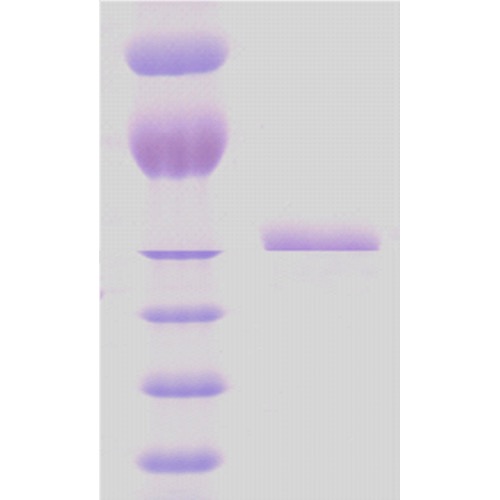
Fulll length recombinant protein corresponding to Mycobacterium bovis HSP65 expressed in E.coli.
Amino Acid Sequence:
MAKTIAYDEEARRGLERGLNALADAVKVTLGPKGRNVVLEKKWG APTITNDGVSIAKEIELEDPYEKIGAELVKEVAKKTDDVAGDGTTTATVLAQALVREG LRNVAAGANPLGLKRGIEKAVEKVTETLLKGAKEVETKEQIAATAAISAGDQSIGDLI AEAMDKVGNEGVITVEESNTFGLQLELTEGMRFDKGYISGYFVTDPERQEAVLEDPYI LLVSSKVSTVKDLLPLLEKVIGAGKPLLIIAEDVEGEALSTLVVNKIRGTFKSVAVKA PGFGDRRKAMLQDMAILTGGQVISEEVGLTLENADLSLLGKARKVVVTKDETTIVEGA GDTDAIAGRVAQIRQEIENSDSDYDREKLQERLAKLAGGVAVIKAGAATEVELKERKH RIEDAVRNAKAAVEEGIVAGGGVTLLQAAPTLDELKLEGDEATGANIVKVALEAPLKQ IAFNSGLEPGVVAEKVRNLPAGHGLNAQTGVYEDLLAAGVADPVKVTRSALQNAASIA GLFLTTEAVVADKPEKEKASVPGGGDMGGMDF
Applications:
Suitable for use in ELISA, Functional Assays, SDS-PAGE and Western Blot. Other applications not tested.
Recommended Dilution:
Optimal dilutions to be determined by the researcher.
Storage and Stability:
May be stored at 4°C for short-term only. Aliquot to avoid repeated freezing and thawing.. Store at -20°C. Aliquots are stable for 6 months after receipt at -20°C. For maximum recovery of product, centrifuge the original vial after thawing and prior to removing the cap. Further dilutions can be made in assay buffer.