



ChIP
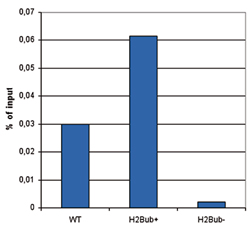
ChIP assays were performed using sheared chromatin from WT yeast cells. Yeast cells with higher steady state levels of H2BK123ub and yeast cells with no ubiquitinylated H2B. Quantitative PCR was performed with primers for the coding region of an active gene. The figure shows the recovery, expressed as a % of input (the relative amount of immunoprecipitated DNA compared to input DNA after qPCR analysis).
ChIP
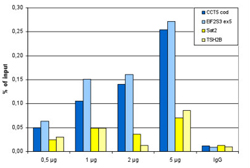
ChIP assays were performed using human HeLa cells. A titration of the antibody consisting of 0.5, 1, 2 and 5 ug per ChIP experiment was analysed. IgG (1 ug/IP) was used as negative IP control. QPCR was performed with primers for the coding regions of the active CCT5 and EIF2S3 genes, used as positive controls, and for the inactive TSH2B gene and the Sat2 satellite repeat region used as negative controls. The figure shows the recovery, expressed as a % of input (the relative amount of immunoprecipitated DNA compared to input DNA after qPCR analysis).
ChIP-Seq
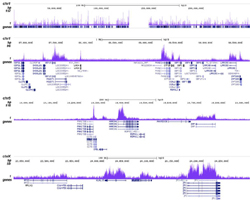
ChIP was performed with 2 ug of antibody. The figure shows the peak distribution along the complete sequence and a 3 Mb region of human chromosome 1 and in two genomic regions surrounding the CCT5 and EIF2S3 positive control genes.
- Specifications
Product Description
Mouse monoclonal antibody raised against synthetic peptide of Histone H2B (K123ub).
Immunogen
A synthetic peptide (conjugated with KLH) corresponding to yeast histone H2B, ubiquitinylated at lysine 123.
Host
Mouse
Reactivity
Human, Yeast
Form
Liquid
Purification
Affinity purification
Isotype
IgG1
Recommend Usage
Western Blot (1:500)
ChIP (2 ug/CHIP)
The optimal working dilution should be determined by the end user.Storage Buffer
In PBS (0.02% sodium azide).
Storage Instruction
Store at -20°C. For long term storage store at -80°C.
Aliquot to avoid repeated freezing and thawing. - Applications
ChIP
ChIP assays were performed using sheared chromatin from WT yeast cells. Yeast cells with higher steady state levels of H2BK123ub and yeast cells with no ubiquitinylated H2B. Quantitative PCR was performed with primers for the coding region of an active gene. The figure shows the recovery, expressed as a % of input (the relative amount of immunoprecipitated DNA compared to input DNA after qPCR analysis).ChIP
ChIP assays were performed using human HeLa cells. A titration of the antibody consisting of 0.5, 1, 2 and 5 ug per ChIP experiment was analysed. IgG (1 ug/IP) was used as negative IP control. QPCR was performed with primers for the coding regions of the active CCT5 and EIF2S3 genes, used as positive controls, and for the inactive TSH2B gene and the Sat2 satellite repeat region used as negative controls. The figure shows the recovery, expressed as a % of input (the relative amount of immunoprecipitated DNA compared to input DNA after qPCR analysis).ChIP-Seq
ChIP was performed with 2 ug of antibody. The figure shows the peak distribution along the complete sequence and a 3 Mb region of human chromosome 1 and in two genomic regions surrounding the CCT5 and EIF2S3 positive control genes.Western Blot
Western Blot (Cell lysate) analysis of 15 ug histone extracts of HeLa cells.Western Blot
Western Blot (Cell lysate) analysis of (1) whole cell extracts of WT yeast cells, (2) yeast cells with higher steady state levels of H2BK123ub, (3) none ubiquitinylated H2B, and (4) ubiquitinylated H2A.