

Biovalley > HLA-G Antibody
HLA-G Antibody

Cat# OAEE00443
Size : 0.1mg(C100)
Contact local distributor :

Phone : +1 850 650 7790
Brand : Aviva Systems Biology
Contact local distributor :
Phone : +1 850 650 7790
| Datasheets/Manuals | Printable datasheet for HLA-G Antibody |
|---|
| Predicted Species Reactivity | Human|Mouse|Rat |
|---|---|
| Product Format | Phosphate buffered saline (PBS), pH 7.4, 15 mM sodium azide |
| Clonality | Monoclonal |
| Clone | 87G |
| Isotype | IgG2a |
| Host | Mouse |
| Conjugation | Biotin |
| Application | ELISA|FC|IHC-Fr |
| Reconstitution and Storage | 2°C to 8°C |
| Immunogen | HLA-B27 transgenic mice were imunized with H-2 identical murine cells transfected with and expressing genes encoding HLA-G and human beta2-microglobulin. |
| Purification | Purified by size-exclusion chromatography |
| Concentration | 1 mg/ml |
| Specificity | The antibody 87G recognizes both membrane-bound and soluble forms of HLA-G (HLA-G1 and HLA-G5). HLA-G belongs to the MHC Class I molecules (MHC Class Ib; nonclassical) and it is expressed on the surface of trophoblast cells. The antibody 87G blocks interaction of HLA-G with inhibitory receptors. |
| Formulation | Biotin |
| Storage Buffer | Phosphate buffered saline (PBS) with 15 mM sodium azide, approx. pH 7.4 |
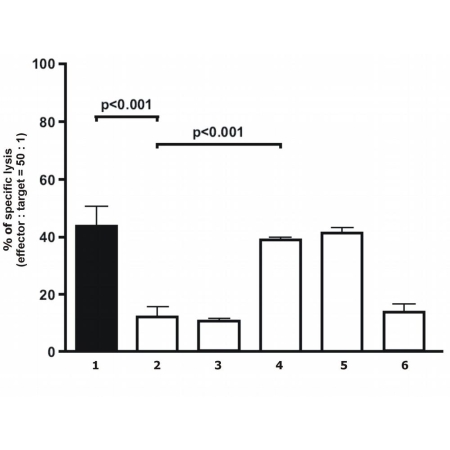
| Reference | Menier C, Saez B, Horejsi V, Martinozzi S, Krawice-Radanne I, Bruel S, Le Danff C, Reboul M, Hilgert I, Rabreau M, Larrad ML, Pla M, Carosella ED, Rouas-Freiss N: Characterization of monoclonal antibodies recognizing HLA-G or HLA-E: new tools to analyze the expression of nonclassical HLA class I molecules. Hum Immunol. 2003 Mar;64(3):315-26. Wiendl H: The non-classical MHC molecule HLA-G protects human muscle cells from immune-mediated lysis: implications for myoblast transplantation and gene therapy. Brain. 126(Pt 1), 176 (2003). LeMaoult J, Caumartin J, Daouya M, Favier B, Le Rond S, Gonzalez A, Carosella ED: Immune regulation by pretenders: cell-to-cell transfers of HLA-G make effector T cells act as regulatory cells. Blood. 2007 Mar 1;109(5):2040-8. Rouas-Freiss N, Moreau P, Ferrone S, Carosella ED: HLA-G proteins in cancer: do they provide tumor cells with an escape mechanism? Cancer Res. 2005 Nov 15;65(22):10139-44. Ishitani A. et al.: Protein Expression and Peptide Binding Suggest Unique and Interacting Functional Roles for HLA-E, F and G in Maternal-Placental Immune Recognitions. The Journal of Immunology 171, 1376 (2003). Shobu T, Sageshima N, Tokui H, Omura M, Saito K, Nagatsuka Y, Nakanishi M, Hayashi Y, Hatake K, Ishitani A: The surface expression of HLA-F on decidual trophoblasts increases from mid to term gestation. J Reprod Immunol. 2006 Dec;72(1-2):18-32. Hackmon R, Hallak M, Krup M, Weitzman D, Sheiner E, Kaplan B, Weinstein Y: HLA-G antigen and parturition: maternal serum, fetal serum and amniotic fluid levels during pregnancy. Fetal Diagn Ther. 2004 Sep-Oct;19(5):404-9. Polakova K, Krcova M, Kuba D, Russ G: Analysis of HLA-G expression in malignant hematopoetic cells from leukemiapatients. Leuk Res. 2003 Jul;27(7):643-8. Polakova K, Bandzuchova E, Hofmeister V, Weiss EH, Hutter H, Russ G: Binding analysis of HLA-G specific antibodies to hematopoietic cells isolated from leukemia patients. Neoplasma. 2003;50(5):331-8. Sageshima N, Ishitani A, Omura M, Akasaki M, Umekage H, Katabuchi H, Okamura H, Hatake K: Necrotic feature of the trophoblasts lacking HLA-G expression in normal andpre-eclamptic placentas. Am J Reprod Immunol. 2003 Mar;49(3):174-82. Riteau B. et al.: HLA-G1 co-expression boosts the HLA class I-mediated NK lysis inhibition. Int Immunol. 13(2), 193 (2001). Lee N. et al.: The membrane-bound and soluble forms of HLA-G bind identical sets of endogenous peptides but differ with respect to TAP association. Immunity 3(5), 591(1995). |
|---|---|
| Gene Symbol | HLA-G |
| Gene Full Name | major histocompatibility complex, class I, G |
| Alias Symbols | b2 microglobulin, HLA class I histocompatibility antigen, alpha chain G, HLA G antigen, HLA-G histocompatibility antigen, class I, G, MHC class I antigen G, MHC class Ib antigen, MHC-G, mutant MHC class I antigen, mutant MHC class Ib antigen. |
| NCBI Gene Id | 3135 |
| Protein Name | HLA class I histocompatibility antigen, alpha chain G |
| Description of Target | Involved in the presentation of foreign antigens to the immune system. Plays a role in maternal tolerance of the fetus by mediating protection from the deleterious effects of natural killer cells, cytotoxic T-lymphocytes, macrophages and mononuclear cells. |
| Uniprot ID | P17693 |
| Protein Accession # | NP_002118.1 |
| Nucleotide Accession # | NM_002127.5 |
Protein interactions
| Name | # of Products |
|---|---|
| B2M | 110 |
| CD8A | 170 |
| COPB1 | 39 |
| HLA-G | 68 |
| KIR2DL4 | 8 |
| KLRD1 | 34 |
| LILRB1 | 35 |
| LILRB2 | 34 |
| TAP1 | 21 |
| TAP2 | 13 |
Biological pathways
| Name | # of Products |
|---|---|
| Antigen processing and presentation of peptide antigen via MHC class I | 174 |
| Cellular defense response | 219 |
| Interferon-gamma-mediated signaling pathway | 264 |
| Regulation of immune response | 318 |
| Type I interferon-mediated signaling pathway | 159 |
Biological process
| Name | # of Products |
|---|---|
| Antigen processing and presentation | 40 |
| Antigen processing and presentation of exogenous peptide antigen via MHC class I | 67 |
| Antigen processing and presentation of exogenous peptide antigen via MHC class I, TAP-dependent | 61 |
| Antigen processing and presentation of exogenous peptide antigen via MHC class I, TAP-independent | 9 |
| Antigen processing and presentation of peptide antigen via MHC class I | 83 |
| Cellular defense response | 54 |
| Cytokine-mediated signaling pathway | 229 |
| Immune response | 404 |
| Immune response-inhibiting cell surface receptor signaling pathway | 3 |
| Interferon-gamma-mediated signaling pathway | 61 |
| Negative regulation of dendritic cell differentiation | 1 |
| Negative regulation of T cell proliferation | 36 |
| Positive regulation of interleukin-12 production | 39 |
| Positive regulation of regulatory T cell differentiation | 6 |
| Positive regulation of T cell tolerance induction | 4 |
| Regulation of immune response | 89 |
| Type I interferon-mediated signaling pathway | 46 |
Cellular components
| Name | # of Products |
|---|---|
| Early endosome membrane | 51 |
| ER to Golgi transport vesicle membrane | 20 |
| Golgi membrane | 308 |
| Integral to lumenal side of endoplasmic reticulum membrane | 9 |
| Integral to membrane | 2793 |
| Membrane | 2769 |
| MHC class I protein complex | 19 |
| Phagocytic vesicle membrane | 19 |
| Plasma membrane | 2678 |
Protein function
| Name | # of Products |
|---|---|
| MHC class I receptor activity | 31 |
| Protein homodimerization activity | 1852 |
| Receptor binding | 932 |
-
 HLA-G Antibody (OASA02906)Catalog #: OASA02906Clone: MEM-G/9Application: ELISA|FC|IF|IHC-FrFormat: Liquid. Phosphate buffered saline
-
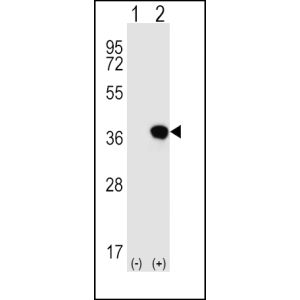 HLA-G Antibody - middle region (OAAB05537)Catalog #: OAAB05537Application: FC,IHC-P,WBFormat: Liquid. PBS with 0.09% (W/V) sodium azide.
-
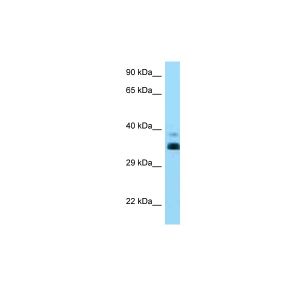 HLA-G Antibody - C-terminal region (ARP63107_P050)Catalog #: ARP63107_P050Species Tested: HumanApplication: WBFormat: Liquid. Purified antibody supplied in 1x PBS buffer with 0.09% (w/v) sodium azide and 2% sucrose.
-
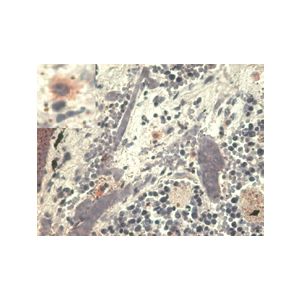 HLA-G AntibodyCatalog #: OAEE00434Clone: MEM-G/1Application: IHC-Fr|IHC-P|WBFormat: Phosphate buffered saline (PBS), pH 7.4, 15 mM sodium azide
-
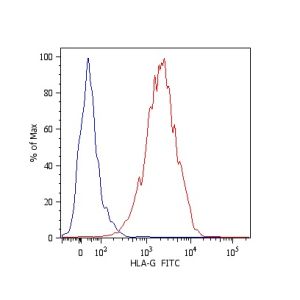 HLA-G AntibodyCatalog #: OAEE00436Clone: MEM-G/11Application: ELISA|FC|IHC-Fr|IPFormat: Phosphate buffered saline (PBS), pH 7.4, 15 mM sodium azide