HSP90AB1 Antibody

Cat# OAED00195
Size : 50ug
Brand : Aviva Systems Biology
Contact local distributor :

Phone : +1 850 650 7790
HSP90AB1 Antibody (OAED00195)
| Datasheets/Manuals | Printable datasheet for HSP90AB1 Antibody (OAED00195) |
|---|
| Predicted Species Reactivity | Bovine|Dog|Guinea Pig|Hamster|Human|Mouse|Porcine|Rabbit|Sheep |
|---|---|
| Product Format | Liquid PBS with 50% glycerol and 0.09% sodium azide |
| Clonality | Polyclonal |
| Host | Rabbit |
| Application | Western blot |
| Reconstitution and Storage | Shipped on Blue Ice. For long term storage, store at -20C. Avoid freeze/thaw cycles. |
| Immunogen | Recombinant human HSP90beta. |
| Purification | Protein A affinity purified |
| Concentration | 1 mg/ml |
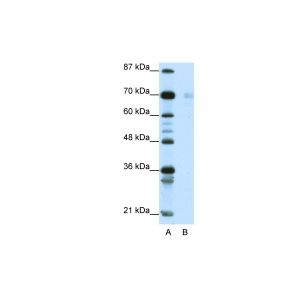
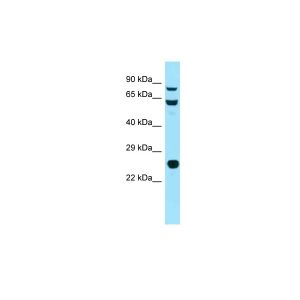
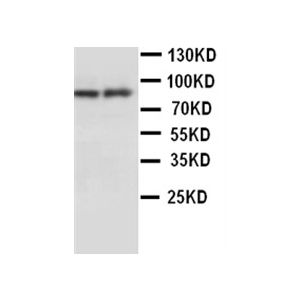
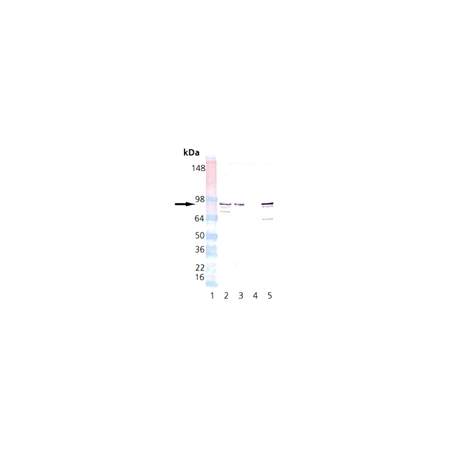
| Specificity | Recognizes human, mouse, bovine, dog, guinea pig, hamster, pig, rabbit, and sheep HSP90beta. Detects a band of ~90kDa by Western blot. |
| Application Info | WB: 1:1000 (colorimetric) |
| Gene Symbol | HSP90AB1 |
|---|---|
| Gene Full Name | heat shock protein 90 alpha family class B member 1 |
| Alias Symbols | D6S182;heat shock 84 kDa;heat shock 90kD protein 1, beta;heat shock protein 90 kDa;heat shock protein 90kDa alpha (cytosolic), class B member 1;heat shock protein 90kDa alpha family class B member 1;heat shock protein HSP 90-beta;HSP84;HSP90B;HSP90-beta;HSPC2;HSPCB. |
| NCBI Gene Id | 3326 |
| Protein Name | Heat shock protein HSP 90-beta |
| Description of Target | Molecular chaperone that promotes the maturation, structural maintenance and proper regulation of specific target proteins involved for instance in cell cycle control and signal transduction. Undergoes a functional cycle that is linked to its ATPase activity. This cycle probably induces conformational changes in the client proteins, thereby causing their activation. Interacts dynamically with various co-chaperones that modulate its substrate recognition, ATPase cycle and chaperone function (PubMed:16478993, PubMed:19696785). Engages with a range of client protein classes via its interaction with various co-chaperone proteins or complexes, that act as adapters, simultaneously able to interact with the specific client and the central chaperone itself. Recruitment of ATP and co-chaperone followed by client protein forms a functional chaperone. After the completion of the chaperoning process, properly folded client protein and co-chaperone leave HSP90 in an ADP-bound partially open conformation and finally, ADP is released from HSP90 which acquires an open conformation for the next cycle (PubMed:27295069, PubMed:26991466). Apart from its chaperone activity, it also plays a role in the regulation of the transcription machinery. HSP90 and its co-chaperones modulate transcription at least at three different levels. In the first place, they alter the steady-state levels of certain transcription factors in response to various physiological cues. Second, they modulate the activity of certain epigenetic modifiers, such as histone deacetylases or DNA methyl transferases, and thereby respond to the change in the environment. Third, they participate in the eviction of histones from the promoter region of certain genes and thereby turn on gene expression (PubMed:25973397). Antagonizes STUB1-mediated inhibition of TGF-beta signaling via inhibition of STUB1-mediated SMAD3 ubiquitination and degradation (PubMed:24613385). Promotes cell differentiation by chaperoning BIRC2 and thereby protecting from auto-ubiquitination and degradation by the proteasomal machinery (PubMed:18239673). Main chaperone that is involved in the phosphorylation/activation of the STAT1 by chaperoning both JAK2 and PRKCE under heat shock and in turn, activates its own transcription (PubMed:20353823). |
| Uniprot ID | P08238 |
| Protein Accession # | NP_001258898.1; NP_001258899.1; NP_001258900.1; NP_031381.2 |
| Nucleotide Accession # | NM_001271969.1; NM_001271970.1; NM_001271971.1; NM_007355.3 |
| Molecular Weight | 90 kDa |