Human CD3C Antibody : APC

Cat# OASB02590
Size : 25tests
Brand : Aviva Systems Biology
Contact local distributor :

Phone : +1 850 650 7790
Human CD3C Antibody : APC (OASB02590)
| Datasheets/Manuals | Printable datasheet for Human CD3C Antibody : APC (OASB02590) |
|---|
| Tested Species Reactivity | Human |
|---|---|
| Predicted Species Reactivity | Human |
| Product Format | Liquid. Phosphate buffered saline containing 0.1% sodium azide and a stabilizer |
| Clonality | Monoclonal |
| Host | Mouse |
| Conjugation | APC |
| Application | FC |
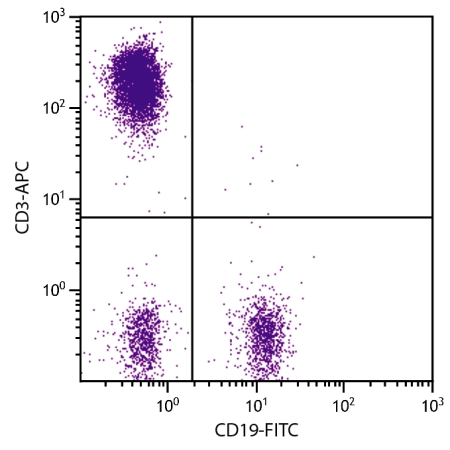
| Additional Information | Description: CD3, a member of the immunoglobulin superfamily of cell surface receptors, is comprised of five invariable chains ranging from 16-28 kDa and is closely associated with the T cell antigen receptor (TCR). CD3 is expressed on 70-80% of normal peripheral blood lymphocytes and on 10-20% of thymocytes. It plays a major role in signaling during antigen recognition, leading to T cell activation. The monoclonal antibody UCHT1 reacts with the 20 kDa epsilon chain of the CD3/TCR complex. |
| Reconstitution and Storage | Store at 2-8C |
| Immunogen | Human peripheral blood lymphocytes from a patient with Sezary's syndrome and infant thymocytes |
| Concentration | Lot specific |
| Specificity | CD3 |
| Gene Symbol | CD3E |
|---|---|
| Gene Full Name | CD3e molecule |
| Alias Symbols | T3E, TCRE, IMD18 |
| NCBI Gene Id | 916 |
| Protein Name | T-cell surface glycoprotein CD3 epsilon chain |
| Description of Target | The protein encoded by this gene is the CD3-epsilon polypeptide, which together with CD3-gamma, -delta and -zeta, and the T-cell receptor alpha/beta and gamma/delta heterodimers, forms the T-cell receptor-CD3 complex. This complex plays an important role in coupling antigen recognition to several intracellular signal-transduction pathways. The genes encoding the epsilon, gamma and delta polypeptides are located in the same cluster on chromosome 11. The epsilon polypeptide plays an essential role in T-cell development. Defects in this gene cause immunodeficiency. This gene has also been linked to a susceptibility to type I diabetes in women. |
| Uniprot ID | P07766 |
| Protein Accession # | NP_000724.1 |
| Nucleotide Accession # | NM_000733.3 |