
Human CHEK1 Antibody : PE (Phospho-Ser345)

Cat# OAAQ00113-100tests
Size : 100Tests
Brand : Aviva Systems Biology
Contact local distributor :
 Phone : +1 850 650 7790
Human CHEK1 Antibody : PE (Phospho-Ser345)
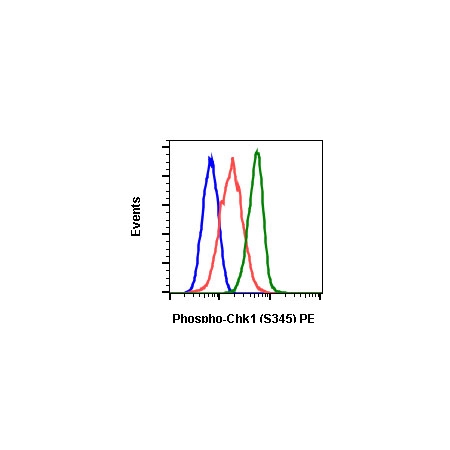
Human CHEK1 Antibody : PE (Phospho-Ser345) (OAAQ00113)
| Datasheets/Manuals | Printable datasheet for OAAQ00113 |
|---|
| Tested Species Reactivity | Human, Mouse, Rat |
|---|---|
| Predicted Species Reactivity | Mouse, Rat |
| Product Format | Liquid. 1X PBS, 0.09% NaN3, 0.2% BSA. |
| Clonality | Monoclonal |
| Clone | Chk1S345-R3F9 |
| Isotype | Rabbit IgG1k |
| Host | Rabbit |
| Conjugation | PE: Phycoerythrin |
| Application | FC |
| Reconstitution and Storage | 2-8C |
| Immunogen | A synthetic phospho-peptide corresponding to residues surrounding Ser345 of human phospho Chk1 |
| Purification | Protein A+G |
| Target Post-Translational Modification | Phospho-Ser345 |
| Application Info | For flow cytometric staining, the suggested use of this reagent is 5 uL per million cells or 5 uL per 100 uL of staining volume. It is recommended that the reagent be titrated for optimal performance for each application. |
| Reference | 1. Caprelli ML, et al. (2013) Cell Cycle, 12: 916-22. 2. Capasso H, et al. (2002) J. Cell Sci. 115: 4555-64. 3. Carrassa L, et al. (2011) Cell Cycle 10: 2121-8. 4. Chen MS, et al. (2003) Mol. Cell Biol. 23: 7488-97. 5. Ciccia A, et al. Mol. Cell 40: 179-204. 6. Cimprich CA, (2014) Oncogene 33: 3351-60 7. Cremona CA, et al. (2014) Oncogene 33: 3351-60. 8. Niida H, et al. (2007) Mol. Cell Biol. 27: 2572-81. |
|---|---|
| Gene Symbol | CHEK1 |
| Gene Full Name | checkpoint kinase 1 |
| Alias Symbols | CHK1 |
| NCBI Gene Id | 1111 |
| Protein Name | serine/threonine-protein kinase Chk1 |
| Description of Target | The protein encoded by this gene belongs to the Ser/Thr protein kinase family. It is required for checkpoint mediated cell cycle arrest in response to DNA damage or the presence of unreplicated DNA. This protein acts to integrate signals from ATM and ATR, two cell cycle proteins involved in DNA damage responses, that also associate with chromatin in meiotic prophase I. Phosphorylation of CDC25A protein phosphatase by this protein is required for cells to delay cell cycle progression in response to double-strand DNA breaks. Several alternatively spliced transcript variants have been found for this gene. |
| Uniprot ID | O14757 |
| Protein Accession # | NP_001107593.1 |
| Nucleotide Accession # | NM_001114121.2 |