Human Lambda Antibody : AP

Cat# OASB00895
Size : 1.0mL
Brand : Aviva Systems Biology
Contact local distributor :

Phone : +1 850 650 7790
Human Lambda Antibody : AP (OASB00895)
| Datasheets/Manuals | Printable datasheet for Human Lambda Antibody : AP (OASB00895) |
|---|
| Tested Species Reactivity | Human |
|---|---|
| Predicted Species Reactivity | Human |
| Clonality | Monoclonal |
| Clone | JDC-12 |
| Isotype | IgG1 |
| Host | Mouse |
| Conjugation | AP |
| Application | WB |
| Reconstitution and Storage | Store at 2-8C |
| Concentration | Lot specific |
| Specificity | Lambda |
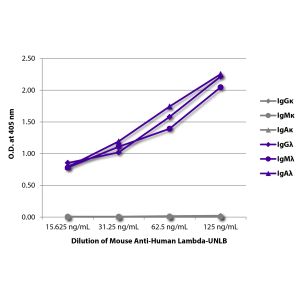
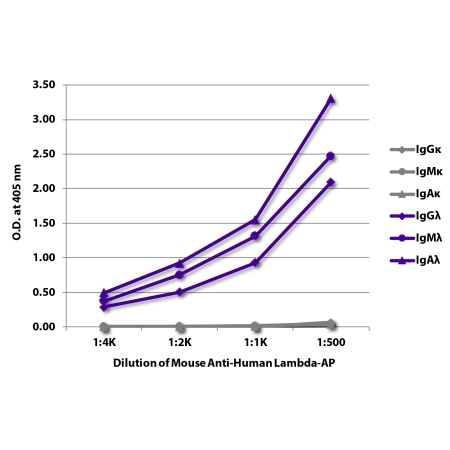
| Characterization | To insure lot- to- lot consistency, each batch of product is tested by ELISA for conformance to characteristics ofa standard reference reagent. |
| Warning | Reagents contain sodium azide. Sodium azide is very toxic if ingested or inhaled. Avoid contact with skin,eyes, or clothing. Wear eye or face protection when handling. If skin or eye contact occurs, wash withcopious amounts of water. If ingested or inhaled, contact a physician immediately. Sodium azide yieldstoxic hydrazoic acid under acidic conditions. Dilute azide- containing compounds in running water beforediscarding to avoid accumulation of potentially explosive deposits in lead or copper plumbing. |
| Dilution | Immunofluorescence ELISA: UNLB antibody BIOT and FITC conjugates R-PE conjugate AP conjugate HRP conjugate BIOT conjugate <= 1 ug/106 cells <= 1 ug/106 cells <= 0.1 ug/106 cells 1:500-1:1,000 1:1,000-1:2,000 1:1,000-1:2,000 |
| Application Info | Indirect immunofluorescent staining of Lambda+ B lymphocytes, Enzyme-Linked-Immunosorbent-Assay (ELISA), Western blotting, Dot-and slot-immunoblotting, Immunohistochemistry (frozen sections), Immunocytochemistry |
| Other Applications Data | Since applications vary, you should determine the optimum workingdilution of the product that is appropriate for your specific need. |
| Storage | - The purified (UNLB) antibody is supplied as 0.5 mg of purified immunoglobulin in 1.0 mL of 100 mMborate buffered saline, pH 8.2. No preservatives or amine- containing buffer salts added. Store at 2- 8 C - The fluorescein (FITC) conjugate is supplied as 0.5 mg in 1.0 mL of PBS/NaN3. Store at 2- 8 C - The alkaline phosphatase (AP) conjugate is supplied as 1.0 mL of stock solution in 50mM Tris/1mMMgCl2/50% Glycerol, pH 8.0, containing 0.1% NaN3 as preservative. Store at 2- 8 C or long- term at - 20 C - The horseradish peroxidase (HRP) conjugate is supplied as 1.0 mL of stock solution in 50% glycerol/50%PBS, pH 7.4. No preservative added. Store at 2- 8 C or long- term at - 20 C - The biotin (BIOT) conjugate is supplied as 0.5 mg in 1.0 mL of PBS/NaN3. Store at 2- 8 C - The R- phycoerythrin (R- PE) conjugate is supplied as 0.1 mg in 1.0 mL of PBS/NaN3 and a stabilizingagent. Store at 2- 8 C. Do not freeze! - Each reagent is stable for the period shown on the bottle label if stored as directed. |
| Gene Symbol | IGL |
|---|---|
| Gene Full Name | Ig lambda-1 chain C regions |
| Alias Symbols | IGL@, IGLC6 |
| NCBI Gene Id | 3535 |
| Protein Name | ig lambda-6 chain C region |
| Description of Target | Immunoglobulins recognize foreign antigens and initiate immune responses such as phagocytosis and the complement system. Each immunoglobulin molecule consists of two identical heavy chains and two identical light chains. There are two classes of light chains, kappa and lambda. This region represents the germline organization of the lambda light chain locus. The locus includes V (variable), J (joining), and C (constant) segments. During B cell development, a recombination event at the DNA level joins a single V segment with a J segment; the C segment is later joined by splicing at the RNA level. Recombination of many different V segments with several J segments provides a wide range of antigen recognition. Additional diversity is attained by junctional diversity, resulting from the random additional of nucleotides by terminal deoxynucleotidyltransferase, and by somatic hypermutation, which occurs during B cell maturation in the spleen and lymph nodes. Several V segments and three C segments are known to be incapable of encoding a protein and are considered pseudogenes. The locus also includes several non-immunoglobulin genes, many of which are pseudogenes or are predicted by automated computational analysis or homology to other species. |