



RayBio® Cell-Based Human/Mouse/Rat MAPK (Thr180/Tyr182) Phosphorylation ELISA Kit. Suitable for adherent whole cell lines.
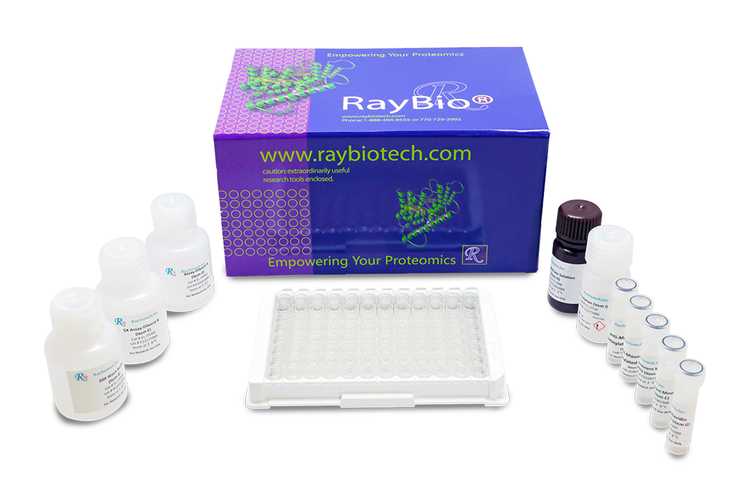
Human/Mouse/Rat Phospho-p38 MAPK (T180/Y182) Cell-Based ELISA Kit
Human/Mouse/Rat Phospho-p38 MAPK (T180/Y182) Cell-Based ELISA Kit
Contact Us for Bulk Request
Product Description
Specifications
| Size | 1 Plate Kit, 2 Plate Kit, 5 Plate Kit |
| Species | Human, Mouse, Rat |
| Specificity | The antibodies provided in this kit recognizes human, mouse and rat P38 MAPK phosphorylated at sites Thr180 and pTyr182 as well as total MAPK for comparison. |
| Compatible Sample Types | Adherent Cell Culture |
| Accession Number | Q16539 |
| Gene Id | 1432 |
| Gene Symbols | MAPK14, CSBP, CSBP1, CSBP2, CSPB1, MXI2, SAPK2A |
| Protein Name / Synonyms | Mitogen-activated protein kinase 14 (MAP kinase 14) (MAPK 14) (EC 2.7.11.24) (Cytokine suppressive anti-inflammatory drug-binding protein) (CSAID-binding protein) (CSBP) (MAP kinase MXI2) (MAX-interacting protein 2) (Mitogen-activated protein kinase p38 alpha) (MAP kinase p38 alpha) (Stress-activated protein kinase 2a) (SAPK2a) |
| Quantitative/Semi-Quantitative | Semi-Quantitative |
| Solid Support | 96-well Microplate |
| Design Principle | Cell-based |
| Method Of Detection | Colorimetric |
| Research Area | Angiogenesis, Cancer, Post-Translational Modifications, Inflammation, Phosphorylation, MAPK Signaling |
| Shipping Type | Blue ice |
| Storage | -20°C |
Related Products
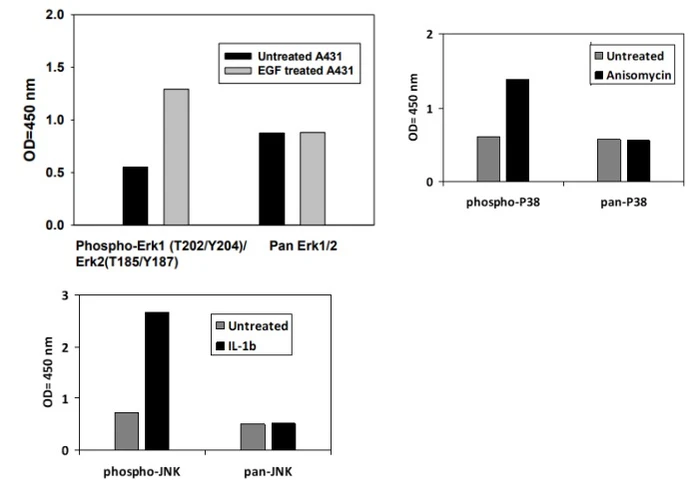
Phospho-ERK/JNK/P38α ELISA Kit
As low as $667.00
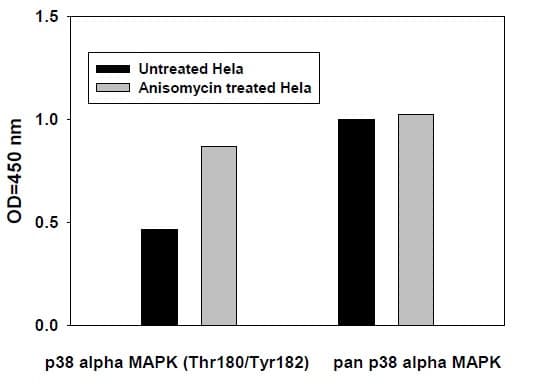
Phospho-p38 alpha (T180/Y182) ELISA Kit
As low as $521.00
Human Phosphotyrosine P38 ELISA Kit
As low as $422.00

Product Features
- Site and signal pathway-specific
- In vitro detection of adherent cell culture
- No sample lysis is needed
- Compatible with a standard ELISA plate reader
- Faster results than with ELISA
- Adaptable for high-throughput screening and drug discovery
Application Notes
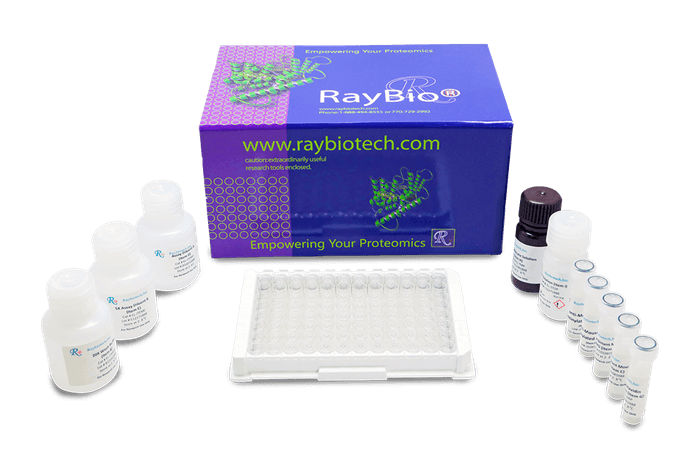
Kit Components
Other Materials Required
- Distilled or deionized water
- 100 ml and 1 liter graduated cylinders
- Tubes to prepare sample dilutions
- Protease and Phosphatase inhibitors
- Precision pipettes to deliver 2 µl to 1 ml volumes
- Adjustable 1-25 ml pipettes for reagent preparation
- Benchtop rocker or shaker
- Microplate reader capable of measuring absorbance at 450 nm
Protocol Outline
- Seed 10,000-30,000 cells into each well and incubate overnight.
- Apply various treatment, inhibitors or activators according to manufacture's instructions.
- Add 100 µl of Fixing Solution into each well and incubate for 20 min at RT with shaking.
- Add 200 µl of prepared 1X Quenching Buffer and incubate 20 min at RT.
- Add 200 µl of Blocking Solution and incubate for 1 h at 37 °C.
- Add 50 µl of 1X anti-phospho-protein specific antibody or anti-pan-protein specific antibody to each well and incubate for 2 h at RT.
- Add 50 µl of prepared 1X HRP-Anti-Rabbit or Mouse IgG and incubate for 1 h at RT.
- Add 100 µl of TMB One-Step Substrate Reagent to each well.
- Incubate 30 min at RT.
- Add 50 µl of Stop Solution to each well.
- Read at 450 nm immediately.
Storage/Stability
The entire kit may be stored at -20°C for up to 6 months from the date of shipment. Avoid repeated freeze-thaw cycles.
citations
Basic tetrapeptides as potent intracellular inhibitors of type A botulinum neurotoxin protease activity.
- Sample Type:
- Cell Lysate (human neuroblast BE(2)-M17 cells )
- Year:
- 2011
- Journal Name:
- The Journal of biological chemistry
- PubMed ID:
- 20961849
