

Human Proteasome Subunit Alpha Type 7 (PSMa7) Antibody Pair Kit (with Standard)

Cat# MBS2103523-10x96
Size : 10x96Tests
Brand : MyBiosource
Contact local distributor :

Phone : +1 850 650 7790
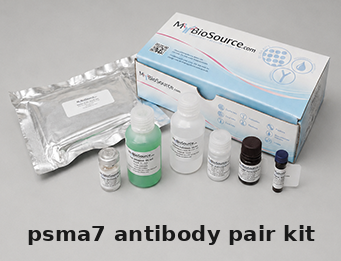
Proteasome Subunit Alpha Type 7 (PSMa7) Antibody Pair Kit for Human
For Research Use Only. Not for use in diagnostic procedures. Special Promotion Catalog #: MBS2103523SPECIAL PROMOTION: Get FREE Starbucks gift card (Maximum 5 gift cards/product). Gift card(s) will be included with shipment
MBS2103523 is an antibody pair kit targeting PSMa7. Also known as Human Proteasome Subunit Alpha Type 7 (PSMa7) Antibody Pair Kit (with Standard). Reactive in Human. More details
Product Overview
Online Datasheet in PDFProduct Name
Proteasome Subunit Alpha Type 7 (PSMa7), Antibody Pair Kit
Full Product Name
Human Proteasome Subunit Alpha Type 7 (PSMa7) Antibody Pair Kit (with Standard)
Product Gene Name
PSMa7 antibody pair kit
Product Synonym Names
C6; HSPC; RC6-1; XAPC7
Species Reactivity
Human
Samples
Tissue Homogenates, Cell Lysates and Other Biological Fluids
Detection Range
0.312-20ng/mL
Molecular Weight
16,135 Da
OMIM
AF022815 mRNA
Supply Chain Verification
Manufactured in a lab with traceable raw materials. Bulk orders can typically be prepared to the customer’s specifications, please inquire.
Standard
Recombinant PSMa7 (Lyophilized, 1 vial-10ug)
Capture Antibody
Rabbit polyclonal antibody (Liquid, 1 vial-400mug/800muL)
Detection Antibody
Biotinylated Rabbit polyclonal antibody (Liquid, 1 vial-100mug/500muL)
Producte Usage
Raw materials can be used for preparation of 5x96T or 10x96T ELISA Kits.
Antibody Support Pack
Antibody Support Pack (Buffer Pack) is sold separately as catalog #MBS2090685
Product Categories/Family for PSMa7 antibody pair kit
Enzyme & Kinase
ISO Certification
Manufactured in an ISO 9001:2015 and ISO 13485:2016 Certified Laboratory.
Applications Tested/Suitable for PSMa7 antibody pair kit
ELISA (EIA), Chemiluminescence Immunoassays (CLIA), ELISPOT, Luminex
Other Notes
Small volumes of PSMa7 antibody pair kit vial(s) may occasionally become entrapped in the seal of the product vial during shipment and storage. If necessary, briefly centrifuge the vial on a tabletop centrifuge to dislodge any liquid in the container`s cap. Certain products may require to ship with dry ice and additional dry ice fee may apply.
Additional Details
NCBI/Uniprot data below describe general gene information for PSMa7. It may not necessarily be applicable to this product.
NCBI Official Full Name
proteasome subunit alpha type-7
NCBI Official Synonym Full Names
proteasome subunit alpha 7
NCBI Official Symbol
PSMA7
NCBI Official Synonym Symbols
C6; HSPC; RC6-1; XAPC7; HEL-S-276
UniProt Protein Name
Proteasome subunit alpha type-7
UniProt Synonym Protein Names
Proteasome subunit RC6-1; Proteasome subunit XAPC7
Protein Family
Proteasome
UniProt Gene Name
PSMA7
UniProt Synonym Gene Names
HSPC
NCBI Protein Information
proteasome subunit alpha type-7
NCBI Summary for PSMa7
The 26S proteasome is a multicatalytic proteinase complex with a highly ordered structure composed of 2 complexes, a 20S core and a 19S regulator. The 20S core is composed of 4 rings of 28 non-identical subunits; 2 rings are composed of 7 alpha subunits and 2 rings are composed of 7 beta subunits. Proteasomes are distributed throughout eukaryotic cells at a high concentration and cleave peptides in an ATP/ubiquitin-dependent process in a non-lysosomal pathway. This gene encodes a member of the peptidase T1A family that functions as a 20S core alpha subunit. The encoded protein interacts with the hepatitis B virus X protein and plays a role in regulating hepatitis C virus internal ribosome entry site (IRES) activity, an activity essential for viral replication. The encoded protein also plays a role in the cellular stress response by regulating hypoxia-inducible factor-1alpha. A pseudogene of this gene is located on the long arm of chromosome 9. [provided by RefSeq, Jul 2012]
Show more UniProt Comments for PSMa7
Component of the 20S core proteasome complex involved in the proteolytic degradation of most intracellular proteins. This complex plays numerous essential roles within the cell by associating with different regulatory particles. Associated with two 19S regulatory particles, forms the 26S proteasome and thus participates in the ATP-dependent degradation of ubiquitinated proteins. The 26S proteasome plays a key role in the maintenance of protein homeostasis by removing misfolded or damaged proteins that could impair cellular functions, and by removing proteins whose functions are no longer required. Associated with the PA200 or PA28, the 20S proteasome mediates ubiquitin-independent protein degradation. This type of proteolysis is required in several pathways including spermatogenesis (20S-PA200 complex) or generation of a subset of MHC class I-presented antigenic peptides (20S-PA28 complex). Inhibits the transactivation function of HIF-1A under both normoxic and hypoxia-mimicking conditions. The interaction with EMAP2 increases the proteasome-mediated HIF-1A degradation under the hypoxic conditions. Plays a role in hepatitis C virus internal ribosome entry site-mediated translation. Mediates nuclear translocation of the androgen receptor (AR) and thereby enhances androgen-mediated transactivation. Promotes MAVS degradation and thereby negatively regulates MAVS-mediated innate immune response.
Show more Precautions
All of MyBioSource's Products are for scientific laboratory research purposes and are not for diagnostic, therapeutics, prophylactic or in vivo use. Through your purchase, you expressly represent and warrant to MyBioSource that you will properly test and use any Products purchased from MyBioSource in accordance with industry standards. MyBioSource and its authorized distributors reserve the right to refuse to process any order where we reasonably believe that the intended use will fall outside of our acceptable guidelines.
Disclaimer
While every efforts were made to ensure the accuracy of the information provided in this datasheet, MyBioSource will not be liable for any omissions or errors contained herein. MyBioSource reserves the right to make changes to this datasheet at any time without prior notice.
It is the responsibility of the customer to report product performance issues to MyBioSource within 30 days of receipt of the product. Please visit our Terms & Conditions page for more information.
It is the responsibility of the customer to report product performance issues to MyBioSource within 30 days of receipt of the product. Please visit our Terms & Conditions page for more information.
Product Note
Select online data sheet information is drawn from bioinformatics databases, occasionally resulting in ambiguous or non-relevant product information. It is the responsibility of the customer to review, verify, and evaluate the information to make sure it matches their requirements before purchasing the kit. Our ELISA Kit assays are dynamic research tools and sometimes they may be updated and improved. If the format of this assay is important to you then please request the current manual or contact our technical support team with a presales inquiry before placing an order. We will confirm the current details of the assay. We cannot guarantee the sample manual posted online is the most current manual, it is intended to serve as an example only. Please refer to the instructions For Use provided with the assay kit for precise details.
Product PubMed Publications
Products associated with PSMa7 antibody pair kit
| Reference Product | PubMed Publications |
|---|---|
| PSMA5 antibody pair kit | >2 publications with PSMa7 and PSMA5 |
| PSMA6 antibody pair kit | >2 publications with PSMa7 and PSMA6 |
| PSMA1 antibody pair kit | >2 publications with PSMa7 and PSMA1 |
| PSMA3 antibody pair kit | >2 publications with PSMa7 and PSMA3 |
| PSMB6 antibody pair kit | >1 publications with PSMa7 and PSMB6 |
| PSMB2 antibody pair kit | >1 publications with PSMa7 and PSMB2 |
| PSMA2 antibody pair kit | >1 publications with PSMa7 and PSMA2 |
| PSMA4 antibody pair kit | >1 publications with PSMa7 and PSMA4 |
Pathways associated with PSMa7 antibody pair kit
| Products by Pathway | Pathway Diagram |
|---|---|
| AMER1 Mutants Destabilize The Destruction Complex Pathway antibodies | AMER1 Mutants Destabilize The Destruction Complex Pathway Diagram |
| APC Truncation Mutants Are Not K63 Polyubiquitinated Pathway antibodies | APC Truncation Mutants Are Not K63 Polyubiquitinated Pathway Diagram |
| APC Truncation Mutants Have Impaired AXIN Binding Pathway antibodies | APC Truncation Mutants Have Impaired AXIN Binding Pathway Diagram |
| APC/C-mediated Degradation Of Cell Cycle Proteins Pathway antibodies | APC/C-mediated Degradation Of Cell Cycle Proteins Pathway Diagram |
| APC/C:Cdc20 Mediated Degradation Of Securin Pathway antibodies | APC/C:Cdc20 Mediated Degradation Of Securin Pathway Diagram |
| APC/C:Cdc20 Mediated Degradation Of Mitotic Proteins Pathway antibodies | APC/C:Cdc20 Mediated Degradation Of Mitotic Proteins Pathway Diagram |
| APC/C:Cdh1 Mediated Degradation Of Cdc20 And Other APC/C:Cdh1 Targeted Proteins In Late Mitosis/early G1 Pathway antibodies | APC/C:Cdh1 Mediated Degradation Of Cdc20 And Other APC/C:Cdh1 Targeted Proteins In Late Mitosis/early G1 Pathway Diagram |
| APC:Cdc20 Mediated Degradation Of Cell Cycle Proteins Prior To Satisfation Of The Cell Cycle Checkpoint Pathway antibodies | APC:Cdc20 Mediated Degradation Of Cell Cycle Proteins Prior To Satisfation Of The Cell Cycle Checkpoint Pathway Diagram |
| AUF1 (hnRNP D0) Destabilizes MRNA Pathway antibodies | AUF1 (hnRNP D0) Destabilizes MRNA Pathway Diagram |
| AXIN Missense Mutants Destabilize The Destruction Complex Pathway antibodies | AXIN Missense Mutants Destabilize The Destruction Complex Pathway Diagram |
Diseases associated with PSMa7 antibody pair kit
| Disease Name | Pubmed Publications |
|---|---|
| Liver Diseases Antibodies | >4 publications with PSMa7 and Liver Diseases |
| Prostatic Diseases Antibodies | >3 publications with PSMa7 and Prostatic Diseases |
| Liver Neoplasms Antibodies | >3 publications with PSMa7 and Liver Neoplasms |
| Lung Neoplasms Antibodies | >2 publications with PSMa7 and Lung Neoplasms |
| Carcinoma Antibodies | >1 publications with PSMa7 and Carcinoma |
| Heart Diseases Antibodies | >1 publications with PSMa7 and Heart Diseases |
| Cell Transformation, Neoplastic Antibodies | >1 publications with PSMa7 and Cell Transformation, Neoplastic |
| Fatty Liver Antibodies | >1 publications with PSMa7 and Fatty Liver |
| Death Antibodies | >1 publications with PSMa7 and Death |
| Adenocarcinoma Antibodies | >1 publications with PSMa7 and Adenocarcinoma |
Organs/Tissues associated with PSMa7 antibody pair kit
| Organ/Tissue Name | Pubmed Publications |
|---|---|
| Liver Antibodies | >7 publications with PSMa7 and Liver |
| Blood Antibodies | >6 publications with PSMa7 and Blood |
| Testis Antibodies | >3 publications with PSMa7 and Testis |
| Prostate Antibodies | >3 publications with PSMa7 and Prostate |
| Lymph Node Antibodies | >2 publications with PSMa7 and Lymph Node |
| Lymph Antibodies | >2 publications with PSMa7 and Lymph |
| Lung Antibodies | >2 publications with PSMa7 and Lung |
| Vascular Antibodies | >1 publications with PSMa7 and Vascular |
| Heart Antibodies | >1 publications with PSMa7 and Heart |
| Muscle Antibodies | >1 publications with PSMa7 and Muscle |