



Quantibody® Human Receptor Array 1 Kit. Detects 40 Human Soluble Receptors. Suitable for all liquid sample types.

Human Receptor Array Q1
Human Receptor Array Q1
Contact Us for Bulk Request
Product Description
Specifications
| Size | 8 Sample Kit, 22 Sample Kit, 50 Sample Kit |
| Species | Human |
| Compatible Sample Types | Cell Culture Supernatants, Plasma, Serum, Tissue Lysates, Cell Lysates |
| Quantitative/Semi-Quantitative | Quantitative |
| Number of Targets Detected | 40 |
| Solid Support | Glass Slide |
| Design Principle | Sandwich-based |
| Method Of Detection | Fluorescence Laser Scanner |
| Shipping Type | Blue ice |
| Storage | -20°C |
Product Features
- More cost-effective than traditional ELISA
- High specificity and system reproducibility
- Suitable for diverse sample types
- Low sample volume requirement: 50 µL or less
- Get results same day (6-hour processing time)
- Well-suited for high throughput assays
- Q Analyzer software provides one-step computation
Target Names
| Scroll over each target protein for more information | ||||
|---|---|---|---|---|
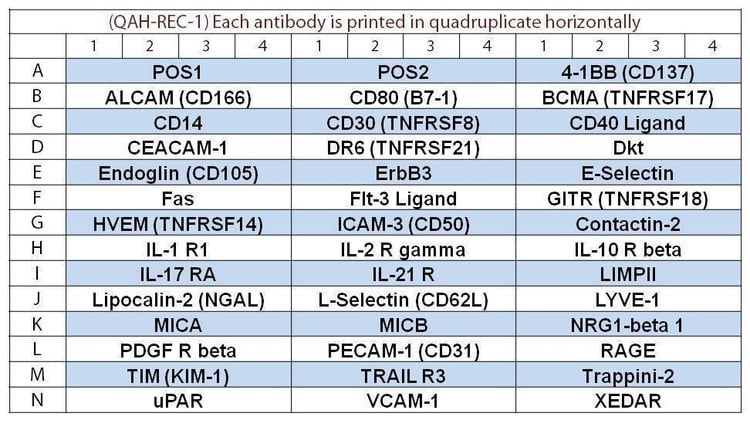
4-1BB (TNFRSF9/CD137)
| ALCAM (CD166)
| CD80 (B7-1)
| BCMA
| CD14
|
CD30 (TNFRSF8)
| CD40 Ligand (TNFSF5)
| CEACAM-1
| DR6 (TNFRSF21)
| Dtk
|
Endoglin (CD105)
| ErbB3
| E-Selectin
| Fas (TNFRSF6/Apo-1)
| Flt-3 Ligand
|
GITR (TNFRSF18)
| HVEM (TNFRSF14)
| ICAM-3 (CD50)
| Contactin-2 (TAG1)
| IL-1 R1
|
IL-2 R gamma (Common gamma Chain)
| IL-10 R beta
| IL-17 RA
| IL-21 R
| LIMPII
|
Lipocalin-2 (NGAL)
| L-Selectin (CD62L)
| LYVE-1
| MICA
| MICB
|
NRG1-beta 1 (HRG1-beta 1)
| PDGF R beta
| PECAM-1
| RAGE
| TIM-1 (KIM-1)
|
TRAIL R3 (TNFRSF10C)
| Trappin-2
| uPAR
| VCAM-1 (CD106)
| XEDAR
|
Application Notes
Suggested Application
Multiplexed Protein Detection; Biomarker Screening; Identifying Key Factors; Confirming Biological Process; Biomarker Validation; Validation of Antibody Array Results; Quantitative Protein Detection; Establishing Normal Range
Kit Components
- Human Receptor Array Q1 Slide(s)
- Blocking Buffer
- Wash Buffer 1
- Wash Buffer 2
- Lyophilized Standard Mix
- Biotinylated Detection Antibody Cocktail
- Streptavidin-Conjugated Fluor
- Slide Washer/Dryer
- Adhesive Plastic Strips
- Manual
Other Materials Required
- Distilled or deionized water
- Small plastic boxes or containers
- Pipettors, pipette tips and other common lab consumables
- Orbital shaker or oscillating rocker
- Aluminum foil
- Gene microarray scanner or similar laser fluorescence scanner
View Compatible Laser Scanners
Don't have a compatible scanner? RayBiotech now offers FREE scanning service for all RayBio glass slide antibody arrays! Learn More
Protocol Outline
- Dry the glass slide
- Prepare Standards
- Block array surface
- Incubate with Samples and Standards
- Incubate with Biotinylated Detection Antibody Cocktail
- Incubate with Streptavidin-Conjugated Fluor
- Disassemble the glass slide
- Scan with a gene microarray laser scanner
- Perform densitometry and analysis
Storage/Stability
For best results, store the entire kit frozen at -20°C upon arrival. Stored frozen, the kit will be stable for at least 6 months which is the duration of the product warranty period. Once thawed, store array slide(s), standard mix, detection antibody cocktail, and Cy3-Conjugated Streptavidin at -20°C and all other reagents undiluted at 4°C for no more than 3 months.
documents
GAL (GAL-QAH-REC-1.gal)
Excel (QAH-REC-1_Analysis_Tool.xls)
citations
Microbial Product Cocktails for Personalized Cancer Immunotherapy
- Species:
- Human
- Sample Type:
- Cell Culture Supernatant (unstimulated, MPC-stimulated PPS1-3 supernatants)
- Year:
- 2025
- Journal Name:
- Nature Communications
- PubMed ID:
- 41331244
Prenatal Infection by Respiratory Viruses Is Associated with Immunoinflammatory Responses in the Fetus
- Species:
- Human
- Sample Type:
- Whole Blood (maternal blood, cord blood)
- Year:
- 2024
- Journal Name:
- American Journal of Respiratory and Critical Care Medicine
- PubMed ID:
- 38051928
Development of machine-learning-driven signatures for diagnosing and monitoring therapeutic response in major depressive disorder using integrated immune cell profiles and plasma cytokines
- Species:
- Human
- Sample Type:
- Plasma (MDD patients and controls)
- Year:
- 2024
- Journal Name:
- Theranostics
- PubMed ID:
- 39629120
Disruption of macrophage migration inhibitory factor signaling induces major tumor-associated macrophage phenotypes in human M2 macrophages
- Species:
- Human
- Sample Type:
- Cell Culture Supernatant (pooled supernatants of M2 macrophages)
- Year:
- 2026
- Journal Name:
- Molecular biomedicine
- PubMed ID:
- 42467313
Longitudinal Proteomic Signatures of Dupilumab and Tralokinumab Treated Atopic Dermatitis Patients
- Species:
- Human
- Sample Type:
- Serum (atopic dermatitis, baseline and 12 months)
- Year:
- 2026
- Journal Name:
- Clinical and translational allergy
Integrated omics profiling reveals systemic dysregulation and potential biomarkers in the blood of patients with neuromyelitis optica spectrum disorders
- Year:
- 2024
- Journal Name:
- Journal of Translational Medicine
- PubMed ID:
- 39487546
Effects of acetazolamide combined with remote ischemic preconditioning on risk of acute mountain sickness: a randomized clinical trial
- Species:
- Human
- Sample Type:
- Plasma (baseline, pre- and post-hypoxia)
- Year:
- 2024
- Journal Name:
- BMC Medicine
- PubMed ID:
- 38166913
OP0211 CHANGE IN URINARY BIOMARKERS AT THREE MONTHS PREDICTS 1-YEAR TREATMENT RESPONSE OF LUPUS NEPHRITIS BETTER THAN PROTEINURIA
- Species:
- Human
- Sample Type:
- urine
- Year:
- 2023
- Journal Name:
- Annals of The Rheumatic Diseases
POS0297 PROTEOMIC ANALYSIS OF HISTOLOGICAL LESIONS LUPUS NEPHRITIS IDENTIFIES AN INFLAMMATORY SIGNATURE OF FIBROUS CRESCENTS
- Species:
- Human
- Sample Type:
- urine
- Year:
- 2023
- Journal Name:
- Annals of The Rheumatic Diseases
Endothelial progenitor cell-derived conditioned medium mitigates chronic cerebral ischemic injury through macrophage migration inhibitory factor-activated AKT pathway
- Species:
- Human
- Sample Type:
- Cell Culture Supernatant (endothelial progenitor cell-derived conditioned medium EPC-CM)
- Year:
- 2024
- Journal Name:
- Stem Cell Research & Therapy
- PubMed ID:
- 39543689