Biovalley > Human STAT5A/STAT5B Antibody : PE (Phospho-Tyr694)
Human STAT5A/STAT5B Antibody : PE (Phospho-Tyr694)

Cat# OAAQ00193-100tests
Size : 100Tests
Contact local distributor :

Phone : +1 850 650 7790
Brand : Aviva Systems Biology
Contact local distributor :
Phone : +1 850 650 7790
Human STAT5A/STAT5B Antibody : PE (Phospho-Tyr694)
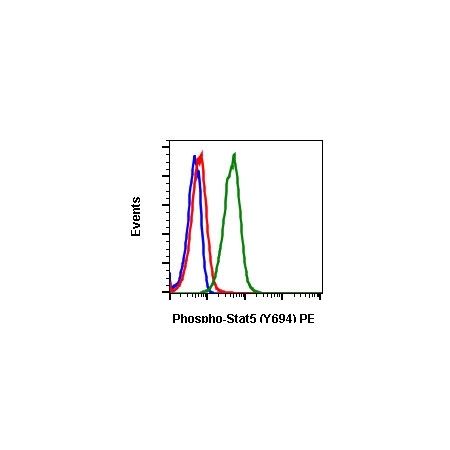

Human STAT5A/STAT5B Antibody : PE (Phospho-Tyr694) (OAAQ00193)
| Datasheets/Manuals | Printable datasheet for OAAQ00193 |
|---|
| Tested Species Reactivity | Human, Mouse |
|---|---|
| Predicted Species Reactivity | Mouse, Rat |
| Product Format | Liquid. 1X PBS, 0.09% NaN3, 0.2% BSA. |
| Clonality | Monoclonal |
| Clone | Stat5Y694-G11 |
| Isotype | Rabbit IgG1k |
| Host | Rabbit |
| Conjugation | PE: Phycoerythrin |
| Application | FC |
| Reconstitution and Storage | 2-8C |
| Immunogen | A synthetic phospho-peptide corresponding to residues surrounding Tyr695 of human phospho Stat5 |
| Purification | Protein A+G |
| Target Post-Translational Modification | Phospho-Tyr694 |
| Application Info | For flow cytometric staining, the suggested use of this reagent is 5 uL per million cells or 5 uL per 100 uL of staining volume. It is recommended that the reagent be titrated for optimal performance for each application. |
| Reference | 1. Gouilleux, F. et al. (1994) EMBO J. 13:4361-4369. 2. Wakao, H. et al. (1994) EMBO J. 13:2182-2191. 3. Okutani, Y. et al. (2001) Oncogene. 20:6643-6650. 4. Demoulin, J.B. et al. (1999) J. Biol. Chem. 274:25855-25861. 5. Dentelli, P. et al. (1999) J. Immunol. 163:2151-2159. 6. Meinke, A. et al. (1996) Mol. Cell. Biol. 16:6937-6944. |
|---|---|
| Gene Symbol | STAT5A, STAT5B |
| Gene Full Name | signal transducer and activator of transcription 5A, signal transducer and activator of transcription 5B |
| Alias Symbols | MGF, STAT5 |
| NCBI Gene Id | 6776; 6777 |
| Protein Name | signal transducer and activator of transcription 5A, signal transducer and activator of transcription 5B |
| Description of Target | The protein encoded by this gene is a member of the STAT family of transcription factors. In response to cytokines and growth factors, STAT family members are phosphorylated by the receptor associated kinases, and then form homo- or heterodimers that translocate to the cell nucleus where they act as transcription activators. This protein is activated by, and mediates the responses of many cell ligands, such as IL2, IL3, IL7 GM-CSF, erythropoietin, thrombopoietin, and different growth hormones. Activation of this protein in myeloma and lymphoma associated with a TEL/JAK2 gene fusion is independent of cell stimulus and has been shown to be essential for tumorigenesis. The mouse counterpart of this gene is found to induce the expression of BCL2L1/BCL-X(L), which suggests the antiapoptotic function of this gene in cells. Alternatively spliced transcript variants have been found for this gene. The protein encoded by this gene is a member of the STAT family of transcription factors. In response to cytokines and growth factors, STAT family members are phosphorylated by the receptor associated kinases, and then form homo- or heterodimers that translocate to the cell nucleus where they act as transcription activators. This protein mediates the signal transduction triggered by various cell ligands, such as IL2, IL4, CSF1, and different growth hormones. It has been shown to be involved in diverse biological processes, such as TCR signaling, apoptosis, adult mammary gland development, and sexual dimorphism of liver gene expression. This gene was found to fuse to retinoic acid receptor-alpha (RARA) gene in a small subset of acute promyelocytic leukemias (APLL). The dysregulation of the signaling pathways mediated by this protein may be the cause of the APLL. |
| Uniprot ID | P42229, P51692 |
| Protein Accession # | NP_001275647.1 |
| Nucleotide Accession # | NM_001288718.1 |