

MC38/Human CCR9 Stable Cell Line

Cat# CSB-SC004848HU
Size : 1vial
Brand : Cusabio
Contact local distributor :

Phone : +1 850 650 7790
| Size | 1 vial contains approximately 5x10⁶ cells in 1 ml |
| Image |
Product Details
Uniprot No.
Growth Properties
Adherent
Selection Marker
Puromycin
Culture Medium
1640 + 10% FBS + 3 μg/mL Puromycin
Alternative Names
CCR9
Tag Info
Tag-Free
Buffer
35% FBS + 55% 1640 + 10% DMSO
Tested Applications
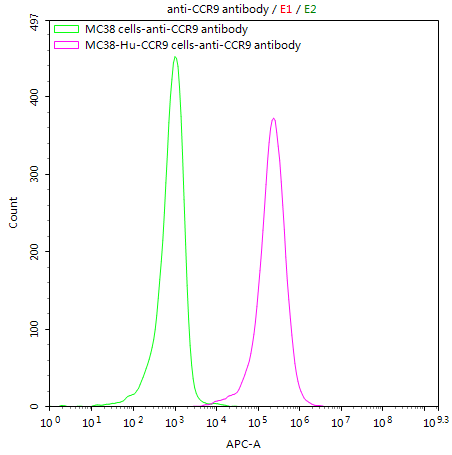
Binding assay by FACS and cell based ELISA.
Storage
Frozen in liquid nitrogen or -80°C
Customer Reviews and Q&A
There are currently no reviews for this product.
Target Background
Function
(From Uniprot)
(From Uniprot)
Receptor for chemokine SCYA25/TECK. Subsequently transduces a signal by increasing the intracellular calcium ions level.; (Microbial infection) Alternative coreceptor with CD4 for HIV-1 infection.
Gene References into Functions
- There were significantly increased CCR9 protein levels in failing human hearts.
- this study showed that CCR7 are overexpressed in CD4(-) CD8(-) thymocytes of myasthenia gravis patients.
- Results indicated that the expression levels of CCR9 in lesional skin may be a useful biologic marker of the clinical efficacy of infliximab therapy in psoriasis patients.
- Xray crystal structure of the CCR9 receptor in complex with vercirnon at 2.8 A resolution
- It plays a pathogenic role in liver diseases and it will be a therapeutic target of the diseases.
- that CCL25/CCR9 signal may provide cancer cells with chemotactic abilities through influencing several epithelial-mesenchymal transitionmarkers
- Studies indicate important roles played by chemokine ligand 25 (CCL25)/chemokine receptor 9 (CCR9) in tumorigenesis, tumor chemoresistance and metastasis.
- CCR9 and Integrin-beta7 expression has a differential effect on graft fate during acute graft-versus-host disease (GVHD) of the liver depending on the GVHD target tissue.
- CCR9 mRNA and protein levels were significantly increased in the nasopharyngeal carcinoma group compared with the control group.
- CCR9-CCL25 interaction promoted proliferation and suppressed apoptosis of non-small cell lung cancer cells by activating the PI3K/Akt pathway.
- CCR9 could be beneficial in predicting lymph node metastasis, and it might act as a novel prognostic biomarker for lung adenocarcinoma.
- We also show that primary tumors can be modeled in immunocompetent mice by microinjecting CCR9-expressing cancer cell lines into early-stage mouse blastocysts, which induces central immune tolerance
- High CCR9 expression is associated with the pathogenesis of ulcerative colitis.
- Expression of CCR9 and CCL25, the only natural ligand of CCR9, was significantly higher (p<0.0001) in NSCLC tissues and serum respectively, compared to their respective controls.
- activation of Notch1 has a dominant-negative effect on Ccr9 transcription and that Notch1 and E proteins control the dynamic expression of Ccr9 during T cell development.
- The results show the potential of the 91R monoclonal antibody as a therapeutic agent for treatment of CCR9-expressing tumors.
- results suggest that CCR9 can act as a novel prognostic marker and therapeutic target for hepatocellular carcinoma
- CCR9 expression is elevated in the nodal lymphomas of patients with GI involvement
- Only rotavirus specific CD4 T cells expressed intestinal homing receptors alpha4beta7 and CCR9.
- Data suggest that P-glycoprotein associate with the F-actin cytoskeleton through ezrin/radixin/moesin (ERM) in CCR9/CCL25 induced multidrug resistance of acute T-lymphocytic leukemia (T-ALL) cells.
- Notch1 regulates chemotaxis and proliferation by controlling the CC-chemokine receptors 5 and 9 in T cell acute lymphoblastic leukaemia.
- We provide the first evidence that CCR9 and its natural ligand CCL25 are highly expressed by ovarian cancer tissue and their expression correlates with histological subtypes.
- CCL25 enhanced the expression of MMP-1, -9, -11 and -13 active proteins by BrCa cells in a CCR9-dependent fashion.
- CCR9+ Th cells are a subset of IL-21-producing T helper cells that influence regional specification of autoimmune diseases that affect accessory organs of the digestive system
- The high fraction of circulating IgA+ and IgG+ B cells expressing CCR9 and CCR10 in the first months of life indicates activation of naive B cells in the gut, coinciding with bacterial colonization.
- TLR2 ligands induce CCR9 and CCR10 expression by circulating B-cells and increase their chemotaxis. TLR2 stimulation also induced J chain and IgA production demonstrating the induction of mucosal-like antibody secreting cells.
- CCR9 expression by monocytes is increased in rheumatoid arthritis
- Results demonstrate enhanced pancreatic intraepithelial neoplasia and pancreatic cancer cell proliferation with activation of CCR9 by its selective ligand CCL25
- Studies indicate that D6 chemokine receptor(CCR-9) may act as scavenging decoys and are involved in clearance of chemokines.
- more active homing of CCR9-926AG T cells to Peyer's patches may produce changes in Ag presentation and result in increased incidence of skin graft vs. host disease.
- over-expressed TECK interacts with CCR9 on the endometrial stromal cells in the endometriotic milieu, which may contribute to the onset and progression of endometriosis.
- A subset of CCR9+ T cells from normal donors has characteristics of mucosal T cells in terms of activated phenotype, proliferative response to anti-CD2 stimulation, a Th1 or Tr1 cytokine profile, and support for Ig production by cocultured B cells.
- CCR9 selectively induced T-ALL CD4+ T-cell chemotaxis and adhesion.
- High Expression of CCR9 is associated with prostate cancer cell migration and invasion
- involved in the pathogenesis of lymphatic filarial disease
- CCR9 overexpression is associated with Adult T-cell leukemia cells infiltrating gastrointestinal tract
- CCR9 expression is reduced on epithelial and lamina propria T cells in untreated celiac disease. Down-regulation of CCR9 persists in intraepithelial T cells from well-treated patients. Possible ongoing immune activation preferentially within epithelium.
- CCR9 is expressed on human melanoma cells and participates in the enhanced motility of melanoma cells and is likely a "homing receptor" for melanoma to the small bowel.
- Functionally active CCR9 on melanoma cells facilitates metastasis to the small intestine which may explain high incidence of metastis to the small intestine.
Subcellular Location
Cell membrane; Multi-pass membrane protein.
Protein Families
G-protein coupled receptor 1 family
Tissue Specificity
Highly expressed in the thymus and low in lymph nodes and spleen.
Database Links
HGNC:
OMIM:
KEGG:
STRING:
UniGene:


Email: support@cusabio.com