

MC38/Human CLDN6 Stable Cell Line

Cat# CSB-SC005508HU2
Size : 1vial
Brand : Cusabio
Contact local distributor :

Phone : +1 850 650 7790
| Size | 1 vial contains approximately 5x10⁶ cells in 1 ml |
| Image |
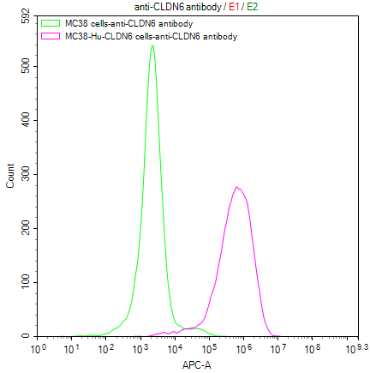
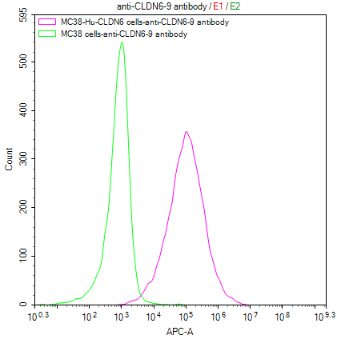
Product Details
Uniprot No.
Growth Properties
Adherent
Selection Marker
Puromycin
Culture Medium
DMEM + 10% FBS + 2 μg/ml Puromycin
Alternative Names
CLDN6
Tag Info
Tag-Free
Buffer
35% FBS + 55% DMEM + 10% DMSO
Tested Applications
Binding assay by FACS and cell based ELISA.
Storage
Frozen in liquid nitrogen or -80°C
Customer Reviews and Q&A
There are currently no reviews for this product.
Target Background
Function
(From Uniprot)
(From Uniprot)
Plays a major role in tight junction-specific obliteration of the intercellular space.; (Microbial infection) Acts as a receptor for hepatitis C virus (HCV) entry into hepatic cells.
Gene References into Functions
- Antibodies recognizing native CLDN6 as displayed on cell surfaces and mediating complement-dependent cytotoxicity were elicited in vaccinated animals. The data suggest applications of CLDN6 displaying Virus-like particles in cancer immunotherapy.
- these results suggest that Helicobacter pylori lipopolysaccharide induces TLR2 expression in the gastric adenocarcinoma cells, and that the longer the exposure to lipopolysaccharide, the greater the expression of TLR2 in the cell membrane; consequently the expression of claudin-4, -6, -7 and -9 also increases
- Study provides evidence that high expression of CLDN6 confers chemoresistance on breast cancer which is mediated by GSTP1, the activity of which is regulated by p53.
- CLDN6 enhances the chemoresistance to ADM via activating the AF-6/ERK signaling pathway and up-regulating cancer stem cell characters in MDAMB231 cells.
- we demonstrated that the downregulation of CLDN6 is regulated through promoter methylation by DNMT1, which depends on the SMAD2 pathway, and that CLDN6 is a key regulator in the SMAD2/DNMT1/CLDN6 pathway to inhibit EMT, migration and invasion of breast cancer cells
- In conclusion, this information from bioinformatics analysis will help future attempts to better understand CLDN6 regulation and functions.
- high expression of CLDN 6 was observed in approx. 65% of the myxofibrosarcomas, whereas the benign soft tissue tumors did not show a high expression of CLDN 6. The expression of CLDN 6 in the myxofibrosarcomas was significantly higher than those of other tumor specimens. Among the myxofibrosarcomas, the high expression of CLDN 6 was correlated with high FNCLCC grades and high AJCC stages.
- Results show that DNA methylation down-regulates CLDN6 expression through MeCP2 binding to the CLDN6 promoter, deacetylating H3 and H4, and altering chromatin structure, consequently promoting migratory and invasive phenotype in breast cancer cells.
- Cldn6 was decreased in alveolar type II-like epithelial cells (A549) and primary small airway epithelial cells when exposed to cigarette smoke ext
- suggest that claudin-6 induces MMP-2 activation through claudin-1 membrane expression
- Data show that claudin-6 (CLDN6) R209Q and occludin (OCLN) P24A mutations do not affect HCV pseudoparticles (HCVpp) entry.
- The expression of ASK1 is correlated with the level of claudin-6 in cervical carcinoma cells and tissues.
- High levels of CLDN6 are associated with non-small-cell lung cancer.
- The expression of claudin-6 was down regulated in gastric cancer tissue.
- Only some hepatitis C virus strains efficiently use CLDN6 for infection.
- This work provides a proof of concept for the use of Claudin-6 to eliminate residual undifferentiated human pluripotent stem cells from culture.
- Although claudin-6 and claudin-9 can serve as entry factors in cell lines, hepatitis C virus infection into human hepatocytes is not dependent on claudin-6 and claudin-9.
- ASK1 signal may play a positive role in the inhibitory effect of claudin-6 in breast cancer.
- Our results show that claudin-6 protein is significantly down-regulated in breast invasive ductal carcinomas
- CLDN6 is not a specific biomarker for atypical teratoid rhabdoid tumors as it is expressed in a variety of other pediatric CNS and soft tissue tumors.
- 17beta-E2 might regulate the expression of claudin-6 and inhibit the proliferation and migration of MCF-7 cells.
- Increased expression of claudin-6, claudin-7, or claudin-9 is sufficient to enhance tumorigenic properties of a gastric adenocarcinoma cell line.
- CLDN6 may be a useful positive marker to help further identify atypical teratoid/rhabdoid tumors for diagnostic and treatment purposes
- Claudins 6, 7, and 9 expressions are closely related to gastric carcinogenesis
- The up-regulation of claudin-6 expression in MCF-7 breast cancer cells suppresses their malignant phenotypes with a correlation with the restoration of tight junction integrity.
- claudin-6, downregulates the malignant phenotype of breast carcinoma.
- Claudin 6 was not found in epithelioid glioblastomas or rhabdoid glioblastomas.
- CLDN6 and CLDN9, but not CLDN1, are expressed in peripheral blood mononuclear cells, an additional site of HCV replication.
- claudin-6 and claudin-9 expressed in CD81+ cells also enable the entry of HCV pseudoparticles derived from six of the major genotypes.
- CLDN6, clustered with CLDN9 at human chromosome 16p13.3, is a four-transmembrane protein with WWCC motif, defined by W-X(17-22)-W-X(2)-C-X(8-10)-C.
Subcellular Location
Cell junction, tight junction. Cell membrane; Multi-pass membrane protein.
Protein Families
Claudin family
Tissue Specificity
Expressed in the liver, in peripheral blood mononuclear cells and hepatocarcinoma cell lines.
Database Links
HGNC:
OMIM:
KEGG:
STRING:
UniGene:


Email: support@cusabio.com