

Biovalley > Mouse CD40 Antibody : LE/AF
Mouse CD40 Antibody : LE/AF

Cat# OASB00444
Size : 0.5mg
Contact local distributor :
 Phone : +1 850 650 7790
Brand : Aviva Systems Biology
Contact local distributor :
Phone : +1 850 650 7790
Mouse CD40 Antibody : LE/AF (OASB00444)
| Datasheets/Manuals | Printable datasheet for Mouse CD40 Antibody : LE/AF (OASB00444) |
|---|
| Tested Species Reactivity | Mouse |
|---|---|
| Predicted Species Reactivity | Mouse |
| Clonality | Monoclonal |
| Clone | 1C10 |
| Isotype | IgG2a |
| Host | Rat |
| Conjugation | LE: Low Endotoxin, AF: Azide Free |
| Application | FC, IP, BL |
| Additional Information | Description: CD40 is a type I cell surface protein belonging to the tumor necrosis factor superfamily of cell surface receptors. In mice it is expressed on B lineage cells, follicular dendritic cells, thymic epithelium, and interdigitating cells in the T-cell zone of secondary lymphoid organs. CD40 first becomes detectable on a subset of small pre-B II cells in bone marrow with the levels of CD40 expression increasing thereafter during B cell maturation. Immature B cells (IgM+IgDloB220lo) express intermediate levels of CD40, whereas mature B cells (IgM+IgDhiB220hi) express high levels. CD40 has a central role in B cell growth and differentiation, and signaling through CD40 in combination with IL-4 reportedly induces immunoglobulin isotype switching and secretion of IgE. The agonistic 1C10 antibody closely resembles gp39/CD40 ligand in its ability to stimulate proliferation of small, resting B lymphocytes in the absence of other cofactors. |
| Reconstitution and Storage | Store at -20C |
| Immunogen | sCD40 |
| Concentration | 0.5 mg/mL |
| Specificity | CD40 |
| Characterization | To ensure lot- to- lot consistency, each batch of monoclonal antibody is tested by flow cytometry to conform tocharacteristics of a standard reference reagent. Representative data are included in this product insert. |
| Warning | Reagents contain sodium azide. Sodium azide is very toxic if ingested or inhaled. Avoid contact with skin,eyes, or clothing. Wear eye or face protection when handling. If skin or eye contact occurs, wash withcopious amounts of water. If ingested or inhaled, contact a physician immediately. Sodium azide yields toxichydrazoic acid under acidic conditions. Dilute azide- containing compounds in running water before discardingto avoid accumulation of potentially explosive deposits in lead or copper plumbing. |
| Dilution | Flow Cytometry: Fluorescein conjugate <= 2 ug/106 cells Biotin conjugate <= 2 ug/106 cells R-phycoerythrin conjugate <= 0.5 ug/106 cells Allophycocyanin conjugate <= 0.5 ug/106 cells Spectral Red conjugate <= 0.5 ug/106 cells |
| Application Info | Flow cytometry 7,9, Immunoprecipitation 8, In vitro induction of proliferation of mature B lymphocytes 7 |
| Other Applications Data | Since applications vary, you should determine the optimum working dilution for the product that is appropriate for yourspecific need. |
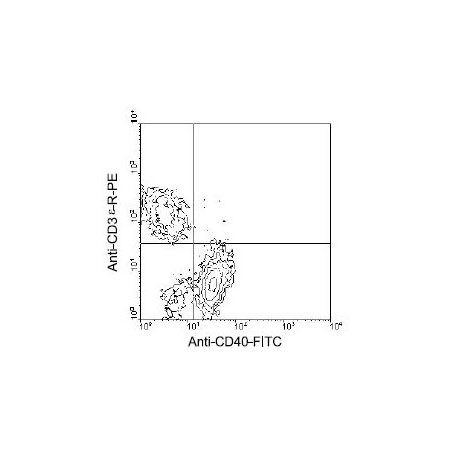
| Other Applications Image 1 Data | Amount Used: 2 Ug/106 Cells from BALB/c spleen were stained with rat antimouse CD40-FITC and hamster anti CD3epsilon-PE , gated on small lymphocytes and analyzed on a FACScan flow cytometer (BDIS, San Jose, CA). |
| Storage | - The purified (UNLB) antibody is supplied as 0.5 mg of purified immunoglobulin in 1.0 mL of 100 mMborate buffered saline, pH 8.2. No preservatives or amine- containing buffer salts added. Store at 2- 8 C - The fluorescein (FITC) conjugate is supplied as 0.5 mg in 1.0 mL of PBS/NaN3. Store at 2- 8 C - The biotin (BIOT) conjugate is supplied as 0.5 mg in 1.0 mL of PBS/NaN3. Store at 2- 8 C - The R- phycoerythrin (R- PE) conjugate is supplied as 0.1 mg in 1.0 mL or 0.2 mg in 2.0 mL of PBS/NaN3and a stabilizing agent. Store at 2- 8 C. Do not freeze! - The allophycocyanin (APC) conjugate is supplied as 0.1 mg in 1.0 mL of PBS/NaN3 and a stabilizingagent. Store at 2- 8 C. Do not freeze! - The Spectral Red (SPRD) conjugate is supplied as 0.1 mg in 1.0 mL of PBS/NaN3 and a stabilizingagent. Store at 2- 8 C. Do not freeze! - The low endotoxin, azide- free (LE/AF) antibody is supplied as 0.5 mg purified immunoglobulin in 1.0 mL ofPBS. Aliquot and store at or below - 20 C - Protect conjugated forms from light. Aliquot and freeze the low endotoxin, azide- free product at - 20 Cimmediately upon receipt. Each reagent is stable for the period shown on the bottle label if stored asdirected. |
| Reference | 1. Santos- Argumedo, L., J. Gordon, A.W. Heath, and M. Howard. 1994. Cell. Immunol. 156:272 2. Heath, A.W., W.W. Wu, and M.C. Howard. 1994. Eur. J. Immunol. 24:1828 3. Hasbold, J., C. Johnson- Leger, C.J. Atkins, E.A. Clark, and G.G. Klaus. 1994. Eur. J. Immunol. 24:1835 4. Grandien, A., A. Bras, and C. Martinez. 1996. Scand. J. Immunol. 43:47 5. Noelle, R.J., J.A. Ledbetter, and A. Aruffo. 1992. Immunol. Today 13:431 6. Clark, E.A., and J.A. Ledbetter. 1994. Nature 367:425 7. Segui, B., N. Andrieu- Abadie, S. Adam- Klages, O. Meilhac, D. Kreder, V. Garcia, A.P. Bruno., J. Jaffrezou, r. Salvayre, M. Kronke, and. T. Levade. 1999. J. Biol. Chem. 274(52):37251 8. Coope, H.J., P.G.P. Atkinson, B. Huhse, M. Belich, J. Janzen, M.J. Holman, G.G.B. Klaus, L.H. Johnston, and S.C. Ley. 2002. EMBO J . 21(20):5375 9. Rolph, M.S., S.H.E. Kaufmann. 2001. J. Immunol. 166:5115. |
|---|---|
| Gene Symbol | CD40 |
| Gene Full Name | Tumor necrosis factor receptor superfamily member 5 |
| Alias Symbols | p5, Bp5, IGM, p50, Bp50, GP39, IMD3, TRAP, Tnfr, HIGM1, T-BAM, Tnfrsf5, AI326936 |
| NCBI Gene Id | 21939 |
| Protein Name | tumor necrosis factor receptor superfamily member 5 |
| Uniprot ID | P27512 |
| Protein Accession # | NP_035741.2 |
| Nucleotide Accession # | NM_011611.2 |
Protein interactions
| Name | # of Products |
|---|---|
| BIRC2 | 191 |
| BIRC3 | 130 |
| CAV1 | 348 |
| CBL | 471 |
| CD40LG | 130 |
| ERP44 | 18 |
| HSPA4 | 423 |
| HSPA8 | 331 |
| IL4R | 67 |
| JAK3 | 169 |
| MAP3K8 | 24 |
| MS4A1 | 18 |
| NCOA6 | 145 |
| NSMAF | 39 |
| PIK3R1 | 517 |
| RIPK2 | 139 |
| RNF219 | 24 |
| SLC3 | 14 |
| SLC30A7 | 14 |
| SUMO1 | 972 |
| TDP2 | 42 |
| TRAF1 | 128 |
| TRAF2 | 432 |
| TRAF3 | 206 |
| TRAF3IP2 | 37 |
| TRAF5 | 100 |
| TRAF6 | 443 |
| UGGT1 | 30 |
| USP15 | 133 |
| XRCC5 | 185 |
| XRCC6 | 272 |
Biological pathways
| Name | # of Products |
|---|---|
| B cell proliferation | 243 |
| Cellular response to mechanical stimulus | 218 |
| Inflammatory response | 911 |
| Platelet activation | 875 |
| Positive regulation of endothelial cell apoptosis | 38 |
| Positive regulation of I-kappaB kinase/NF-kappaB cascade | 414 |
| Protein complex assembly | 152 |
Biological process
| Name | # of Products |
|---|---|
| B cell proliferation | 22 |
| Cellular calcium ion homeostasis | 76 |
| Cellular response to mechanical stimulus | 62 |
| Defense response to virus | 72 |
| Immune response-regulating cell surface receptor signaling pathway | 7 |
| Inflammatory response | 339 |
| Platelet activation | 202 |
| Positive regulation of B cell proliferation | 66 |
| Positive regulation of Cdc42 GTPase activity | 7 |
| Positive regulation of endothelial cell apoptosis | 6 |
| Positive regulation of I-kappaB kinase/NF-kappaB cascade | 160 |
| Positive regulation of interleukin-12 production | 39 |
| Positive regulation of isotype switching to IgG isotypes | 27 |
| Positive regulation of MAP kinase activity | 56 |
| Positive regulation of NF-kappaB transcription factor activity | 135 |
| Positive regulation of protein kinase C signaling cascade | 8 |
| Positive regulation of protein phosphorylation | 125 |
| Positive regulation of Rac GTPase activity | 16 |
| Positive regulation of transcription from RNA polymerase II promoter | 968 |
| Positive regulation of tyrosine phosphorylation of Stat1 protein | 19 |
| Protein complex assembly | 100 |
| Regulation of immune response | 89 |
| Regulation of immunoglobulin secretion | 9 |
| Signal transduction | 1058 |
Cellular components
| Name | # of Products |
|---|---|
| CD40 receptor complex | 12 |
| External side of plasma membrane | 261 |
| Extracellular region | 1573 |
| Integral to plasma membrane | 817 |
| Intracellular membrane-bounded organelle | 233 |
| Plasma membrane | 2678 |
Protein function
| Name | # of Products |
|---|---|
| Enzyme binding | 898 |
| Protein binding | 12191 |
| Receptor activity | 3624 |
| Signal transducer activity | 1270 |
Diseases
| Name | # of Products |
|---|---|
| Disease mutation | 5332 |
-
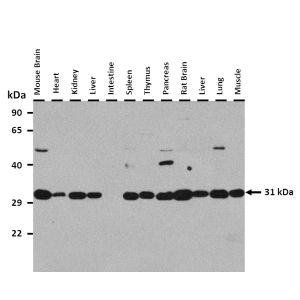 CD40 Antibody - N-terminal region (ARP41929_P050)Catalog #: ARP41929_P050Species Tested: HumanApplication: WBFormat: Liquid. Purified antibody supplied in 1x PBS buffer with 0.09% (w/v) sodium azide and 2% sucrose.
 -
 Anti-CD40 Antibody (OAAI00212)Catalog #: OAAI00212Application: ELISA, FC, IHC, IP, WBFormat: Liquid. This affinity purified antibody is supplied in sterile Phosphatebuffered saline (pH7.2) containing antibody stabilizer
 -
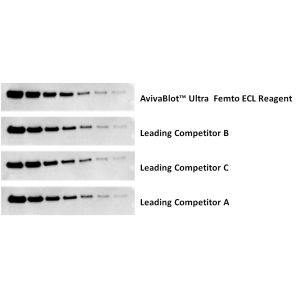
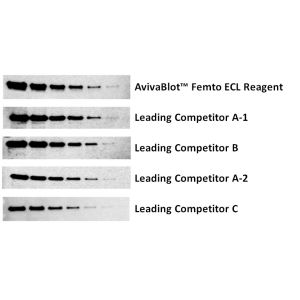 AvivaBlot Femto ECL Reagent (OKCF00002)Catalog #: OKCF00002Application: WBFormat: LiquidSize: 250 mL
 -
-
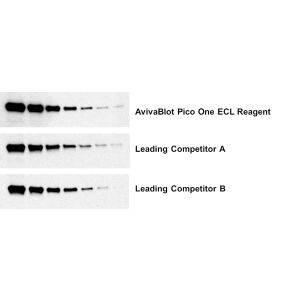 AvivaBlot Pico One ECL Reagent (OKCF00001)Catalog #: OKCF00001Application: WBFormat: LiquidSize: 250 mL