



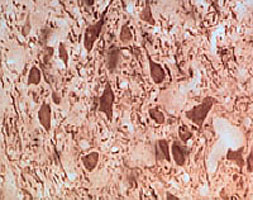
Immunohistochemistry
Immunohistochemical staining of PARK2 in rat brainstem using rabbit PARK2 polyclonal antibody (Cat # PAB0714) . Trigeminal motor neurons are intensely stained.
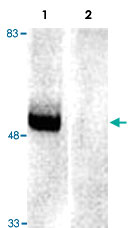
Western Blot (Tissue lysate)
PARK2 immunoreactivity of rat brain extracts and immunobloted with PARK2 polyclonal antibody (Cat # PAB0714) . Lane 1 : Rat brain extracts. Lane 2 : Rat brain extracts preincubated with PARK2.
- Specifications
Product Description
Rabbit polyclonal antibody raised against synthetic peptide of PARK2.
Immunogen
A synthetic peptide (conjugated diphtheria toxoid) corresponding to amino acids 305-323 of human PARK2.
Sequence
RILGEEQYNRYQQYGAEEC
Host
Rabbit
Reactivity
Guinea pig, Human, Rat
Form
Lyophilized
Recommend Usage
ELISA (1:500-1:2000)
Immunohistochemistry (1:500-1:2000)
Western Blot (1:500-1:2000)
The optimal dilution should be determined by the end user.Storage Buffer
Lyophilized from whole serum.
Storage Instruction
Store at 4°C for short term. For long term storage, store at -20 °C on dry atmosphere.
After reconstitution with sterile water, store at -20°C. Centrifuge to remove any insoluble material.
Aliquot to avoid repeated freezing and thawing. - Applications
Immunohistochemistry
Immunohistochemical staining of PARK2 in rat brainstem using rabbit PARK2 polyclonal antibody (Cat # PAB0714) . Trigeminal motor neurons are intensely stained.Enzyme-linked Immunoabsorbent Assay
Western Blot (Tissue lysate)
PARK2 immunoreactivity of rat brain extracts and immunobloted with PARK2 polyclonal antibody (Cat # PAB0714) . Lane 1 : Rat brain extracts. Lane 2 : Rat brain extracts preincubated with PARK2. - Gene Info — PARK2
Entrez GeneID
5071Protein Accession#
O60260Gene Name
PARK2
Gene Alias
AR-JP, LPRS2, PDJ, PRKN
Gene Description
Parkinson disease (autosomal recessive, juvenile) 2, parkin
Gene Ontology
HyperlinkGene Summary
The precise function of this gene is unknown; however, the encoded protein is a component of a multiprotein E3 ubiquitin ligase complex that mediates the targeting of substrate proteins for proteasomal degradation. Mutations in this gene are known to cause Parkinson disease and autosomal recessive juvenile Parkinson disease. Alternative splicing of this gene produces multiple transcript variants encoding distinct isoforms. Additional splice variants of this gene have been described but currently lack transcript support. [provided by RefSeq
Other Designations
E3 ubiquitin ligase|OTTHUMP00000017565|OTTHUMP00000017566|OTTHUMP00000017567|parkin|parkin 2
- Interactomes
- Pathways
- Diseases
- Publication Reference
- LDHB inhibition induces mitophagy and facilitates the progression of CSFV infection.
Shuangqi Fan, Keke Wu, Mingqiu Zhao, Jin Yuan, Shengming Ma, Ereng Zhu, Yuming Chen, Hongxing Ding, Lin Yi, Jinding Chen.
Autophagy 2020 Sep; 1.
Application:WB-Tr, Pig, 3D4/2, PK-15 cells.
- Dual NDP52 Function in Persistent CSFV Infection.
Shuangqi Fan, Keke Wu, Chaowei Luo, Xin Li, Mengpo Zhao, Dan Song, Shengming Ma, Erpeng Zhu, Yuming Chen, Hongxing Ding, Lin Yi, Jun Li, Mingqiu Zhao, Jinding Chen
Front Microbiol 2020 Nov; 10:2962.
- CSFV induced mitochondrial fission and mitophagy to inhibit apoptosis.
Hongchao Gou, Mingqiu Zhao, Hailuan Xu, Jin Yuan, Wencheng He, Mengjiao Zhu, Hongxing Ding, Lin Yi, Jinding Chen
Oncotarget 2017 Jun; 8(24):39382-3940.
- Alternative splicing generates different parkin protein isoforms: evidences in human, rat, and mouse brain.
Soraya Scuderi, Valentina La Cognata, Filippo Drago, Sebastiano Cavallaro, Velia D'Agata
Biomed Res Int 2014 Aug; 2014:690796.
- Increasing the Coding Potential of Genomes Through Alternative Splicing: The Case of PARK2 Gene.
Valentina La Cognata, Rosario Iemmolo, Velia D'Agata, Soraya Scuderi, Filippo Drago, Mario Zappia, Sebastiano Cavallaro
Curr Genomics 2014 Jun; 15(3):203-16.
- LDHB inhibition induces mitophagy and facilitates the progression of CSFV infection.
- Literature Request
Pab, MaxPab, & DNAxPab