



Recombinant human glycoprotein A33 (transmembrane), derived from transfected human HEK293 cells.
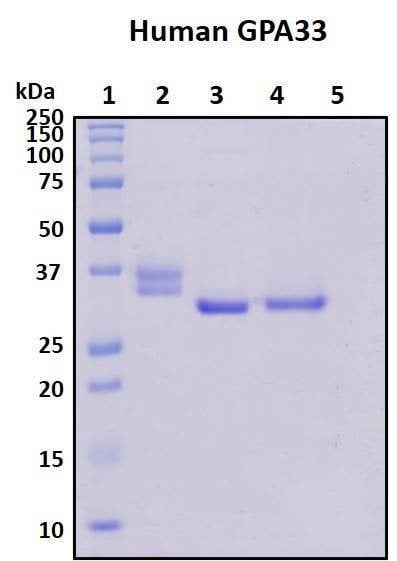
Recombinant Human Glycoprotein A33
Recombinant Human Glycoprotein A33
Contact Us for Bulk Request
Product Description
Specifications
| Size | 10 µg, 50 µg, 200 µg |
| Species | Human |
| Accession Number | Q99795 |
| Gene Symbols | GPA33 |
| Protein Name / Synonyms | Glycoprotein A33, Glycoprotein A33 (Transmembrane), Transmembrane Glycoprotein A33, Transmembrane Glycoprotein A33, A33 |
| Expressed Region | Ile22-Val235 |
| Expression System | HEK293 cells |
| Tag | N-terminal histidine tag |
| Purity | >95% |
| Purity Determined By | SDS-PAGE under reducing conditions and visualized by Coomassie blue staining |
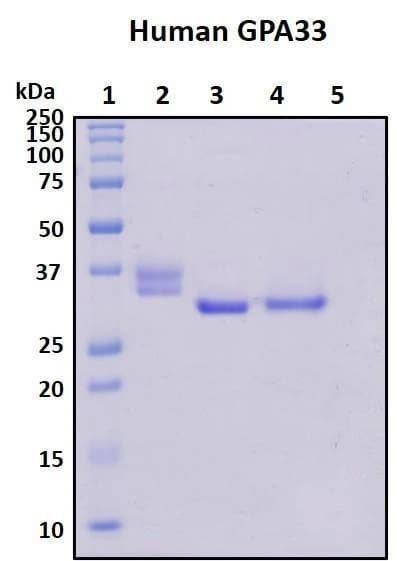
| Molecular Weight (kDa) | Recombinant human GPA33 protein has a calculated molecular mass of 24 kDa. Due to the abundant glycosylation, it migrates as approximately 30-35 kDa protein bands in SDS-PAGE under DTT, beta-mercaptoethanol reducing conditions. |
| Format | Lyophilized powder |
| Formulation | Lyophilized from a 0.2 µm filtered solution in PBS |
| Concentration (lot specific) | Determined by Pierce BCA protein assay kit |
| Reconstitution | Briefly spin the vial and bring the contents to the bottom prior to opening. It is recommended to reconstitute at 0.5 - 1.0 mg/mL with sterile deionized water. |
| Shipping Type | Ambient temperature |
| Storage | -20°C |
Related Products
Recombinant Human Glycoprotein A33, Biotinylated
As low as $186.00
SDS-PAGE Image
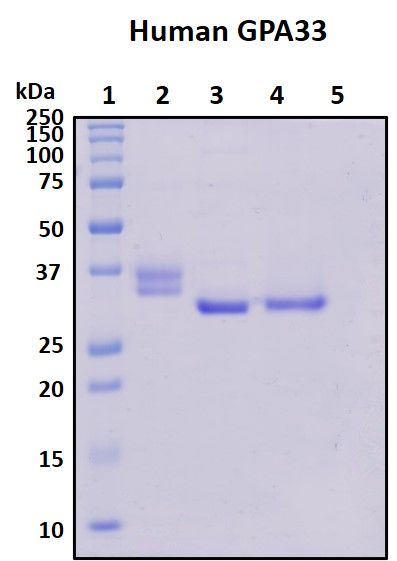
Lane 1: Protein standard ladder (kDa)
Lane 2: Untreated protein under reducing conditions
Lane 3: Treated protein with deglycosylation enzymes under native conditions
Lane 4: Treated protein with deglycosylation enzymes under reducing conditions.
Lane 5: Deglycosylation mixture only without target proteins.
Stability & Storage
Storage/Stability
Upon arrival, the lyophilized protein may be stored for 2 weeks at 4°C. For long term storage, it is recommended to store desiccated below -20 °C in a manual defrost freezer. Following reconstitution, the protein may be stored for 2 weeks under sterile conditions at -20 °C. For long term storage, it is recommended to make appropriate aliquots and store at -80 °C. Avoid repeated freeze-thaw cycles.
Custom Labeling Request
We can custom label this protein with biotin or fluorescent dyes (choose from violet, blue, green or red). Request now.