



Recombinant Monkeypox virus (MPXV) envelope protein A28 homolog with C-terminal His-tag, derived from the transfected human HEK293 cells.
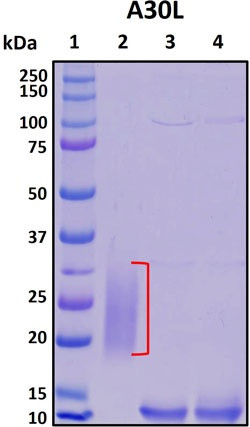
Recombinant Monkeypox Virus Envelope protein A28 homolog, A30L
Recombinant Monkeypox Virus Envelope protein A28 homolog, A30L
Contact Us for Bulk Request
Product Description
Specifications
| Size | 100 µg |
| Species | Monkeypox virus (MPXV) |
| Accession Number | Q8V4U9 |
| Gene Symbols | A30L |
| Expressed Region | Gln22-Leu146 |
| Expression System | HEK293 cells |
| Tag | C-terminal His-tag |
| Purity Determined By | SDS-PAGE under reducing conditions and visualized by Coomassie blue staining |
| Molecular Weight (kDa) | Recombinant protein product has a calculated molecular mass of ∼14 kDa. Due to the abundant glycosylation, it migrates as approximately ∼20-30 kDa protein bands in SDS-PAGE under DTT, beta-mercaptoethanol reducing conditions. |
| Format | Lyophilized powder |
| Formulation | Lyophilized from a 0.2 µm filtered solution in PBS (pH 7.4) with 1% mannitol and 5% trehalose |
| Concentration (lot specific) | Determined by BCA protein assay |
| Reconstitution | Briefly spin the vial and bring the contents to the bottom prior to opening. It is recommended to reconstitute at 0.5 - 1 mg/mL with sterile deionized water. |
| Endotoxin Level | <0.5 EU per µg of the protein as determined by the LAL method |
| Research Area | Infectious Disease, Mpox |
| Shipping Type | Ambient temperature |
| Storage | -20°C |
SDS-PAGE:
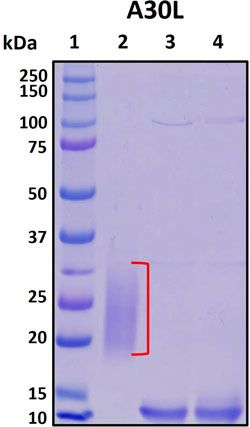
Lane 1: protein standard ladder (kDa).
Lane 2: untreated protein.
Lane 3: treated protein with deglycosylation enzymes under native conditions.
Lane 4: treated protein with deglycosylation enzymes under denature conditions.
Stability & Storage
Storage/Stability
Upon arrival, the protein may be stored for 2 weeks at 4°C. For long term storage, it is recommended to store at -20°C or -80°C in appropriate aliquots. Avoid repeated freeze-thaw cycles.