

Krebs cycle pathway
The Krebs cycle, also known as the citric acid cycle or tricarboxylic acid cycle (TCA cycle), is a fundamental metabolic pathway that plays a critical role in cellular respiration and energy production in aerobic organisms. It occurs in the mitochondrial matrix and consists of eight enzymatic steps that oxidize acetyl-CoA derived from carbohydrates, fats, and proteins into carbon dioxide (CO2), while capturing high-energy electrons in the form of NADH and FADH2, and generating a small amount of ATP or GTP directly.
Overview of the Krebs Cycle
Discovered by Hans Krebs in 1937, the cycle starts with the condensation of a two-carbon acetyl group from acetyl-CoA with a four-carbon molecule oxaloacetate to form citrate, a six-carbon tricarboxylic acid. The cycle then undergoes a series of chemical transformations resulting in the regeneration of oxaloacetate, making it a closed loop. Through these steps, energy-rich electron carriers NADH and FADH2 are produced, which subsequently feed electrons into the respiratory chain to drive ATP synthesis.
Detailed Steps of the Krebs Cycle
Step 1: Formation of Citrate
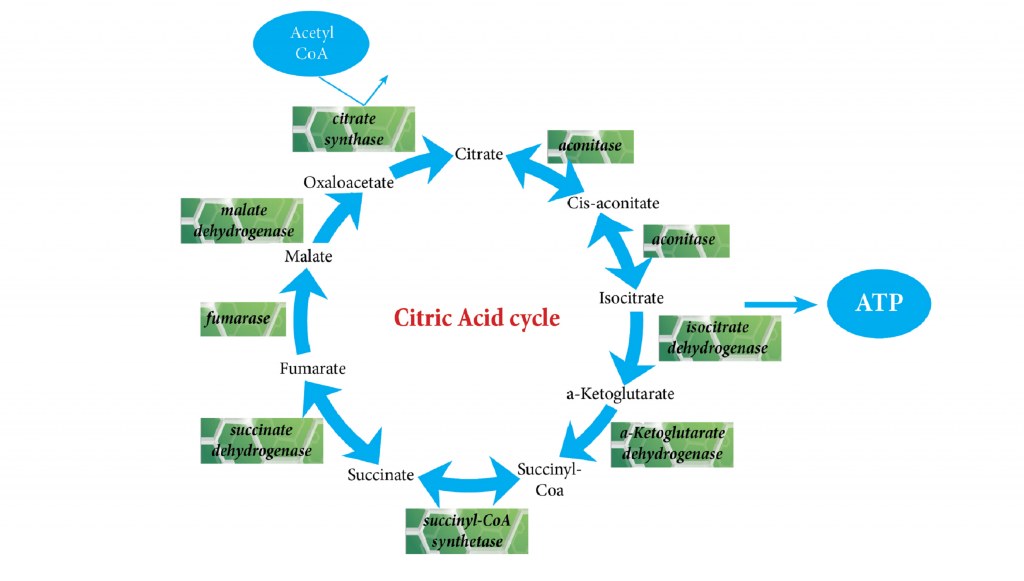
Acetyl-CoA (2 carbons) condenses with oxaloacetate (4 carbons) to form citrate (6 carbons) with the release of coenzyme A (CoA-SH). This reaction is catalyzed by the enzyme citrate synthase.
Step 2: Conversion of Citrate to Isocitrate
Citrate is isomerized to isocitrate via the intermediate cis-aconitate. The enzyme aconitase facilitates this rearrangement.
Step 3: Oxidative Decarboxylation of Isocitrate
Isocitrate undergoes oxidative decarboxylation catalyzed by isocitrate dehydrogenase, forming alpha-ketoglutarate (5 carbons). In this step, one molecule of CO2 is released, and NAD+ is reduced to NADH.
Step 4: Formation of Succinyl-CoA
Alpha-ketoglutarate undergoes another oxidative decarboxylation by the alpha-ketoglutarate dehydrogenase complex, resulting in succinyl-CoA (4 carbons), the release of CO2, and the reduction of NAD+ to NADH.
Step 5: Conversion of Succinyl-CoA to Succinate
Succinyl-CoA is converted to succinate by succinyl-CoA synthetase, concurrently producing GTP (or ATP) by substrate-level phosphorylation. Coenzyme A is also released.
Step 6: Oxidation of Succinate to Fumarate
Succinate is oxidized to fumarate by succinate dehydrogenase. This reaction reduces FAD to FADH2.
Step 7: Hydration of Fumarate to Malate
Fumarate is hydrated to malate by the enzyme fumarase.
Step 8: Oxidation of Malate to Oxaloacetate
Malate is oxidized to oxaloacetate by malate dehydrogenase, reducing NAD+ to NADH and thus completing the cycle.
|
|
Summary of Energy Yield and Function
Each turn of the Krebs cycle produces 3 NADH, 1 FADH2, 1 GTP (or ATP), and releases 2 CO2 molecules as waste. Since one glucose molecule produces two acetyl-CoA molecules, two cycles occur per glucose, doubling the yield. The NADH and FADH2 produced transport electrons to the electron transport chain, where oxidative phosphorylation generates the bulk of cellular ATP. The Krebs cycle is not only central to energy metabolism but also provides precursors for various biosynthetic pathways, making it a key metabolic hub in the cell.