



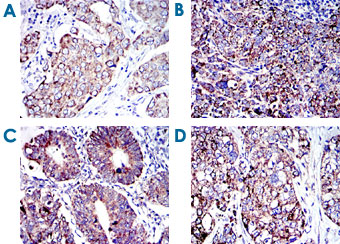
Immunohistochemistry (Formalin/PFA-fixed paraffin-embedded sections)
Immunohistochemical analysis of paraffin-embedded human breast cancer (A), human cervical cancer (B), human rectum cancer (C) and human lung cancer (D) tissues using AIFM1 monoclonal antibody, clone 4E7 (Cat # MAB10484) with DAB staining.
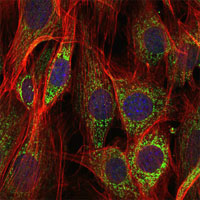
Immunofluorescence
Immunofluorescence analysis of NIH/3T3 cells using AIFM1 monoclonal antibody, clone 4E7 (Cat # MAB10484) (green). Blue: DRAQ5 fluorescent DNA dye. Red: Actin filaments have been labeled with Alexa Fluor-555 phalloidin.
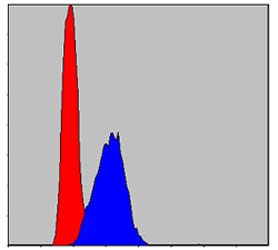
Flow Cytometry
Flow cytometric analysis of HepG2 cells using AIFM1 monoclonal antibody, clone 4E7 (Cat # MAB10484) (blue) and negative control (red).
- Specifications
Product Description
Mouse monoclonal antibody raised against partial recombinant AIFM1.
Immunogen
Recombinant protein corresponding to human AIFM1.
Host
Mouse
Theoretical MW (kDa)
67
Reactivity
Human, Monkey, Mouse, Rat
Form
Liquid
Isotype
IgG2b
Recommend Usage
ELISA (1:10000)
Western Blot (1:500-1:2000)
Immunohistochemistry (1:200-1:1000)
Immunofluorescence (1:200-1:1000)
Flow cytometry (1:200-1:400)
The optimal working dilution should be determined by the end user.Storage Buffer
In ascites (0.03% sodium azide)
Storage Instruction
Store at 4°C. For long term storage store at -20°C.
Aliquot to avoid repeated freezing and thawing. - Applications
Immunohistochemistry (Formalin/PFA-fixed paraffin-embedded sections)
Immunohistochemical analysis of paraffin-embedded human breast cancer (A), human cervical cancer (B), human rectum cancer (C) and human lung cancer (D) tissues using AIFM1 monoclonal antibody, clone 4E7 (Cat # MAB10484) with DAB staining.Immunofluorescence
Immunofluorescence analysis of NIH/3T3 cells using AIFM1 monoclonal antibody, clone 4E7 (Cat # MAB10484) (green). Blue: DRAQ5 fluorescent DNA dye. Red: Actin filaments have been labeled with Alexa Fluor-555 phalloidin.Flow Cytometry
Flow cytometric analysis of HepG2 cells using AIFM1 monoclonal antibody, clone 4E7 (Cat # MAB10484) (blue) and negative control (red).Enzyme-linked Immunoabsorbent Assay
ELISA detection with AIFM1 monoclonal antibody, clone 4E7 (Cat # MAB10484).Western Blot (Cell lysate)
Western blot analysis using AIFM1 monoclonal antibody, clone 4E7 (Cat # MAB10484) against NIH/3T3 (1), Jurkat (2), HeLa (3), HepG2 (4), MOLT 4 (5), C6 (6), Raji (7), COS-7 (8) and PC-12 (9) cell lysate.Western Blot (Recombinant protein)
Western blot analysis using AIFM1 monoclonal antibody, clone 4E7 (Cat # MAB10484) against recombinant protein. - Gene Info — AIFM1
Entrez GeneID
9131Gene Name
AIFM1
Gene Alias
AIF, MGC111425, PDCD8
Gene Description
apoptosis-inducing factor, mitochondrion-associated, 1
Omim ID
300169Gene Ontology
HyperlinkGene Summary
This gene encodes a flavoprotein essential for nuclear disassembly in apoptotic cells that is found in the mitochondrial intermembrane space in healthy cells. Induction of apoptosis results in the translocation of this protein to the nucleus where it effects chromosome condensation and fragmentation. In addition, this gene product induces mitochondria to release the apoptogenic proteins cytochrome c and caspase-9. Several alternative transcripts encoding different isoforms have been identified for this gene. [provided by RefSeq
Other Designations
OTTHUMP00000024007|OTTHUMP00000024008|OTTHUMP00000024009|programmed cell death 8|programmed cell death 8 (apoptosis-inducing factor)|striatal apoptosis-inducing factor
- Interactomes
- Pathways
- Diseases