

Anti-GAPDH (GA1R) Loading Control Monoclonal Antibody

Cat# MBS525009-0,05mg
Size : 0.05mg
Brand : MyBiosource
Contact local distributor :

Phone : +1 850 650 7790
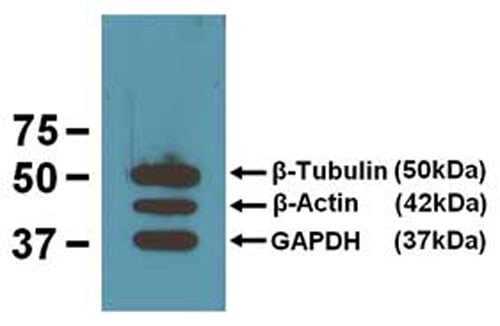
Fig. 01 EBI's three loading control mAbs reacting against 10ug/lane of mouse brain tissue lysates. 50kDa band is Anti-beta-Tubulin (BT7R) at 1:2000 dilution (0.5ug/mL); 42kDa band is Anti-beta-Actin (BA3R) at 1:1000 dilution (1ug/mL); 37kDa band is Anti-GAPDH (GA1R) at 1:5000 dilution (0.2ug/mL)
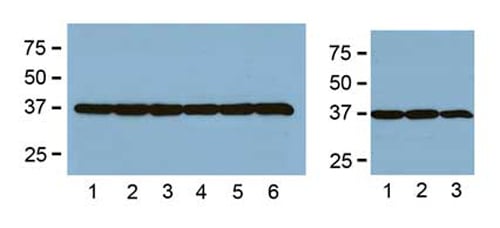
Fig. 02 LEFT: 1:2000 (0.5ug/mL) Ab dilution used in WB of 5ug/lane tissue lysates from human (1), mouse (2), rat (3), rabbit (4), chicken (5), and hamster (6). RIGHT: WB from BL-21 bacteria (1), Sf9 insect (2), and Saccharomyces cerevisiae (3)
GAPDH Antibody – Mouse Monoclonal
For Research Use Only. Not for use in diagnostic procedures. Catalog #: MBS525009MBS525009 is an antibody targeting Gapdh. Also known as Anti-GAPDH (GA1R) Loading Control Monoclonal Antibody. Reactive in GAPDH from BL-21 bacteria, Sf9 insect, Saccharomyces cerevisiae (yeast), human, mouse, rat, rabbit, chicken, and hamster. GAPDH from… More details
Product Overview
Online Datasheet in PDFProduct Name
GAPDH, Monoclonal Antibody
Full Product Name
Anti-GAPDH (GA1R) Loading Control Monoclonal Antibody
Product Gene Name
anti-Gapdh antibody
Product Synonym Names
Anti-GAPDH
Clonality
Monoclonal
Isotype
IgG1
Clone Number
GA1R
Host
Mouse
Species Reactivity
GAPDH from BL-21 bacteria, Sf9 insect, Saccharomyces cerevisiae (yeast), human, mouse, rat, rabbit, chicken, and hamster. GAPDH from other species may also be detectable
Form/Format
Liquid: 1mg/ml in 10mM PBS, pH 7.2, with 0.05% NaN3.
Lyophilized: 1mg/ml Lyophilized in 10mM PBS, pH 7.2, with 1% BSA and 0.05% NaN3.
Lyophilized: 1mg/ml Lyophilized in 10mM PBS, pH 7.2, with 1% BSA and 0.05% NaN3.
Purity/Purification
Protein A affinity chromatography from mouse ascites fluid
Specificity
Recognizes native and denatured forms of GAPDH (~37kDa)
Preparation and Storage
Liquid: Store at -20 degree C for 2 years or more. Centrifuge after first thaw to maximize product recovery. Aliquot to avoid repeated freeze-thaw cycles. Store aliquots at 4 degree C for several days to weeks.
Lyophilized: Store at -20 degree C for 3 years or more. Reconstitute with distilled water to desired concentration before use. Aliquot to avoid repeated freeze-thaw cycles. Store aliquots at 4 degree C for several days to weeks.
Lyophilized: Store at -20 degree C for 3 years or more. Reconstitute with distilled water to desired concentration before use. Aliquot to avoid repeated freeze-thaw cycles. Store aliquots at 4 degree C for several days to weeks.
Applications Tested/Suitable for anti-Gapdh antibody
Dot Blot (DB), ELISA (EIA), Immunostaining (IS), Western Blot (WB)
Application Notes for anti-Gapdh antibody
WB (with ECL): 1:1000-100,000 dilution (incubate for 1 hour at room temperature)
For best results with other assays please determine optimal working dilution by titration test.
For best results with other assays please determine optimal working dilution by titration test.
Testing Data of anti-Gapdh antibody
Fig. 01 EBI's three loading control mAbs reacting against 10ug/lane of mouse brain tissue lysates. 50kDa band is Anti-beta-Tubulin (BT7R) at 1:2000 dilution (0.5ug/mL); 42kDa band is Anti-beta-Actin (BA3R) at 1:1000 dilution (1ug/mL); 37kDa band is Anti-GAPDH (GA1R) at 1:5000 dilution (0.2ug/mL)
Other Notes
Small volumes of anti-Gapdh antibody vial(s) may occasionally become entrapped in the seal of the product vial during shipment and storage. If necessary, briefly centrifuge the vial on a tabletop centrifuge to dislodge any liquid in the container`s cap. Certain products may require to ship with dry ice and additional dry ice fee may apply.
Additional Details
NCBI/Uniprot data below describe general gene information for Gapdh. It may not necessarily be applicable to this product.
NCBI Official Full Name
Glyceraldehyde-3-phosphate dehydrogenase
NCBI Official Synonym Full Names
glyceraldehyde-3-phosphate dehydrogenase
NCBI Official Symbol
Gapdh
NCBI Official Synonym Symbols
Gapd
UniProt Protein Name
Glyceraldehyde-3-phosphate dehydrogenase
UniProt Synonym Protein Names
38 kDa BFA-dependent ADP-ribosylation substrate; BARS-38; Peptidyl-cysteine S-nitrosylase GAPDH
Protein Family
Glyceraldehyde-3-phosphate dehydrogenase
UniProt Gene Name
Gapdh
UniProt Synonym Gene Names
Gapd; GAPDH
UniProt Entry Name
G3P_RAT
NCBI Protein Information
glyceraldehyde-3-phosphate dehydrogenase; BARS-38; peptidyl-cysteine S-nitrosylase GAPDH; 38 kDa BFA-dependent ADP-ribosylation substrate
NCBI Summary for Gapdh
catalyzes the interconversion of D-glyceraldehyde 3-phosphate, phosphate, and NAD(+) to 3-phospho-D-glyceroyl phosphate and NADH; may contribute to apoptosis [RGD, Feb 2006]
UniProt Comments for Gapdh
Function: Has both glyceraldehyde-3-phosphate dehydrogenase and nitrosylase activities, thereby playing a role in glycolysis and nuclear functions, respectively. Glyceraldehyde-3-phosphate dehydrogenase is a key enzyme in glycolysis that catalyzes the first step of the pathway by converting D-glyceraldehyde 3-phosphate (G3P) into 3-phospho-D-glyceroyl phosphate. Modulates the organization and assembly of the cytoskeleton. Facilitates the CHP1-dependent microtubule and membrane associations through its ability to stimulate the binding of CHP1 to microtubules. Also participates in nuclear events including transcription, RNA transport, DNA replication and apoptosis. Nuclear functions are probably due to the nitrosylase activity that mediates cysteine S-nitrosylation of nuclear target proteins such as SIRT1, HDAC2 and PRKDC. Component of the GAIT (gamma interferon-activated inhibitor of translation) complex which mediates interferon-gamma-induced transcript-selective translation inhibition in inflammation processes. Upon interferon-gamma treatment assembles into the GAIT complex which binds to stem loop-containing GAIT elements in the 3'-UTR of diverse inflammatory mRNAs (such as ceruplasmin) and suppresses their translation
By similarity. Ref.3 Ref.12 Ref.13 Ref.15
Catalytic activity: D-glyceraldehyde 3-phosphate + phosphate + NAD+ = 3-phospho-D-glyceroyl phosphate + NADH.
Pathway: Carbohydrate degradation; glycolysis; pyruvate from D-glyceraldehyde 3-phosphate: step 1/5.
Subunit structure: Homotetramer. Interacts with EIF1AD, USP25, PRKCI and WARS. Interacts with TPPP; the interaction is direct
By similarity. Interacts (when S-nitrosylated) with SIAH1; leading to nuclear translocation. Interacts with RILPL1/GOSPEL, leading to prevent the interaction between GAPDH and SIAH1 and prevent nuclear translocation. Interacts with CHP1; the interaction increases the binding of CHP1 with microtubules. Associates with microtubules. Component of the GAIT complex
By similarity. Ref.12 Ref.13 Ref.14 Ref.15
Subcellular location: Cytoplasm › cytosol. Cytoplasm › cytoskeleton. Nucleus. Note: Translocates to the nucleus following S-nitrosylation and interaction with SIAH1, which contains a nuclear localization signal. Colocalizes with CHP1 to small punctate structures along the microtubules tracks. Ref.12 Ref.13 Ref.14 Ref.15
Tissue specificity: High levels in skeletal muscle and heart, low levels in liver, brain, and kidney. Ref.8
Post-translational modification: S-nitrosylation of Cys-150 leads to interaction with SIAH1, followed by translocation to the nucleus. The effect of S-nitrosylation on enzymatic activity is unclear: according to some authors, it inhibits enzymatic activity and increases endogenous ADP-ribosylation, inhibiting the enzyme in a non-reversible manner (Ref.11). According to others, it does not affect glycolysis (Ref.13). ADP-ribosylation is likely to be a pathophysiological event associated with inhibition of gluconeogenesis.ISGylated
By similarity.Sulfhydration at Cys-150 increases catalytic activity
By similarity.
Sequence similarities: Belongs to the glyceraldehyde-3-phosphate dehydrogenase family.
Show more By similarity. Ref.3 Ref.12 Ref.13 Ref.15
Catalytic activity: D-glyceraldehyde 3-phosphate + phosphate + NAD+ = 3-phospho-D-glyceroyl phosphate + NADH.
Pathway: Carbohydrate degradation; glycolysis; pyruvate from D-glyceraldehyde 3-phosphate: step 1/5.
Subunit structure: Homotetramer. Interacts with EIF1AD, USP25, PRKCI and WARS. Interacts with TPPP; the interaction is direct
By similarity. Interacts (when S-nitrosylated) with SIAH1; leading to nuclear translocation. Interacts with RILPL1/GOSPEL, leading to prevent the interaction between GAPDH and SIAH1 and prevent nuclear translocation. Interacts with CHP1; the interaction increases the binding of CHP1 with microtubules. Associates with microtubules. Component of the GAIT complex
By similarity. Ref.12 Ref.13 Ref.14 Ref.15
Subcellular location: Cytoplasm › cytosol. Cytoplasm › cytoskeleton. Nucleus. Note: Translocates to the nucleus following S-nitrosylation and interaction with SIAH1, which contains a nuclear localization signal. Colocalizes with CHP1 to small punctate structures along the microtubules tracks. Ref.12 Ref.13 Ref.14 Ref.15
Tissue specificity: High levels in skeletal muscle and heart, low levels in liver, brain, and kidney. Ref.8
Post-translational modification: S-nitrosylation of Cys-150 leads to interaction with SIAH1, followed by translocation to the nucleus. The effect of S-nitrosylation on enzymatic activity is unclear: according to some authors, it inhibits enzymatic activity and increases endogenous ADP-ribosylation, inhibiting the enzyme in a non-reversible manner (Ref.11). According to others, it does not affect glycolysis (Ref.13). ADP-ribosylation is likely to be a pathophysiological event associated with inhibition of gluconeogenesis.ISGylated
By similarity.Sulfhydration at Cys-150 increases catalytic activity
By similarity.
Sequence similarities: Belongs to the glyceraldehyde-3-phosphate dehydrogenase family.
Precautions
All of MyBioSource's Products are for scientific laboratory research purposes and are not for diagnostic, therapeutics, prophylactic or in vivo use. Through your purchase, you expressly represent and warrant to MyBioSource that you will properly test and use any Products purchased from MyBioSource in accordance with industry standards. MyBioSource and its authorized distributors reserve the right to refuse to process any order where we reasonably believe that the intended use will fall outside of our acceptable guidelines.
Disclaimer
While every efforts were made to ensure the accuracy of the information provided in this datasheet, MyBioSource will not be liable for any omissions or errors contained herein. MyBioSource reserves the right to make changes to this datasheet at any time without prior notice.
It is the responsibility of the customer to report product performance issues to MyBioSource within 30 days of receipt of the product. Please visit our Terms & Conditions page for more information.
It is the responsibility of the customer to report product performance issues to MyBioSource within 30 days of receipt of the product. Please visit our Terms & Conditions page for more information.
Product Note
Select online data sheet information is drawn from bioinformatics databases, occasionally resulting in ambiguous or non-relevant product information. It is the responsibility of the customer to review, verify, and evaluate the information to make sure it matches their requirements before purchasing the kit. Our ELISA Kit assays are dynamic research tools and sometimes they may be updated and improved. If the format of this assay is important to you then please request the current manual or contact our technical support team with a presales inquiry before placing an order. We will confirm the current details of the assay. We cannot guarantee the sample manual posted online is the most current manual, it is intended to serve as an example only. Please refer to the instructions For Use provided with the assay kit for precise details.
Product PubMed Publications
Products associated with anti-Gapdh antibody
| Reference Product | PubMed Publications |
|---|---|
| Actb antibody | >181 publications with Gapdh and Actb |
| Egfr antibody | >13 publications with Gapdh and Egfr |
| Alb antibody | >6 publications with Gapdh and Alb |
| Akt1 antibody | >4 publications with Gapdh and Akt1 |
| Il2 antibody | >1 publications with Gapdh and Il2 |
| Fn1 antibody | >1 publications with Gapdh and Fn1 |
Pathways associated with anti-Gapdh antibody
| Products by Pathway | Pathway Diagram |
|---|---|
| Alzheimer's Disease Pathway antibodies | Alzheimer's Disease Pathway Diagram |
| Alzheimer's Disease Pathway antibodies | Alzheimer's Disease Pathway Diagram |
| Androgen Receptor Signaling Pathway antibodies | Androgen Receptor Signaling Pathway Diagram |
| Biosynthesis Of Amino Acids Pathway antibodies | Biosynthesis Of Amino Acids Pathway Diagram |
| Biosynthesis Of Amino Acids Pathway antibodies | Biosynthesis Of Amino Acids Pathway Diagram |
| Carbon Metabolism Pathway antibodies | Carbon Metabolism Pathway Diagram |
| Carbon Metabolism Pathway antibodies | Carbon Metabolism Pathway Diagram |
| Gluconeogenesis, Oxaloacetate => Fructose-6P Pathway antibodies | Gluconeogenesis, Oxaloacetate => Fructose-6P Pathway Diagram |
| Gluconeogenesis, Oxaloacetate => Fructose-6P Pathway antibodies | Gluconeogenesis, Oxaloacetate => Fructose-6P Pathway Diagram |
| Glycolysis (Embden-Meyerhof Pathway), Glucose => Pyruvate antibodies | Glycolysis (Embden-Meyerhof Pathway), Glucose => Pyruvate Diagram |
Diseases associated with anti-Gapdh antibody
| Disease Name | Pubmed Publications |
|---|---|
| Neoplasms Antibodies | >594 publications with Gapdh and Neoplasms |
| Nervous System Diseases Antibodies | >234 publications with Gapdh and Nervous System Diseases |
| Cardiovascular Diseases Antibodies | >215 publications with Gapdh and Cardiovascular Diseases |
| Necrosis Antibodies | >181 publications with Gapdh and Necrosis |
| Brain Diseases Antibodies | >180 publications with Gapdh and Brain Diseases |
| Inflammation Antibodies | >158 publications with Gapdh and Inflammation |
| Heart Diseases Antibodies | >128 publications with Gapdh and Heart Diseases |
| Liver Diseases Antibodies | >110 publications with Gapdh and Liver Diseases |
| Kidney Diseases Antibodies | >84 publications with Gapdh and Kidney Diseases |
| Liver Neoplasms Antibodies | >64 publications with Gapdh and Liver Neoplasms |
Organs/Tissues associated with anti-Gapdh antibody
| Organ/Tissue Name | Pubmed Publications |
|---|---|
| Muscle Antibodies | >490 publications with Gapdh and Muscle |
| Brain Antibodies | >433 publications with Gapdh and Brain |
| Liver Antibodies | >345 publications with Gapdh and Liver |
| Heart Antibodies | >258 publications with Gapdh and Heart |
| Kidney Antibodies | >217 publications with Gapdh and Kidney |
| Lung Antibodies | >194 publications with Gapdh and Lung |
| Embryonic Tissue Antibodies | >109 publications with Gapdh and Embryonic Tissue |
| Eye Antibodies | >84 publications with Gapdh and Eye |
| Connective Tissue Antibodies | >71 publications with Gapdh and Connective Tissue |
| Placenta Antibodies | >59 publications with Gapdh and Placenta |