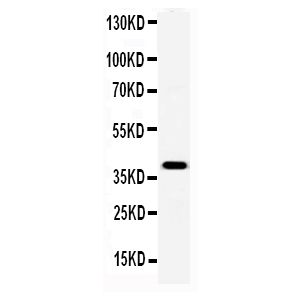

APCS Antibody - N-terminal region - Biotin

Cat# ARP41962_T100-Biotin
Size : 100ul
Brand : Aviva Systems Biology
Contact local distributor :
 Phone : +1 850 650 7790
APCS Antibody - N-terminal region : Biotin (ARP41962_T100-Biotin)
| Datasheets/Manuals | Printable datasheet for anti-APCS (ARP41962_T100-Biotin) antibody |
|---|
| Predicted Species Reactivity | Human, Mouse, Rat, Guinea Pig |
|---|---|
| Product Format | Liquid. Purified antibody supplied in 1x PBS buffer. |
| Clonality | Polyclonal |
| Host | Rabbit |
| Conjugation | Biotin |
| Application | IHC, WB |
| Reconstitution and Storage | All conjugated antibodies should be stored in light-protected vials or covered with a light protecting material (i.e. aluminum foil). Conjugated antibodies are stable for at least 12 months at 4C. If longer storage is desired (24 months), conjugates may be diluted with up to 50% glycerol and stored at -20C to -80C. Freezing and thawing conjugated antibodies will compromise enzyme activity as well as antibody binding. |
| Immunogen | The immunogen is a synthetic peptide directed towards the N terminal region of human APCS |
| Predicted Homology Based on Immunogen Sequence | Guinea Pig: 86%; Human: 100%; Mouse: 77%; Rat: 93% |
| Peptide Sequence | Synthetic peptide located within the following region: NFTLCFRAYSDLSRAYSLFSYNTQGRDNELLVYKERVGEYSLYIGRHKVT |
| Concentration | 0.5 mg/ml |
| Blocking Peptide | For anti-APCS (ARP41962_T100-Biotin) antibody is Catalog # AAP41962 (Previous Catalog # AAPS11103) |
| Reference | Veerhuis,R., Neurobiol. Dis. 19 (1-2), 273-282 (2005) |
|---|---|
| Gene Symbol | APCS |
| Gene Full Name | Amyloid P component, serum |
| Alias Symbols | SAP, PTX2, HEL-S-92n |
| NCBI Gene Id | 325 |
| Protein Name | Serum amyloid P-component |
| Description of Target | APCS is a glycoprotein, belonging to the pentraxin family of proteins, which has a characteristic pentameric organization. These family members have considerable sequence homology which is thought to be the result of gene duplication. The binding of the protein to proteins in the pathological amyloid cross-beta fold suggests its possible role as a chaperone. This protein is also thought to control the degradation of chromatin. It has been demonstrated that this protein binds to apoptotic cells at an early stage, which raises the possibility that it is involved in dealing with apoptotic cells in vivo.The protein encoded by this gene is a glycoprotein, belonging to the pentraxin family of proteins, which has a characteristic pentameric organization. These family members have considerable sequence homology which is thought to be the result of gene duplication. The binding of the encoded protein to proteins in the pathological amyloid cross-beta fold suggests its possible role as a chaperone. This protein is also thought to control the degradation of chromatin. It has been demonstrated that this protein binds to apoptotic cells at an early stage, which raises the possibility that it is involved in dealing with apoptotic cells in vivo. This gene has multiple polyadenylation sites. |
| Uniprot ID | P02743 |
| Protein Accession # | NP_001630 |
| Nucleotide Accession # | NM_001639 |
| Protein Size (# AA) | 223 |
| Molecular Weight | 25kDa |
| Protein Interactions | COPS5; GK; HES1; GRB2; GOT2; FCGR3B; FCGR2B; CALU; TG; LAMA1; FCGR1A; FCGR3A; FN1; CRP; C4BPA; C1QA; COL4A1; APCS; |