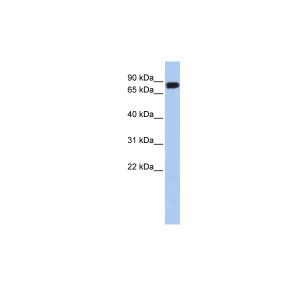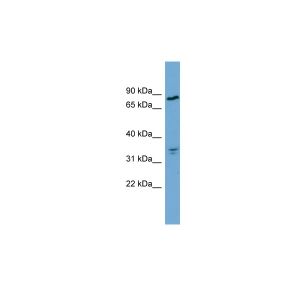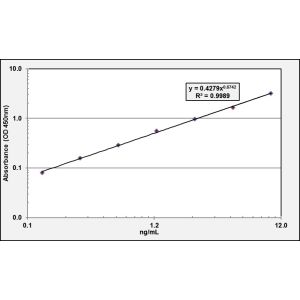

APEH Antibody - N-terminal region - Biotin

Cat# ARP48181_P050-Biotin
Size : 100ul
Brand : Aviva Systems Biology
Contact local distributor :
 Phone : +1 850 650 7790
APEH Antibody - N-terminal region : Biotin (ARP48181_P050-Biotin)
| Datasheets/Manuals | Printable datasheet for anti-APEH (ARP48181_P050-Biotin) antibody |
|---|
| Predicted Species Reactivity | Human, Mouse, Rat, Cow, Dog, Guinea Pig, Horse, Rabbit, Zebrafish |
|---|---|
| Product Format | Liquid. Purified antibody supplied in 1x PBS buffer. |
| Clonality | Polyclonal |
| Host | Rabbit |
| Conjugation | Biotin |
| Application | WB, IHC |
| Reconstitution and Storage | All conjugated antibodies should be stored in light-protected vials or covered with a light protecting material (i.e. aluminum foil). Conjugated antibodies are stable for at least 12 months at 4C. If longer storage is desired (24 months), conjugates may be diluted with up to 50% glycerol and stored at -20C to -80C. Freezing and thawing conjugated antibodies will compromise enzyme activity as well as antibody binding. |
| Immunogen | The immunogen is a synthetic peptide directed towards the N terminal region of human APEH |
| Purification | Affinity Purified |
| Predicted Homology Based on Immunogen Sequence | Cow: 100%; Dog: 93%; Guinea Pig: 100%; Horse: 100%; Human: 100%; Mouse: 100%; Rabbit: 100%; Rat: 100%; Zebrafish: 83% |
| Peptide Sequence | Synthetic peptide located within the following region: VYEDDCFGCLSWSHSETHLLYVAEKKRPKAESFFQTKALDVSASDDEIAR |
| Concentration | 0.5 mg/ml |
| Blocking Peptide | For anti-APEH (ARP48181_P050-Biotin) antibody is Catalog # AAP48181 (Previous Catalog # AAPP28690) |
| Sample Type Confirmation | APEH is supported by BioGPS gene expression data to be expressed in 721_B |
| Reference | Pope,S.N. J. Steroid Biochem. Mol. Biol. 94 (1-3), 203-208 (2005) |
|---|---|
| Gene Symbol | APEH |
| Gene Full Name | N-acylaminoacyl-peptide hydrolase |
| Alias Symbols | APH, OPH, AARE, ACPH, D3S48E, D3F15S2, DNF15S2 |
| NCBI Gene Id | 327 |
| Protein Name | Acylamino-acid-releasing enzyme |
| Description of Target | APEH is the enzyme acylpeptide hydrolase, which catalyzes the hydrolysis of the terminal acetylated amino acid preferentially from small acetylated peptides. The acetyl amino acid formed by this hydrolase is further processed to acetate and a free amino acid by an aminoacylase. This gene is located within the same region of chromosome 3 (3p21) as the aminoacylase gene, and deletions at this locus are also associated with a decrease in aminoacylase activity. The acylpeptide hydrolase is a homotetrameric protein of 300 kDa with each subunit consisting of 732 amino acid residues. It can play an important role in destroying oxidatively damaged proteins in living cells. Deletions of this gene locus are found in various types of carcinomas, including small cell lung carcinoma and renal cell carcinoma.This gene encodes the enzyme acylpeptide hydrolase, which catalyzes the hydrolysis of the terminal acetylated amino acid preferentially from small acetylated peptides. The acetyl amino acid formed by this hydrolase is further processed to acetate and a free amino acid by an aminoacylase. This gene is located within the same region of chromosome 3 (3p21) as the aminoacylase gene, and deletions at this locus are also associated with a decrease in aminoacylase activity. The acylpeptide hydrolase is a homotetrameric protein of 300 kDa with each subunit consisting of 732 amino acid residues. It can play an important role in destroying oxidatively damaged proteins in living cells. Deletions of this gene locus are found in various types of carcinomas, including small cell lung carcinoma and renal cell carcinoma. Publication Note: This RefSeq record includes a subset of the publications that are available for this gene. Please see the Entrez Gene record to access additional publications. |
| Uniprot ID | P13798 |
| Protein Accession # | NP_001631 |
| Nucleotide Accession # | NM_001640 |
| Protein Size (# AA) | 732 |
| Molecular Weight | 81kDa |
| Protein Interactions | IST1; UBC; LGALS8; APEH; SNX6; CAND1; TOLLIP; CYHR1; JMJD6; HSPA4L; IPO7; DNM1L; VPS26A; NMI; H1FX; ZYX; TBCD; TARS; STAT1; SHMT2; SHMT1; PPM1G; SERPINE2; PAWR; LAMP2; KARS; HIST1H1C; GARS; CTTN; CARS; PREPL; SHBG; UBA5; TMEM62; |