
CD163 Antibody

Cat# OAEE00676
Size : 100tests(T100)
Brand : Aviva Systems Biology
Contact local distributor :
 Phone : +1 850 650 7790
| Datasheets/Manuals | Printable datasheet for CD163 Antibody |
|---|
| Predicted Species Reactivity | Human |
|---|---|
| Product Format | Stabilizing phosphate buffered saline (PBS), pH 7.4, 15 mM sodium azide |
| Clonality | Monoclonal |
| Clone | GHI/61 |
| Isotype | IgG1 |
| Host | Mouse |
| Conjugation | APC |
| Application | FC |
| Reconstitution and Storage | 2°C to 8°C |
| Immunogen | Hairy cell leukemia cells |
| Purification | Purified by size-exclusion chromatography |
| Concentration | 10 ul / test |
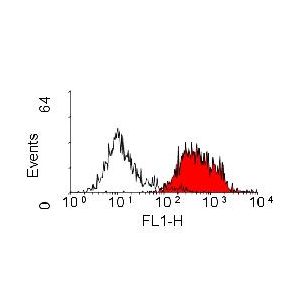
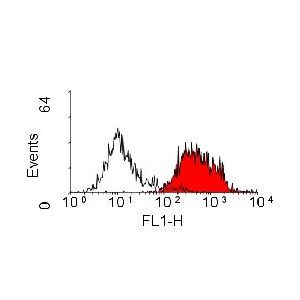
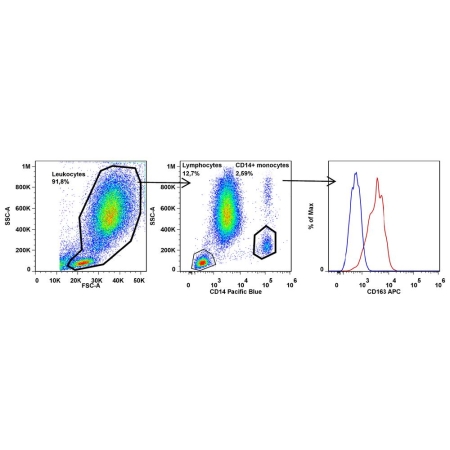
| Specificity | The mouse monoclonal antibody GHI/61 recognizes CD163, an approximately 130 kDa high affinity scavenger receptor expressed mainly on monocytes and macrophages, which binds hemoglobin-haptoglobin complex. HLDA VI; WS Code M38 |
| Formulation | APC |
| Storage Buffer | The reagent is provided in phosphate buffered saline (PBS) containing 15 mM sodium azide and 0.2% (w/v) high-grade protease free Bovine Serum Albumin (BSA) as a stabilizing agent. |
| Reference | Pulford K, Micklem K, McCarthy S, Cordell J, Jones M, Mason DY: A monocyte/macrophage antigen recognized by the four antibodies GHI/61, Ber-MAC3, Ki-M8 and SM4. Immunology. 1992 Apr;75(4):588-95. Kusi KA, Gyan BA, Goka BQ, Dodoo D, Obeng-Adjei G, Troye-Blomberg M, Akanmori BD, Adjimani JP: Levels of soluble CD163 and severity of malaria in children in Ghana. Clin Vaccine Immunol. 2008 Sep;15(9):1456-60. Bover LC, Cardó-Vila M, Kuniyasu A, Sun J, Rangel R, Takeya M, Aggarwal BB, Arap W, Pasqualini R: A previously unrecognized protein-protein interaction between TWEAK and CD163: potential biological implications. J Immunol. 2007 Jun 15;178(12):8183-94. Moniuszko M, Kowal K, Rusak M, Pietruczuk M, Dabrowska M, Bodzenta-Lukaszyk A: Monocyte CD163 and CD36 expression in human whole blood and isolated mononuclear cell samples: influence of different anticoagulants. Clin Vaccine Immunol. 2006 Jun;13(6):704-7. Kim WK, Alvarez X, Fisher J, Bronfin B, Westmoreland S, McLaurin J, Williams K: CD163 identifies perivascular macrophages in normal and viral encephalitic brainsand potential precursors to perivascular macrophages in blood. Am J Pathol. 2006 Mar;168(3):822-34. Philippidis P, Mason JC, Evans BJ, Nadra I, Taylor KM, Haskard DO, Landis RC: Hemoglobin scavenger receptor CD163 mediates interleukin-10 release and hemeoxygenase-1 synthesis: antiinflammatory monocyte-macrophage responses in vitro, in resolving skin blisters in vivo, and after cardiopulmonary bypass surgery. Circ Res. 2004 Jan 9;94(1):119-26. Madsen M, Møller HJ, Nielsen MJ, Jacobsen C, Graversen JH, van den Berg T, Moestrup SK: Molecular characterization of the haptoglobin.hemoglobin receptor CD163. Ligandbinding properties of the scavenger receptor cysteine-rich domain region. J Biol Chem. 2004 Dec 3;279(49):51561-7. Møller HJ, Peterslund NA, Graversen JH, Moestrup SK: Identification of the hemoglobin scavenger receptor/CD163 as a natural soluble protein in plasma. Blood. 2002 Jan 1;99(1):378-80. Leukocyte Typing VI., Kishimoto T. et al. (Eds.), Garland Publishing Inc. (1997). Law SK, Micklem KJ, Shaw JM, Zhang XP, Dong Y, Willis AC, Mason DY: A new macrophage differentiation antigen which is a member of the scavenger receptor superfamily. Eur J Immunol. 1993 Sep;23(9):2320-5. And many other. |
|---|---|
| Gene Symbol | CD163 |
| Gene Full Name | CD163 molecule |
| Alias Symbols | hemoglobin scavenger receptor, M130, macrophage-associated antigen, MM130, SCARI1, scavenger receptor cysteine-rich type 1 protein M130. |
| NCBI Gene Id | 9332 |
| Protein Name | Scavenger receptor cysteine-rich type 1 protein M130 |
| Description of Target | Acute phase-regulated receptor involved in clearance and endocytosis of hemoglobin/haptoglobin complexes by macrophages and may thereby protect tissues from free hemoglobin-mediated oxidative damage. May play a role in the uptake and recycling of iron, via endocytosis of hemoglobin/haptoglobin and subsequent breakdown of heme. Binds hemoglobin/haptoglobin complexes in a calcium-dependent and pH-dependent manner. Exhibits a higher affinity for complexes of hemoglobin and multimeric haptoglobin of HP*1F phenotype than for complexes of hemoglobin and dimeric haptoglobin of HP*1S phenotype. Induces a cascade of intracellular signals that involves tyrosine kinase-dependent calcium mobilization, inositol triphosphate production and secretion of IL6 and CSF1. Isoform 3 exhibits the higher capacity for ligand endocytosis and the more pronounced surface expression when expressed in cells. |
| Uniprot ID | Q86VB7 |
| Protein Accession # | NP_004235.4; NP_981961.2 |
| Nucleotide Accession # | NM_004244.5; NM_203416.3 |