CD4 Antibody

Cat# OAEE00849
Size : 0.1mg(C100)
Brand : Aviva Systems Biology
Contact local distributor :

Phone : +1 850 650 7790
| Datasheets/Manuals | Printable datasheet for CD4 Antibody |
|---|
| Predicted Species Reactivity | Mouse |
|---|---|
| Product Format | Phosphate buffered saline (PBS), pH 7.4, 15 mM sodium azide |
| Clonality | Monoclonal |
| Clone | GK1.5 |
| Isotype | IgG2b |
| Host | Rat |
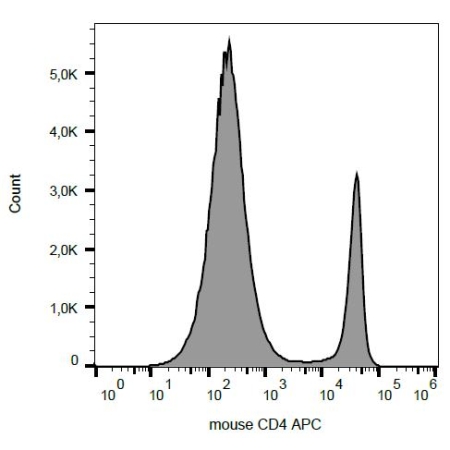
| Conjugation | APC |
| Application | FC |
| Reconstitution and Storage | 2°C to 8°C |
| Immunogen | Mouse CTL clone V4 cells |
| Purification | Purified by size-exclusion chromatography |
| Concentration | 0.5 mg/ml |
| Specificity | The rat monoclonal antibody GK1.5 reacts with an extracellular epitope of mouse CD4 transmembrane glycoprotein (55 kDa). |
| Formulation | APC |
| Storage Buffer | Phosphate buffered saline (PBS) with 15 mM sodium azide, approx. pH 7.4 |
| Reference | Yi H, Zhen Y, Zeng C, Zhang L, Zhao Y: Depleting anti-CD4 monoclonal antibody (GK1.5) treatment: influence on regulatory CD4+CD25+Foxp3+ T cells in mice. Transplantation. 2008 Apr 27;85(8):1167-74. Hu M, Watson D, Zhang GY, Graf N, Wang YM, Sartor M, Howden B, Fletcher J, Alexander SI: Long-term cardiac allograft survival across an MHC mismatch after "pruning" of alloreactive CD4 T cells. J Immunol. 2008 May 15;180(10):6593-603. Felix NJ, Donermeyer DL, Horvath S, Walters JJ, Gross ML, Suri A, Allen PM: Alloreactive T cells respond specifically to multiple distinct peptide-MHC complexes. Nat Immunol. 2007 Apr;8(4):388-97. Zheng B, Han S, Kelsoe G: T helper cells in murine germinal centers are antigen-specific emigrants that downregulate Thy-1. J Exp Med. 1996 Sep 1;184(3):1083-91. Gavett SH, Chen X, Finkelman F, Wills-Karp M: Depletion of murine CD4+ T lymphocytes prevents antigen-induced airway hyperreactivity and pulmonary eosinophilia. Am J Respir Cell Mol Biol. 1994 Jun;10(6):587-93. Godfrey DI, Kennedy J, Gately MK, Hakimi J, Hubbard BR, Zlotnik A: IL-12 influences intrathymic T cell development. J Immunol. 1994 Mar 15;152(6):2729-35. Wu L, Antica M, Johnson GR, Scollay R, Shortman K: Developmental potential of the earliest precursor cells from the adult mouse thymus. J Exp Med. 1991 Dec 1;174(6):1617-27. Wilde DB, Marrack P, Kappler J, Dialynas DP, Fitch FW: Evidence implicating L3T4 in class II MHC antigen reactivity; monoclonal antibodyGK1.5 (anti-L3T4a) blocks class II MHC antigen-specific proliferation, release of lymphokines, and binding by cloned murine helper T lymphocyte lines. J Immunol. 1983 Nov;131(5):2178-83. Dialynas DP, Quan ZS, Wall KA, Pierres A, Quintáns J, Loken MR, Pierres M, Fitch FW: Characterization of the murine T cell surface molecule, designated L3T4, identified by monoclonal antibody GK1.5: similarity of L3T4 to the human Leu-3/T4 molecule. J Immunol. 1983 Nov;131(5):2445-51. Dialynas DP, Wilde DB, Marrack P, Pierres A, Wall KA, Havran W, Otten G, Loken MR, Pierres M, Kappler J, et al.: Characterization of the murine antigenic determinant, designated L3T4a, recognized by monoclonal antibody GK1.5: expression of L3T4a by functional T cell clones appears to correlate primarily with class II MHC antigen-reactivity. Immunol Rev. 1983;74:29-56. |
|---|---|
| Gene Symbol | Cd4 |
| Gene Full Name | CD4 antigen |
| Alias Symbols | L3T, L3T4, Ly-, Ly-4, T-cell differentiation antigen L3T4, T-cell surface antigen T4/Leu-3, T-cell surface glycoprotein CD4. |
| NCBI Gene Id | 12504 |
| Protein Name | T-cell surface glycoprotein CD4 |
| Description of Target | Integral membrane glycoprotein that plays an essential role in the immune response and serves multiple functions in responses against both external and internal offenses. In T-cells, functions primarily as a coreceptor for MHC class II molecule:peptide complex. The antigens presented by class II peptides are derived from extracellular proteins while class I peptides are derived from cytosolic proteins. Interacts simultaneously with the T-cell receptor (TCR) and the MHC class II presented by antigen presenting cells (APCs). In turn, recruits the Src kinase LCK to the vicinity of the TCR-CD3 complex. LCK then initiates different intracellular signaling pathways by phosphorylating various substrates ultimately leading to lymphokine production, motility, adhesion and activation of T-helper cells. In other cells such as macrophages or NK cells, plays a role in differentiation/activation, cytokine expression and cell migration in a TCR/LCK-independent pathway. Participates in the development of T-helper cells in the thymus and triggers the differentiation of monocytes into functional mature macrophages. |
| Uniprot ID | P06332 |
| Protein Accession # | NP_000607.1 |
| Nucleotide Accession # | NM_000616.4 |