

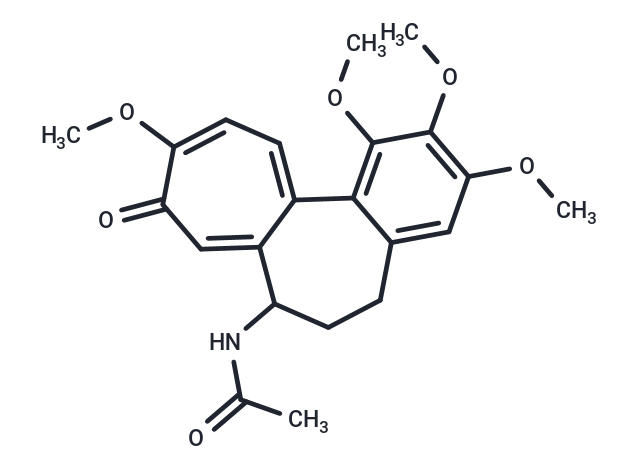
Colchicine [64-86-8]

Cat# T0320-1ml
Size : 1mLx10mM(inDMSO)
Brand : TargetMol
Contact local distributor :
 Phone : +1 850 650 7790
Colchicine
(Synonyms: Colcin, Colchisol, Colchineos) Copy Product Info

Product Information
| Description | Colchicine is an orally active natural alkaloid that acts by inhibiting microtubule polymerization (IC50 = 3 nM) and as a competitive antagonist of the α3 glycine receptor. It possesses broad anti-inflammatory, immunosuppressive, and antifibrotic activities, can inhibit NLRP3 inflammasome activation to prevent NSAID-induced small intestine injury, holds potential for gouty arthritis and rheumatoid arthritis research, and is commonly used to establish Alzheimer’s disease models. |
| Targets & IC50 | 786-O cells:0.022 μM, A10 cells:0.03 μM (EC50), Microtubule:3 nM |
| In vitro | METHODS: Human pharyngeal carcinoma cells FaDu and SNU1041 were treated with Colchicine (0.0-1 μM) for 24-72 h. Cell viability was measured by XTT assay. RESULTS: Colchicine treatment was cytotoxic to both FaDu and SNU1041 cell lines in a dose- and time-dependent manner. [1] METHODS: Chorionic villous cells AFCs and amniotic fluid cells CVCs were treated with Colchicine (0.15 μg/mL) for 3-24 h. Apoptosis was detected by Flow Cytometry. RESULTS: Colchicine induced a significant increase in the proportion of annexin V and PI double positive cells. [2] |
| In vivo | METHODS: To investigate the antitumor activity, Colchicine (0.1 mg/kg) was orally administered to BALB/c-nu mice bearing the human pharyngeal cancer tumor FaDu every two days for fourteen days. RESULTS: Colchicine was effective in inhibiting tumor growth in a hypopharyngeal cancer model nude mouse without serious complications. [1] METHODS: To investigate the effect of anti-Fas antibody-induced lethality, Colchicine (2 mg/kg) was injected intraperitoneally into C57BL/6 mice, followed by Jo2 antibody (10 μg) 24 h later. RESULTS: All mice treated with Colchicine survived the lethal attack.Colchicine reduced the susceptibility of mice to the lethal effect of Jo2 against Fas antibody. [3] |
| Synonyms | Colcin, Colchisol, Colchineos |
| Disease Modeling Protocol | Alzheimer's Disease (AD) Model
*Precautions: Monitor the postoperative recovery of rats during the modeling period. Rats with infection or severe behavioral abnormalities should be culled promptly. *References:Kumar A,et,al. Neuroprotective Effects of Centella asiatica against Intracerebroventricular Colchicine-Induced Cognitive Impairment and Oxidative Stress. Int J Alzheimers Dis. 2009 Sep 13;2009:972178. |
| Animal Research | a C57BL/6 background are used. To examine the effects of Colchicine on NSAID-induced small intestinal injury, vehicle or Colchicine (1 or 3 mg/kg) is administered orally 30 min prior to indomethacin administration. Mice received intraperitoneal injections of sterilized phosphate buffered saline or mouse recombinant IL-1β (0.1 μg/kg) 3 h after indomethacin treatment. Vehicle or Colchicine (1 or 3 mg/kg) is also administered to NLRP3?/? mice before indomethacin administration. The lesion index is evaluated 24 h after indomethacin administration and examined mRNA and protein expression of inflammasome components 6 h after indomethacin administration. |
| Molecular Weight | 399.44 |
| Formula | C22H25NO6 |
| Cas No. | 64-86-8 |
| Smiles | COC1=C(OC)C(OC)=C2C(CCC(NC(C)=O)C3=CC(=O)C(OC)=CC=C23)=C1 |
| Relative Density. | 1.2770 g/cm3 (Estimated) |
| Storage | Keep away from direct sunlight Powder: -20°C for 3 years | In solvent: -80°C for 1 year Shipping with blue ice/Shipping at ambient temperature. | ||||||||||||||||||||||||||||||||||||||||
| Solubility Information | DMSO: 257.5 mg/mL (644.65 mM), Sonication is recommended.  H2O: 1.33 mg/mL (3.33 mM), Sonication is recommended. | ||||||||||||||||||||||||||||||||||||||||
| In Vivo Formulation | 10% DMSO+90% Saline: 10 mg/mL (25.04 mM), Solution. Please add the solvents sequentially, clarifying the solution as much as possible before adding the next one. Dissolve by heating and/or sonication if necessary. Working solution is recommended to be prepared and used immediately. The formulation provided above is for reference purposes only. In vivo formulations may vary and should be modified based on specific experimental conditions. | ||||||||||||||||||||||||||||||||||||||||
Solution Preparation Table | |||||||||||||||||||||||||||||||||||||||||
H2O/DMSO
DMSO
Note : The dilution table applies only to solid products. For liquid products, please calculate the stock solution based on the stated concentration and/or density. | |||||||||||||||||||||||||||||||||||||||||